What Is Spread in Forex? The Ultimate Guide for Beginners

ye

Ever been to an airport currency exchange and seen two different prices for the same currency? One to buy it and another, slightly different price to sell it?

Congratulations, you've already seen the forex spread in action. That tiny gap between the prices is how those places make money. In forex trading, it’s the most basic cost you’ll encounter and the main way your broker gets paid for letting you trade on the global market.

What the Forex Spread Really Means for You

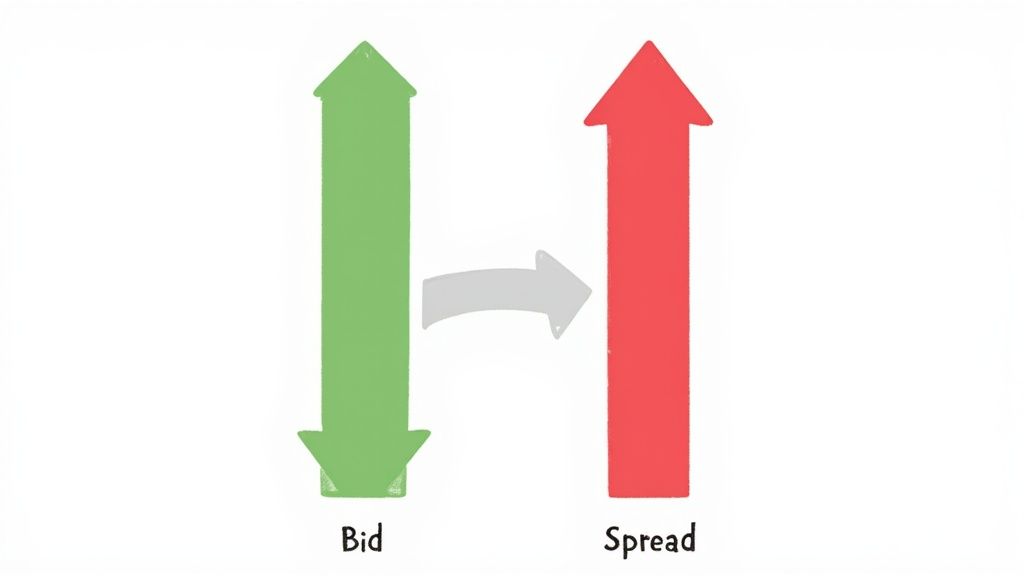
A visual representation of the bid and ask price on a trading chart, highlighting the spread.

Think of it like starting a race a few feet behind the starting line. Every single time you open a trade, you begin with a small disadvantage equal to the spread. The market price has to move in your favor by that exact amount just for you to get back to zero.

This gap is created by two key prices:

  • The bid price is what your broker will buy the currency from you at. In simple terms, it's your sell price.
  • The ask price is what your broker will sell the currency to you at. This is your buy price.

The spread is just the difference between these two. Simple, right?

Bid vs Ask Price At a Glance

Let's drop this into a quick table to make it crystal clear.

Concept What It Means for You Example Price (EUR/USD)
Ask Price (Buy Price) The price you pay to BUY the currency. 1.0852
Bid Price (Sell Price) The price you get when you SELL the currency. 1.0850
The Spread The difference – basically your broker's fee. 0.0002 or 2 Pips

The difference looks tiny, but trust me, it adds up.

Here’s a cool fact: the US dollar is involved in a whopping 88.5% of all forex trades. Because so many people are trading it, the market is super liquid. This means popular pairs like EUR/USD usually have very small, or "tight," spreads, making them cheaper to trade.

"The difference between the bid and the ask price is the spread. The spread is how 'no commission' brokers make their money." – Kathy Lien, Managing Director of FX Strategy for BK Asset Management

Nailing this concept is your first big step. To really get into the weeds of how these prices work, check out this a complete guide to defining spread in forex.

How to Calculate the Forex Spread
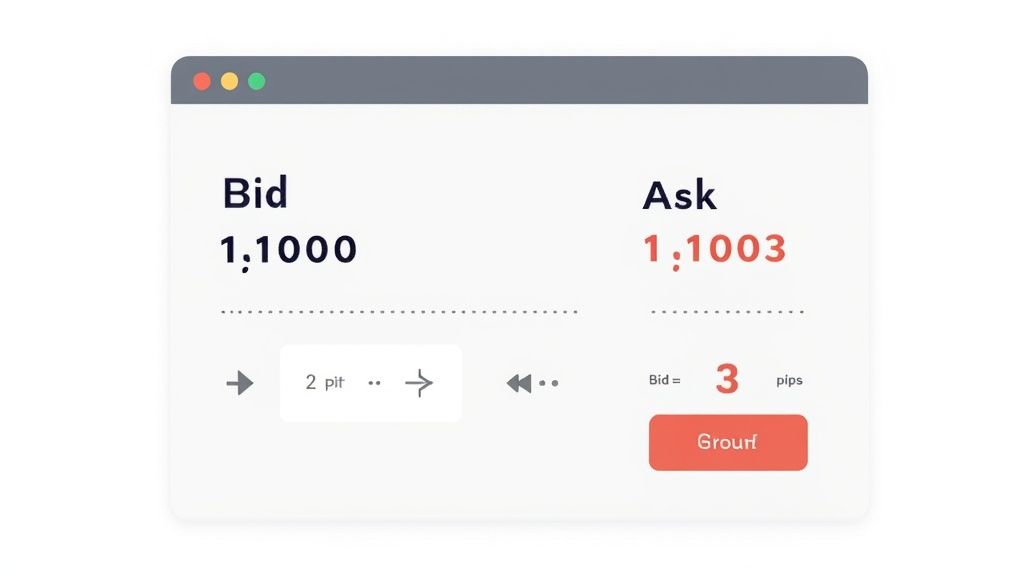
A trading chart showing a currency pair with the bid and ask prices clearly marked, visually explaining the concept of the spread.

Ready for some math? Don’t worry, it's super easy. Before we get to the formula, you need to know about the pip.

A pip (short for "percentage in point") is the smallest price change a currency pair can make. Think of it as one point in a video game. For most pairs like EUR/USD, a pip is the fourth number after the decimal point (0.0001).

For pairs with the Japanese Yen (JPY), like USD/JPY, a pip is the second decimal place (0.01). This little unit is how we measure the spread.

The Simple Spread Formula

The calculation is just one step: subtract the bid price from the ask price. That's it! While we have another guide that goes deep on ask price vs bid price, all you need is this simple formula.

Spread = Ask Price – Bid Price

Let's use the mega-popular EUR/USD pair. Imagine your trading screen shows these prices:

  • Ask Price (what you buy at): 1.0852
  • Bid Price (what you sell at): 1.0850

Now, just plug those into the formula:
1.0852 - 1.0850 = 0.0002

That result, 0.0002, is two pips. So, the spread on this trade is 2 pips. Easy peasy.

When you see a spread, you're not just looking at numbers; you're seeing the instant cost of getting into the market. A smaller number means a lower cost, giving you a better head start.

Let's try a JPY pair. Say the USD/JPY prices are:

  • Ask Price: 157.45
  • Bid Price: 157.42

Same deal:
157.45 - 157.42 = 0.03

Since a pip for a JPY pair is the second decimal place, that 0.03 means the spread is 3 pips. Once you get this, you can instantly see your trading costs for any currency.

Why a Tiny Spread Can Make a Huge Difference

A few pips might sound like nothing, but in forex, they are a big deal. The spread is directly connected to your profit because every trade you open starts slightly negative. How negative? Exactly the size of the spread.

This means the market has to move in your favor just for you to break even. Only after the price covers the spread can you start thinking about profit. It's like a small hurdle you have to jump over at the start of every race.

The Power of Small Costs

Even billionaires worry about small costs. The legendary investor Warren Buffett has two famous rules: "Rule No. 1 is never lose money. Rule No. 2 is never forget Rule No. 1." The spread is a tiny, guaranteed loss you take the second you open a trade. Keeping it low helps you follow Buffett's rules.

A lower spread is your first advantage. It means a smaller gap to cross to become profitable, which can be the difference between a winning and losing strategy over time.

For traders who jump in and out of the market all day – known as scalpers – these tiny costs add up fast. A 2-pip spread on 20 trades is 40 pips in costs you have to beat just to break even. This is why understanding what is spread in forex isn't just theory; it's a survival skill.

This is especially true for us regular folks. While a mind-blowing $7.5 trillion is traded in the forex market daily, individual traders like us make up only about 5.5% of that. For us, tight spreads are vital. They lower our business costs and make it easier to actually turn a profit. You can find more cool stats like this from retail trader market statistics on currenciesfx.com.

Ultimately, managing these costs is your first real step toward success.

What Makes Forex Spreads Widen or Tighten?
A dynamic chart showing financial market volatility, with upward and downward trends indicating price fluctuations.

If you've ever watched a trading chart, you’ve probably noticed the spread isn't set in stone. It breathes, shrinking and expanding all day. This isn't random. Two big forces are at play: liquidity and volatility. Every good trader knows how they work.

Liquidity: How Busy is the Market?

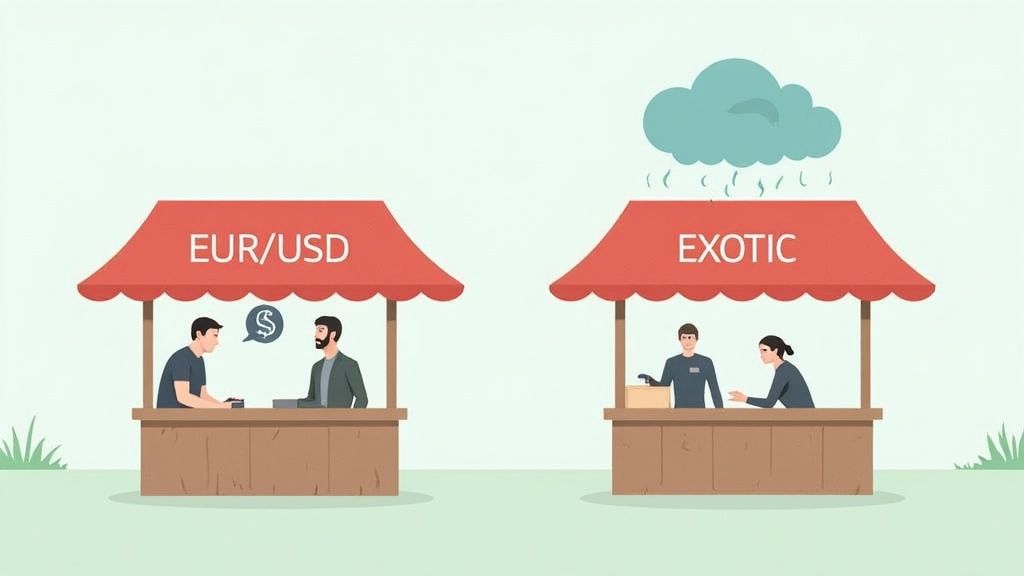
Think of liquidity like the number of people at a party. A currency pair like EUR/USD is a massive festival, buzzing with buyers and sellers 24/7. With so many people ready to trade, there's a ton of competition, which keeps the gap between the bid and ask price super small, or tight.

Now, imagine an exotic pair like USD/TRY (US Dollar/Turkish Lira). This is more like a small, quiet get-together. Fewer buyers and sellers mean it's harder to make a deal, so the price gap has to be bigger, or wider. It's simple supply and demand.

Volatility: The Market's Mood Swings

The second ingredient is volatility. Think of it as the market's mood – how quickly and crazily prices are jumping around. Imagine major news drops, like a central bank suddenly changing interest rates. It causes a ton of uncertainty.

During these chaotic moments, brokers widen their spreads. Why? It's a defensive move. They're protecting themselves from the wild price swings. For you, this means the cost to open a trade can shoot up in an instant.

"In the short run, the market is a voting machine but in the long run, it is a weighing machine." – Benjamin Graham

Benjamin Graham's famous quote is perfect here. It highlights how emotional the market can get in the short term. The daily forex market turnover exploded from $1.5 trillion in 1998 to $7.5 trillion in 2022, and spreads have become even more sensitive to news. You can dig into more of these fascinating Forex market statistics at BestBrokers.com.

During major world events or surprise economic news, spreads can blow out. Knowing when this is likely to happen is a huge part of understanding the spread. Keep an eye on the economic calendar, and you'll be in a better position to time your trades and avoid paying extra.

Smart Strategies to Manage Spread Costs

A trader analyzing a forex chart on a laptop, making smart, strategic decisions.

Knowing what the spread is gets you in the game. Learning how to manage it is how you start to win. Keeping these costs low is a skill, and it all begins with timing.

One of the biggest mistakes new traders make is trading right when big economic news is announced. During these high-volatility moments, spreads can explode from 1 pip to 10 pips in seconds, making your trade way more expensive from the start. A smarter move is to wait for the dust to settle.

Trading During the Golden Hours

To get the best spreads, trade when the market is busiest. The sweet spot is when two major trading sessions overlap – especially the London and New York sessions.

This overlap happens from about 8 AM to 12 PM EST. With so many people trading at once, liquidity is at its peak, and brokers offer their tightest spreads. Simply trading during these high-traffic times is an easy way to lower your costs.

Spreads aren't just a fee; they're a live indicator of market conditions. By choosing when to trade, you can pick moments when the cost of entry is lowest, giving you an immediate edge.

Choosing the Right Broker and Account

Finally, your choice of broker is huge. Different brokers and account types offer different spread models.

  • Fixed Spreads: These are predictable, so you always know your cost. The downside? They're usually wider than variable spreads.
  • Variable Spreads: These change with the market and can be incredibly tight during calm periods. They are often the best choice for active traders.

When you're starting, it's a great idea to read up on comparing brokerage fees to see what fits your style. Also, look into related costs like slippage in trading, which is when your trade goes through at a slightly different price than you expected.

Still Have Questions About Forex Spreads?

Got some questions still rattling around? Totally normal. Let's tackle a few common ones so you can get started with confidence.

Which Is Better for a Beginner: Fixed or Variable Spreads?

This really depends on your personality. Fixed spreads are like a set menu at a restaurant – you know the price upfront. This is great for planning your costs when you're just starting. The catch? The price is usually a bit higher.

Variable spreads are more like the daily specials. They can be super cheap (sometimes as low as 0.1 pips) when the market is calm but can spike during big news events. A smart strategy for beginners is to use an account with tight variable spreads but only trade during those calm, high-volume hours to avoid nasty surprises.

Can a Forex Spread Actually Be Zero?

For a regular trader, seeing a true zero spread is like finding a unicorn. It's super rare. Brokers might advertise "zero spread" or "raw spread" accounts, which sounds awesome. But there's almost always a catch.

Instead of making money from the spread, these brokers charge a fixed commission on every trade. So while the price gap might be almost zero, you're still paying a fee. It's like a concert ticket with no "service fee" that has a mandatory "venue fee" at checkout.

Always look at the total cost – spread plus commission – to figure out which account is actually the better deal for you.

How Can I See the Live Spread on My Trading Platform?

This is one of the easiest – and most important – things to learn. Most modern platforms, like the famous MetaTrader 4 (MT4) and MetaTrader 5 (MT5), make this simple.

Just find the "Market Watch" window where all the currency pairs are listed. You'll see columns for the "Bid" and "Ask" prices.

Pro Tip: In most platforms, you can right-click on the column headers (like "Bid") and add a "Spread" column. This will show you the live spread in pips for every pair, updating in real-time.

Doing this turns an abstract idea into a real number you can use. It's the key to truly understanding what is spread in forex from a practical standpoint, letting you see your costs before you even click buy or sell.


Ready to put what you've learned into action? At financeillustrated.com, we believe learning about the markets should be simple and engaging. Dive into our free Trading School, practice with our risk-free trading simulators, and build the skills you need to trade with confidence. Start your learning journey with Finance Illustrated today!
Ask Price vs Bid Price: Your Ultimate Guide to Trading

ye

Ever looked at a stock and seen two prices? Welcome to the club. When you first get into trading, you'll see a bid price and an ask price for everything, from stocks to crypto. The difference is super simple once you get the hang of it.

The ask price is the lowest price a seller is willing to accept for their asset. Think of it as the "sticker price." On the other side, the bid price is the highest price a buyer is willing to pay for that same asset. As a trader, you almost always buy at the ask price and sell at the bid price.

What Are Bid and Ask Prices in Trading?

Imagine you're trying to sell a limited-edition sneaker. You list it for $500 – that's your ask price. At the same time, someone out there is offering to buy that exact sneaker for $475. That's their bid price. The stock market is basically a massive, lightning-fast version of this.

The ask price is always higher than the bid price. It's a constant, silent negotiation. The seller wants the most money possible (the ask), and the buyer wants to pay the least (the bid).

Bid and Ask Explained

When you hit the "buy" button on a stock, you agree to pay a price close to the current ask. When you decide to sell, you get a price near the current bid. That small gap between the two is called the spread, and it's how brokers and market makers make their money.

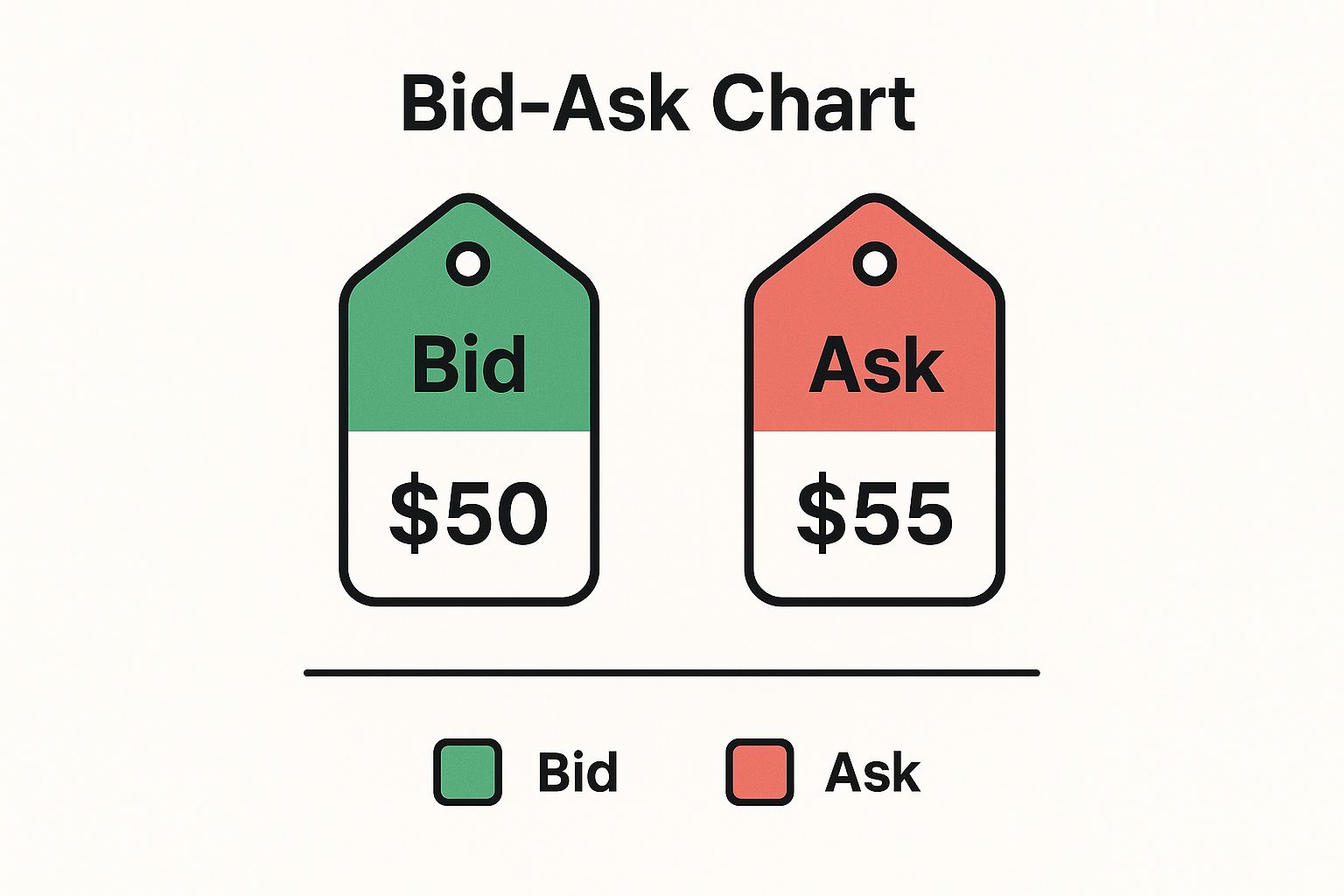
This visual gives you a clear look at how these two prices show up on a trading platform.

Infographic about ask price vs bid price

As you can see, the ask price always sits above the bid. If you're looking to brush up on more trading terms, a good comprehensive financial glossary can be a huge help.

For huge companies like Apple (AAPL), the spread can be tiny – sometimes just a penny – because millions of people are buying and selling all the time. For less popular assets, that gap can be much wider.

Quick Comparison of Bid vs Ask

Here's a simple table to break down the key difference between bid and ask prices from your perspective as a trader.

Concept Bid Price Ask Price
Who sets it? The buyer The seller
What does it represent? The highest price someone is willing to pay The lowest price someone is willing to accept
Your action This is the price you sell at This is the price you buy at
Relative Value Always lower than the ask price Always higher than the bid price

Ultimately, understanding this simple relationship is your first step to navigating the market. It dictates the price you pay and the price you get, forming the foundation of every trade you'll ever make.

Understanding the Bid-Ask Spread

So, you have the bid price (what buyers will pay) and the ask price (what sellers want). That little gap in between? That's the bid-ask spread. It’s not just empty space; it’s the engine room of the market and how brokers earn a small profit on every trade.

Diagram showing the bid and ask prices with a gap labeled as the spread

Think about it like changing money at an airport. They'll buy your dollars for one price (their bid) but sell you euros for a slightly higher price (their ask). That tiny difference is how they make money. The bid-ask spread in the stock market works the exact same way.

“The stock market is filled with individuals who know the price of everything, but the value of nothing.” – Philip Fisher

Getting a handle on the spread helps you see the true cost of placing a trade. It’s an invisible fee, baked right into the price of every transaction.

Why the Spread Matters to You

The size of the spread is like a health check for a stock. A tight spread – meaning a tiny gap between the bid and ask – is a fantastic sign. It usually means the stock is heavily traded, making it easy to buy or sell without your order messing with the price. You'll see this with giants like Amazon or Tesla.

On the other hand, a wide spread can be a red flag. It suggests there aren't many buyers and sellers, which can make getting a fair price a real headache. This is common with smaller companies or when the market gets spooked.

Here's what the spread is really telling you:

  • Liquidity: A tight spread screams high liquidity (easy to trade). A wide spread signals the opposite.
  • Volatility: Spreads can get wider during major news events, reflecting higher risk.
  • Trading Costs: Every time you trade, that spread is a cost you pay. For active traders, these small costs can seriously add up and eat into your profits.

Ultimately, paying attention to the difference between the ask and bid price is more than just looking at numbers. You're getting a real-time report card on a stock's popularity and your actual trading costs.

Why Bid and Ask Prices Constantly Change

If you've ever watched a live stock chart, you've seen it: the bid and ask prices flicker non-stop. This isn't random noise. It's the market's heartbeat, the result of a constant tug-of-war between supply (sellers) and demand (buyers).

Think of it like an auction. When lots of people want to buy something, they start offering more money, pushing the bid price up. Sellers see this and raise their prices, pulling the ask price up too. If bad news hits and everyone wants to sell, they lower their prices to get out fast. This makes the ask price drop, dragging the bid price down with it.

What Makes the Market Move

So, what causes these sudden shifts? A few key things are almost always behind the action. Getting a feel for them is key to seeing the bigger picture.

  • Breaking News: A company announcing a cool new product can start a buying frenzy in minutes.
  • Company Earnings: A great earnings report can send a stock soaring. A bad one can cause it to crash.
  • Economic Data: Big-picture news on things like inflation or jobs can shake the whole market.
  • Social Media Hype: Never underestimate the power of a single tweet. A message from an influential figure like Elon Musk can create massive, instant demand. A funny fact: in 2021, Musk's tweets about Dogecoin sent its price flying over 400% in a week.

Each of these events changes how investors feel about an asset's future. Their collective buying and selling is what moves the bid and ask prices in real-time. To see how these ideas apply globally, our guide on what influences exchange rates is a great next step.

“The key to making money in stocks is not to get scared out of them.” – Peter Lynch

This classic quote perfectly captures how emotional reactions to news are what fuel most of the market's short-term swings.

Today, this process is supercharged by high-frequency trading (HFT) algorithms. These aren't people clicking buttons; they're powerful computer programs that scan the news and make trades in millionths of a second, which is why prices adjust almost instantly.

How to Place Smarter Trades Using Bid and Ask

Okay, you get the theory behind ask price vs bid price. Now it's time to actually use that knowledge to make smarter moves. This is where you go from being a spectator to a player with a game plan. It all comes down to how you place your trades.

A person analyzing stock charts on a computer screen, looking thoughtful and strategic.

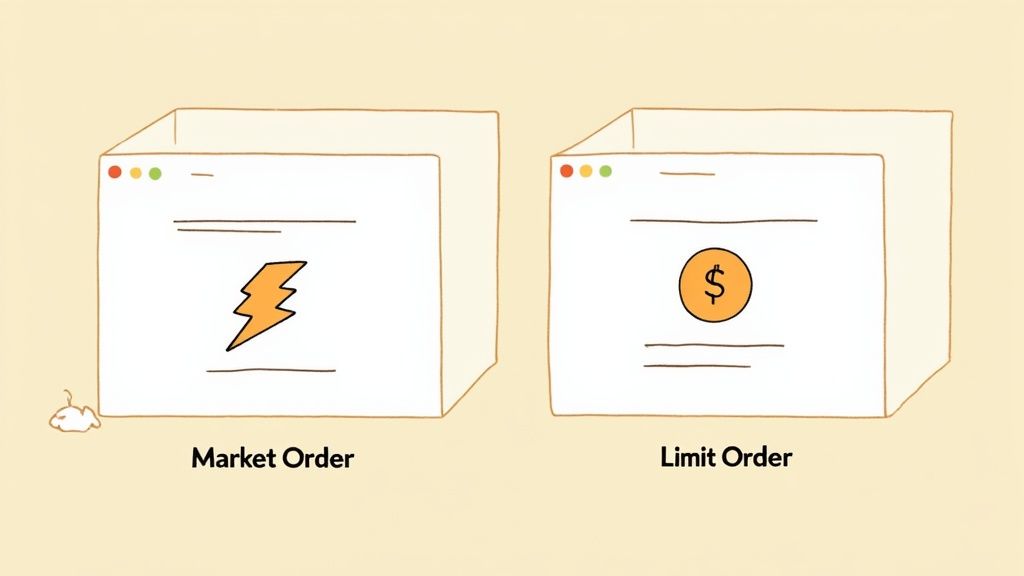
You have two main tools: market orders and limit orders. Think of them as a choice between speed and precision. One gets you in the game now, the other lets you set the rules.

Market Orders for Speed

A market order is the simplest way to trade. You’re telling your broker, "Get me this stock right now at the best available price." When you buy, your order will be filled at or near the current ask price. When you sell, you'll get a price close to the bid price.

This is perfect when your top priority is getting the trade done immediately. You aren't worried about a few pennies – you just want in or out, fast.

Limit Orders for Control

A limit order, on the other hand, puts you in the driver's seat. Instead of taking whatever the market offers, you set the exact price you're willing to pay or accept. For example, you could set a limit order to buy a stock only if it drops to $50.05, or to sell it only if it climbs to $52.50.

Using a limit order is your best defense against paying more than you planned. It ensures your trade only happens at your price or better.

This approach gives you total control. The downside? If the stock never hits your price, your order might sit there unfilled.

So, when do you use which? Here’s a quick guide:

  • Use a Market Order if: You’re trading a popular stock with a tight spread and you need to get the trade done instantly.
  • Use a Limit Order if: You have a specific entry or exit price in mind, or if you're dealing with a less-traded stock with a wide spread.

Getting comfortable with both is a fundamental skill. To take your strategy to the next level, you might also find some great insights from these effective day trading tips. Knowing which order to use is how you turn a basic understanding of the bid-ask spread into a real trading advantage.

Bid and Ask Prices Beyond the Stock Market

The whole bid vs. ask price concept isn't just for stocks. Once you get it, you'll start seeing it everywhere in finance. It's the universal language of buying and selling pretty much any asset.

Take the huge foreign exchange (Forex) market. When you look at a currency pair like EUR/USD, the bid-ask spread is often razor-thin – we're talking fractions of a penny. That’s because countless banks and traders are constantly buying and selling, which keeps things super liquid. If you want to get into the details, our guide on how to read currency pairs breaks it down perfectly.

Commodities and Crypto Markets

This same principle powers the world of commodities. Whether it's a barrel of oil or an ounce of gold, you'll always find a bid and an ask price. Big news, like a surprise oil discovery, can make that spread widen in a heartbeat as traders scramble to react.

And yes, the same rules apply to the wild world of cryptocurrency. The bid-ask spread on a major player like Bitcoin might be pretty tight. But for a smaller, lesser-known altcoin? That spread can be huge. A wide gap is a dead giveaway for lower trading volume and higher risk. Fun fact: even celebrities get involved. When Ashton Kutcher's venture capital firm invested in a crypto project, it brought huge attention, which tightened the bid-ask spread as more people started trading it.

"The four most dangerous words in investing are: 'this time it's different'." – Sir John Templeton

This quote is a great reminder that no matter the asset – currency, commodity, or crypto – the fundamental principles of supply and demand, shown through the bid-ask spread, always apply.

Across all these markets, the core idea is the same. The bid is what buyers will pay, the ask is what sellers will accept, and the spread is the cost of making the trade happen. Grasping this simple dynamic gives you a powerful lens to view any asset you might consider trading.

Common Questions Answered

Got a few more questions rattling around? No problem. Here are some quick answers to the things new traders often wonder about.

What Is a Good Bid-Ask Spread?

Simple: a tight one. For big, popular stocks that trade millions of shares a day, the spread might only be a penny. A tiny spread is a great sign – it means the stock is super liquid (easy to get in and out of) and your trading costs are low.

On the other hand, a really wide spread should make you pause. It can be a red flag for low trading volume, wild price swings, or general riskiness.

Can I Buy at the Bid Price?

As a regular retail trader, the system is pretty set: you buy from the market at the ask price and you sell to the market at the bid price. Think of the bid price as the standing offer from buyers (like market makers) ready to take shares off your hands.

The best way to get control over your price is to use a limit order. This tells your broker the exact price you're willing to pay, giving you the final say.

Using limit orders is a smart habit that can stop you from overpaying if the price suddenly jumps right as you hit the buy button.

How Does the Spread Affect My Profit?

The spread is a direct, unavoidable cost of trading. If you buy a stock, its price has to climb higher than the spread itself just for you to break even.

This might seem small on one trade, but for active traders making dozens or hundreds of trades, these little costs can bleed you dry. They stack up fast and can take a serious bite out of your profits. Learning to minimize the impact of the spread is a key skill for any winning strategy.


Ready to put this knowledge into practice? financeillustrated.com offers a free Trading School that breaks down how markets really work. You can start with easy-to-digest lessons and then jump into risk-free simulators to build your confidence at https://financeillustrated.com.