

Trading skills
5 Famous Forex Traders: Their Stories and What They Can Teach You
Meet five famous currency and macro traders: Lipschutz, Soros, Kovner, Druckenmiller and Tudor Jones. Learn what their stories show, and what they hide.
One candle packs four prices into one small shape. Learn to read it in seconds, and learn what it cannot tell you.
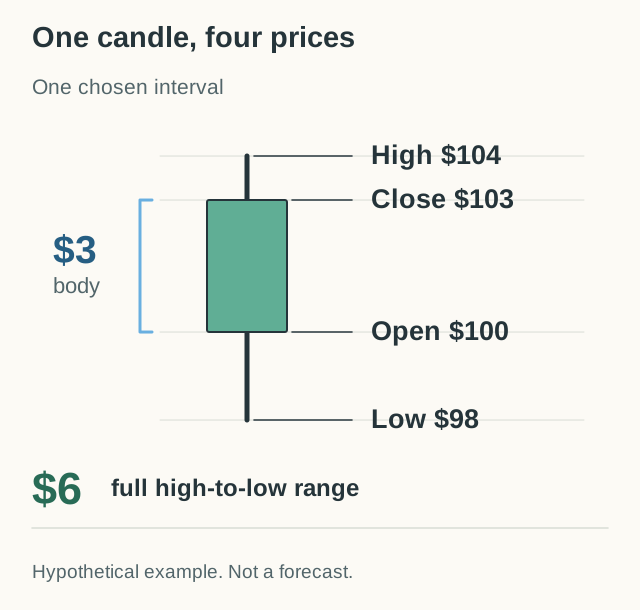
A is a small shape on a price chart. Each one sums up one period of time, such as 5 minutes, 1 hour or 1 day. That period is the chart's .
Each candle shows four prices, often written as :
A usually joins only the closing prices, so it hides how far the price moved inside each period. Candlestick charts and bar charts show all four prices. CME Group's chart lesson compares the three types.
You do not need several screens to learn this. One chart, one time frame and a price source you know are enough.
The thick part is the . It runs from the open to the close. The thin lines above and below it are the , also called shadows. They reach up to the high and down to the low.
If the close is above the open, the price rose during the period. Many charts show these candles in green or with a hollow body. If the close is below the open, the price fell, and many charts use red or a filled body. Colours are a setting, so check yours.
| Part | Price | What it tells you |
|---|---|---|
| Top of the upper wick | $104 | The highest price in the period |
| Top of the body (close) | $103 | The last price in the period |
| Bottom of the body (open) | $100 | The first price in the period |
| Bottom of the lower wick | $98 | The lowest price in the period |
Now measure it. The body is $103 minus $100, so $3. The upper wick is $104 minus $103, so $1. The lower wick is $100 minus $98, so $2. The full range, from the low to the high, is $6. These numbers stay the same whatever colours your chart uses.
Try it yourself
Press Play and watch the price move through one period. The candle grows as it goes. Then draw a second period and compare the two candles.
Example: a period opens at $100, rises to $104, dips to $98 and closes at $103. The candle has a $3 body from $100 to $103, a wick up to $104 and a wick down to $98.
What would you expect?
What this shows: A candle squeezes a whole period into four prices: open, high, low and close. Everything the price did in between is lost.
The body shows where the price started and ended. The wicks show how far it reached. Very different journeys can draw exactly the same candle.
No. A candle keeps four prices and leaves out the rest. Our example could have gone from $100 up to $104, down to $98, then back up to $103. It could also have dropped to $98 first and then climbed to $104. Both journeys draw exactly the same candle.
This matters when you test a trading idea. If your stop and your target both sit inside one candle, the candle cannot tell you which one the price reached first.
A candle also does not show how many shares were traded, how many orders were waiting, or the price you could have got. A big body measures a big move from open to close. It does not prove that big buyers are in charge, or that the move will continue.
A 5-minute candle and a daily candle sum up very different periods. Switch from hourly to daily candles, and a long wick can disappear inside a bigger body. Switch the other way, and one calm candle can turn into several sharp swings. Neither view is the "true" one.
Always note the time frame and the time zone, so someone else could check what you saw. Markets also start and end their day at different times. Some stock charts show only the main trading session, while others add early and late trading.
Forex charts use prices from one provider, so two apps can draw slightly different candles. Share splits and missing data can also change how old candles look. Check the source before you read meaning into a strange gap.
A is a candle whose open and close are the same, or almost the same. Its body is just a thin line. It can still have long wicks, so it does not mean nothing happened. The price may have moved a lot and then ended where it started.
Some traders read a doji, a hammer or a shooting star as a hint that a trend may be about to change. These names describe shapes. None of them has a fixed success rate, so treat them as questions to test. The NFA explains why results from made-up tests have limits.
An hourly candle opens at $52, reaches $55, falls to $49 and closes at $50. Find the body, the full range and both wicks. Do you need to know its colour?
Practise on real charts by writing a plain description of each candle before you guess what comes next: description first, prediction later. Then see how traders use candles in three popular chart patterns and in technical analysis.
On many charts, green means the close was above the open, so the price rose in that period. Red means the close was below the open. Some charts use hollow and filled bodies instead. Colours are a setting, so check yours.
A line chart usually joins only the closing prices. A candlestick chart also shows the open, high and low of each period, so you can see how far the price moved inside it.
Not on their own. Names like hammer or doji describe shapes, and no shape has a fixed success rate. If you want to use one, write an exact rule and test it, costs included, on data you did not use to invent it.
Meet five famous currency and macro traders: Lipschutz, Soros, Kovner, Druckenmiller and Tudor Jones. Learn what their stories show, and what they hide.

Seven daily trading habits for beginners: plan before you trade, size from your stop, check the calendar, know your orders, count costs and review.