
Forex
The ABC of Forex Trading: Pairs, Pips, Lots and Leverage
Learn the forex basics in plain words: currency pairs, going long or short, pips, lots, the spread, and how leverage makes a small move cost a lot.
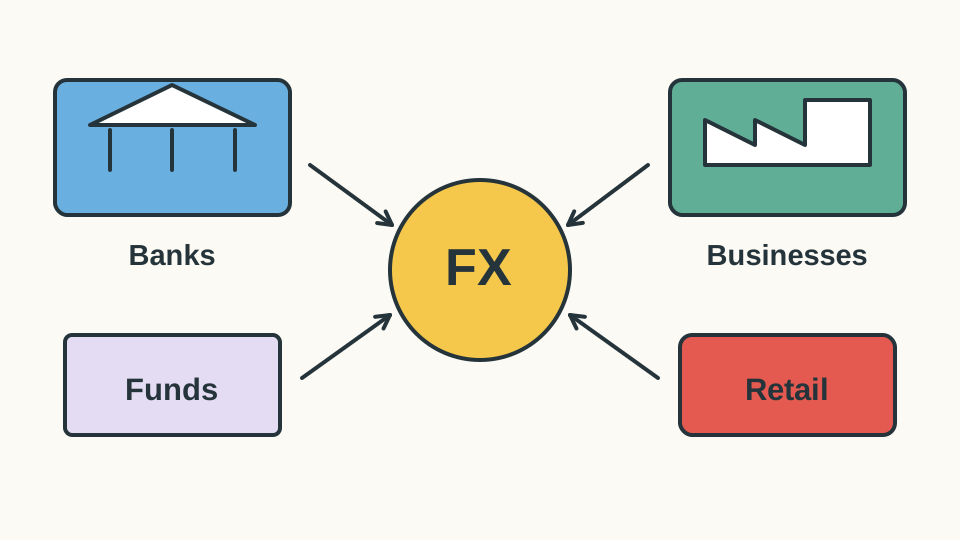
The biggest forex players are banks, businesses, funds and central banks, and they trade for very different reasons. Knowing why helps you read prices more carefully.
The Bank for International Settlements (BIS) says forex trading averaged about $9.5 trillion a day in April 2025. That total includes deals, which swap currencies now, and contracts to swap them at a later date.
This number counts deals. It is not a pile of profit for traders to share, and it is not all betting. One customer order can lead to several deals between banks.
In April 2025, news about US tariffs led to extra trading. Part of it came from investors protecting themselves against a weaker US dollar. That is why the BIS called its report "when takes centre stage".
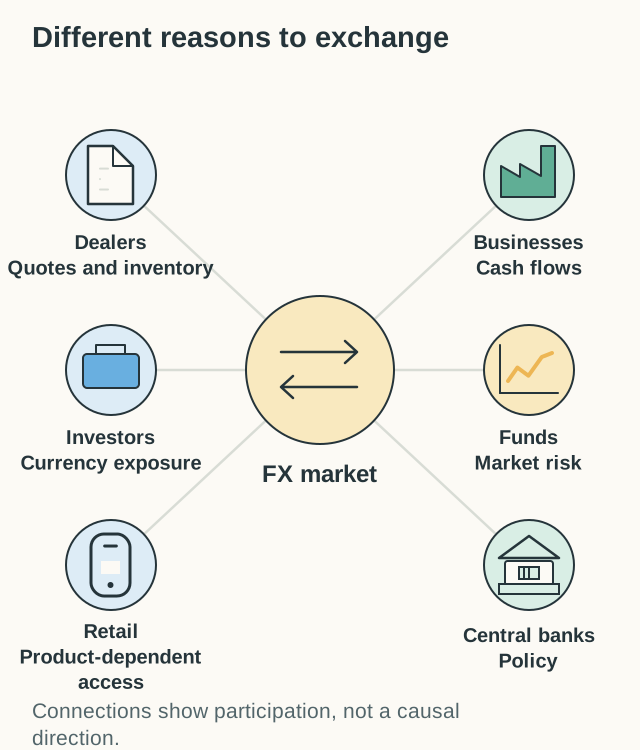
The biggest players are big banks and firms. But they are not all making the same kind of bet. Here are the main groups and why they trade:
Knowing why people trade is more useful than knowing famous names.
Try it yourself
Each card is a real kind of forex trade. Sort it by why it happens. Tap a card, then tap a box.
Business need: the Canadian firm and the Japanese car maker. Investing abroad: the pension fund and the fund paying back investors. Betting on the move: the hedge fund and the app trader. Central bank job: buying its own currency and adding to reserves. Only 2 of the 8 trades are bets.
What would you expect?
What this shows: Forex is not just a betting market. Firms paying bills, funds buying assets and central banks all trade currencies, each for their own reason.
That is why a price move rarely tells you who is behind it. The same rise in EUR/USD could come from a company, a fund, a central bank or a trader.
Banks and other dealers quote two prices: a bid to buy and an ask to sell. They earn the gap between them, and they manage the risk that customer trades create.
Say a dealer sells euros to a US importer in the morning. Then it buys euros from an exporter in the afternoon. The two trades partly cancel out. So the dealer does not need a separate market trade for every customer.
The price a customer gets depends on the size of the deal, the relationship, credit and market conditions. It is not just the line you see on an online chart.
Imagine a Canadian business that will receive US$100,000 in three months. It does not know what that money will be worth in Canadian dollars. So it may fix a rate today with a contract. Reducing a risk you already have like this is called hedging.
If USD/CAD later moves in its favour, the hedge gives up that gain. That is fine. The firm wanted a budget it could plan with, not a bet.
Investors face the same issue. A US fund that buys Canadian bonds also takes on the Canadian dollar, unless it hedges. Say the bonds gain 5% but the Canadian dollar falls 10% against the US dollar. In US dollars, 1.05 × 0.90 = 0.945, which is a loss of 5.5% before costs.
So a fund's currency trade can simply be part of buying, selling or protecting an investment. Read more in currency risk for Canadian investors.
Central banks change interest rates and say what they expect to do next. That changes how attractive their currency is, without any trading at all. The lesson on what influences exchange rates shows how.
Some central banks also trade directly to push their currency up or down. This is called . Managing the country's savings of foreign money, its reserves, is another job again. So not everything a central bank does is an attempt to set the exchange rate.
Policies differ by country. The Bank of Canada says the Canadian dollar floats and that it does not try to set the exchange rate. Read each central bank's own statements, not lists of officials, which go out of date quickly.
Some players trade to profit from currency moves or from gaps between interest rates. Some hold a trade for minutes, others for months.
The most famous example is from September 1992. The UK government was trying to hold up the value of the pound. George Soros's fund had bet heavily that it would fall. The government gave up and the pound fell. According to Britannica, the fund made a profit of about $1 billion. Soros became known as "the man who broke the Bank of England".
We remember stories like this because they are so unusual. They say little about what suits a beginner with a small account, higher costs and less room for losses. Also, a fund's position may be a hedge inside a much bigger portfolio, not a simple bet.
Retail traders, meaning people trading their own money, usually reach forex through a broker or dealer. In US retail forex, the dealer is your , as the CFTC explains. That means it takes the other side of your trade, which is different from trading currency futures on an exchange.
Your chart cannot tell you that a certain bank is buying. A sharp move can come from news, or from dealers pulling back their prices. It can come from big players changing their positions, or from all of these at once. Be careful with stories about banks hunting your stop, unless there is real evidence.
Next lesson: forex market analysis. As you read it, ask what each method can really see, when so many players trade for so many reasons.
Big banks and other dealers, businesses, investment funds, central banks and speculators such as hedge funds. Retail traders, people trading their own money, are in the market too, usually through a broker.
Large orders can move prices, especially when markets are quiet. But a chart cannot show you who is trading or why. Many moves come from news, with many players reacting at once.
It means reducing a currency risk you already have. A firm expecting foreign money can fix an exchange rate now, so it knows its budget. It gives up possible gains in return for certainty.
Learn the forex basics in plain words: currency pairs, going long or short, pips, lots, the spread, and how leverage makes a small move cost a lot.
Learn what EUR/USD 1.1000 means, which currency you buy, why the price goes up or down, and how to flip a quote. Try it with a hands-on seesaw.