

Crypto
Bitcoin Memes: 13 Funny Favorites and the Truth Behind the Jokes
13 funny Bitcoin memes and two viral crypto videos, from chart-checking to AI meme-coin hype, with the real lesson behind each joke.
Ethereum has crashed in very different ways: on one exchange, on the network and in the headlines. Here are five shocks and the lesson each one teaches.
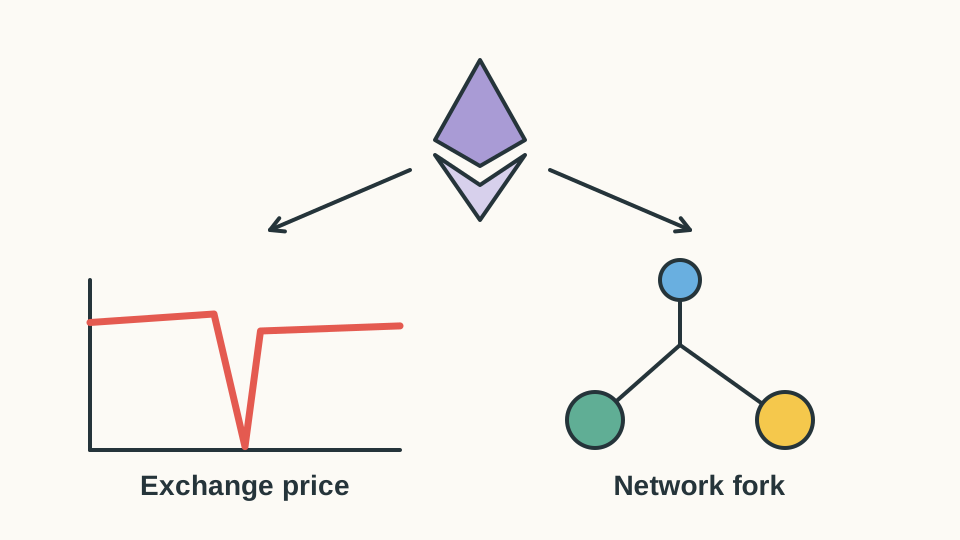
Ethereum is a network that runs apps and payments, a bit like Bitcoin's network. Its own coin is called , with the short code ETH. When people say "Ethereum crashed", they usually mean the price of ether fell.
That difference matters. A crash can happen in at least three places: on one exchange's list of orders, on the network itself, or in the market price everywhere. Each one needs different evidence. Calling all three "a crash" hides what really happened.
The five events below come from 2016 and 2017. They are well recorded, but they are not ranked by size.
A waits until the price reaches a level you set. Then it becomes an order to sell at the best price on offer. The level you set is the trigger. It is not a promise that you will get that price.
On 21 June 2017, one big sale pushed the price through many traders' triggers at once. Each triggered order sold at the next price on offer, which pushed the price lower and set off more triggers. Some positions, bought with borrowed money, were closed automatically too.
In its account of the event, the exchange said it had credited the accounts of customers who were directly affected. That was its own choice. Don't count on the same help after the next crash.
Try it yourself
Try a market order and a limit order. Then set a stop order a little below the price, and watch what happens when the price suddenly drops 20%.
The illustrative price starts at $300 and moves a little. At step 40 it drops 20% in one jump. A market order fills at once at the current price. A limit order fills only at your price or better, or not at all. A stop order placed just below the price before the drop is triggered by the jump, but it fills at the first price after it, about 20% below the old price.
What would you expect?
What this shows: A stop is a trigger, not a promise. If the price jumps past it, you sell at the next price, which can be far lower.
In this illustrative market, the price drops 20% in one step. A stop set just below the old price is triggered, but nobody is buying at the stop price, so it fills at the first price after the gap. In June 2017, hundreds of real stop orders and margin calls went through the same thing at once.
Not necessarily. The fake death rumour shows why. The price fell around the same time, but Fortune noted that ether had been jumpy all week, including the flash crash a few days earlier. Two things happening together does not prove that one caused the other.
So keep two columns in your notes: the timeline, and what caused what. An official post can prove what it says and when it was posted. It can't prove that it moved every price that came after it. A move with no clear cause is an open question, not a reason to make up a story.
| Question | Evidence to look for |
|---|---|
| What moved? | Ether, in a named currency, on a named exchange |
| Over what time? | Exact start and end times, measured the same way |
| What happened technically? | Official posts and incident reports |
| What could be traded? | The order rules and how many buyers were there |
| What is still unknown? | Claims about causes that the evidence does not support |
Also check the date of any technical explanation. In September 2022, Ethereum changed how it agrees on its records. It moved from to in an upgrade called the Merge. Older explanations may describe a different network.
Here is a made-up example. A coin falls from $400 to $240, a drop of 40%. Then it rises to $300, a rebound of 25%. It is still 25% below where it started.
Now add a 1% fee when you buy at $400 and another 1% when you sell at $300. Buying one coin costs $404. Selling it returns $297. You lose $107, which is about 26.5% of the $404 you paid.
So always say what your percentage is measured against. A price change and a money result after fees are different numbers. These figures are invented, not a replay of any real ether market.
Write down two orders. One accepts an uncertain price, like a market order. The other accepts that it may not fill at all, like a limit order. Then decide what you would do if your internet dropped, or if only part of the order filled.
Read your app's own rules for stop orders before you rely on one. The word "stop" does not promise a safe exit. Compare the examples in crypto orders and fees and market, limit and stop orders.
Neither a past recovery nor a network upgrade means future buyers must pay a higher price. For the maths of falls and recoveries, see volatility and drawdowns, or compare with Bitcoin's big crashes.
On 21 June 2017, one $12.5 million sell order on the GDAX exchange set off several hundred automatic stop orders and margin calls. ETH traded as low as $0.10 on that exchange for a moment, and it was back near $300 within 10 seconds.
No. In June 2017, a false story on the 4chan website claimed he had died in a car crash. He posted a photo online to show he was alive. Ethereum's market value fell around the same time, but that does not prove the rumour caused it.
The DAO was a big project built on Ethereum that was attacked in 2016. On 20 July 2016, the network made a hard fork, a change to its rules. It moved about 12 million ether into a contract that returned it to DAO token holders.
It helps, but it is not a promise. When the price reaches your trigger, the order sells at the next price on offer. In a fast fall, that can be far below your trigger.
13 funny Bitcoin memes and two viral crypto videos, from chart-checking to AI meme-coin hype, with the real lesson behind each joke.
Bitcoin millionaire stories, from 5,000 forgotten coins to a $1,000 bet in 2011, and what the headlines leave out: timing, paper wealth and the losers.