

Trading skills
5 Famous Forex Traders: Their Stories and What They Can Teach You
Meet five famous currency and macro traders: Lipschutz, Soros, Kovner, Druckenmiller and Tudor Jones. Learn what their stories show, and what they hide.
'AI company' is a broad label. This watchlist sorts 18 famous names by how they earn money, then shows how to research them. It is a list to study, not a list to buy.
Our original , first published in 2017, named 18 companies linked to (AI) and robots. They are all famous. But they make money in very different ways, so they carry very different risks.
Here they are, grouped by how they earn money. This is a watchlist to research, not a list of stocks to buy.
| Group | Companies | How they earn money | One question to research |
|---|---|---|---|
| Chips and chip tools | Nvidia, AMD, Intel, QuickLogic, BrainChip (listed in Australia), Synopsys | Selling chips, or software used to design chips | How much demand comes from a few big buyers? |
| Cloud and business software | Microsoft, Amazon (also online shopping), Salesforce, Veritone, Splunk (now part of Cisco) | Renting computing power and selling software, often by subscription | Does AI add more sales than it adds costs? |
| Consumer apps and devices | Apple, Alphabet (Google, also cloud), Meta Platforms (formerly Facebook), Netflix, Tencent (listed in Hong Kong) | Selling devices, subscriptions or advertising, with AI used inside the products | How much of the business really depends on AI? |
| Cars and machines | Tesla, Deere & Company (John Deere) | Selling vehicles and farm machines with automated features | Do the automated features bring in new money, or mainly help sell machines? |
Two names have changed since the list was written. Facebook's parent company renamed itself Meta Platforms in 2021. Splunk was bought by Cisco in 2024, so its shares no longer trade on their own. Always check a company's current name and listing before you research it.
Yes. A business can grow quickly while its shares fall. The reason is the price investors pay.
One common yardstick is the , or P/E: the share price divided by yearly profit per share. It tells you how many dollars investors pay for each $1 of profit.
A popular theme can push P/E ratios very high, because investors expect a lot of growth. If growth disappoints, or only matches what was expected, the price can fall even while the company does well.
Try it yourself
Read what happens to each company. Guess whether its share price ends up or down, then watch the chart.
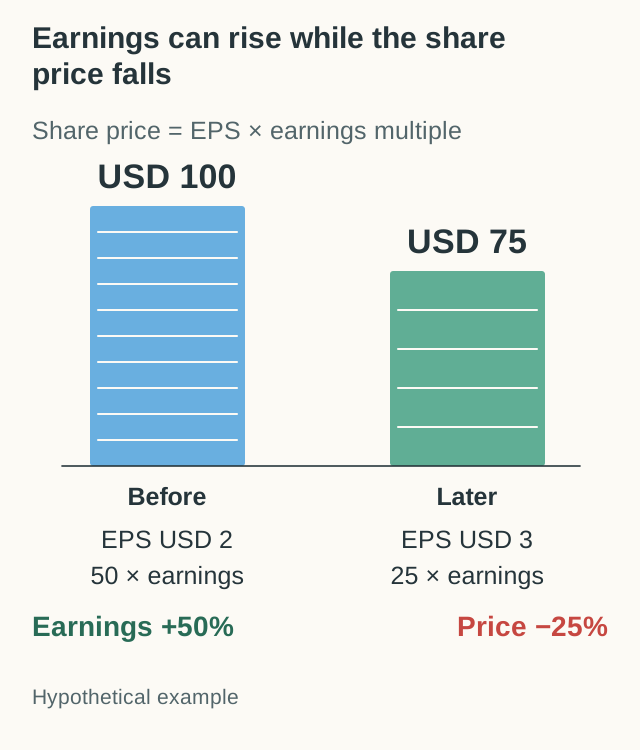
AI Chip Co: profit per share rises from $2 to $3 (up 50%), but the P/E falls from 50 to 25. Price before: $2 × 50 = $100. Price after: $3 × 25 = $75, a 25% fall.
What would you expect?
What this shows: A business can grow fast while its shares fall. Profit up 50% with the P/E halved means a 25% lower share price.
Share price = profit per share × what investors pay for each $1 of profit. Hype can push that figure very high, and it can fall even when the business does well.
For each company on your list, find out how it gets paid: selling hardware, subscriptions, usage fees, advertising or machines. Then ask what it must spend first. Data centres and new chips cost a lot of money before any profit arrives.
The same AI boom can help one company and hurt another. More AI use means more sales for a chip seller. For a cloud company, it can also mean bigger bills for chips and power.
Read the company's annual report. The SEC's guide to reading a 10-K shows where to find the business description, results by segment, cash flow, spending and risks. Keep the company's hopes apart from its results. A demo or a partnership announcement is not the same as steady, profitable sales. Our stock research resources list shows where to find each report.
If a report does not show AI sales on their own line, write 'not separately disclosed'. Don't guess the number from a slogan.
Company years don't all end in December. Nvidia's fiscal 2025 ended on 26 January 2025. Microsoft's fiscal 2025 ended on 30 June 2025. Both say '2025', but the periods are different, so compare their growth rates with care.
AI can also sit inside a much bigger business. Alphabet's 2024 annual report covers search, advertising and cloud. Not every dollar of its sales is AI revenue.
Ownership changes too. In October 2025, SoftBank Group agreed to buy ABB's robotics business, expecting to complete the deal in mid-to-late 2026 if regulators approve. ABB, a Swiss industrial company, is not one of the 18. But its case shows why you check the latest company reports before you treat a share as a robot investment.
So date every fact on your watchlist. Note takeovers, sales of a business and name changes before you compare one year with another.
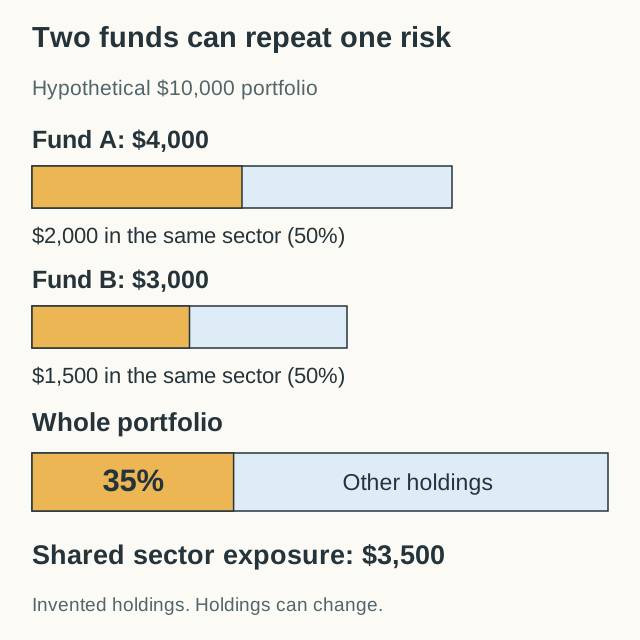
Not always. Several AI companies can depend on the same customers, or on the same wave of spending on data centres. If that spending slows, several 'different' AI stocks can fall together.
Look at your list and ask: what single event could hurt most of these at once? If the answer is easy to name, your list is one bet, not many.
Annual reports often name the customers that make up a big share of sales. If the same customers keep appearing across your list, those companies share a risk.
Our guide on how to diversify a portfolio explains how to spread risk across industries. For a quick sense of company size, compare their market capitalization, not their share prices.
Give each company one short entry that you can update:
Keep product claims in their own column, apart from reported results. Check whether the number of shares is rising, because that spreads profit thinner across each share. And it is fine to decide that a famous company is too hard to judge.
Before you trust any AI promise about trading itself, read how to check AI trading claims.
This page does not recommend any stock. It is a research list. Use it to learn how each business earns money, what the share price already expects and what could go wrong. If you invest, think about your goal, costs and diversification first.
Cisco completed its purchase of Splunk in 2024, so Splunk's shares no longer trade separately. Its business is now part of Cisco. Old watchlists often keep names like this, which is why you check each company's current status.
They can be. Popular themes often trade at high prices compared with profit, so a disappointment can hit the share price hard. Risk depends on the company and the price you pay, not on the label.
There is no single good number. A P/E only makes sense next to the company's likely growth, its risks and similar companies. A high P/E means investors expect a lot. If that growth does not arrive, the price can fall.
Meet five famous currency and macro traders: Lipschutz, Soros, Kovner, Druckenmiller and Tudor Jones. Learn what their stories show, and what they hide.

Seven daily trading habits for beginners: plan before you trade, size from your stop, check the calendar, know your orders, count costs and review.