How to Calculate Risk Reward Ratio: Your Ultimate Guide

ye

Figuring out your risk reward ratio is as simple as dividing what you could lose by what you could win. It’s quick math that tells you how much bang you're getting for your buck on every single trade. This simple number is one of the most powerful tools for making smart, calculated decisions in the wild world of investing.

What Is the Risk Reward Ratio, Really?

A chart showing a bullish trend with risk and reward levels marked.

Think of the risk reward ratio as your secret map in the trading jungle. It’s a super simple concept that helps you decide if a trade is a smart move or just a hopeful gamble. Before you even think about clicking "buy," it makes you answer the most important question: "Is this actually worth it?"

Let's use a real-world example. Imagine you’re looking at a pair of limited-edition sneakers from a collaboration with a huge celebrity, like Travis Scott. You could buy them for $200, hoping to sell them for $500 as the hype builds. Your potential reward is $300. But, if the hype dies down, the price could drop to $150. Your potential risk is $50.

In this scenario, you're risking $50 for a chance to make $300. That's a solid bet.

From Sneakers to Stocks

This exact same logic is what separates smart investors from gamblers in the stock market. The risk reward ratio forces you to weigh the potential upside against the potential downside before your money is on the line. As the legendary investor Paul Tudor Jones famously said, "The most important rule of trading is to play great defense, not great offense." This ratio is your best defensive move.

It keeps your decisions based on logic, not emotion. Instead of trading because of a gut feeling or hype you saw on TikTok, you’re using a clear, objective measure to guide you.

A good risk reward ratio can make you profitable even if you lose more trades than you win. It's not about being right all the time; it's about making sure your wins are big enough to matter.

So, what do these ratios actually mean? The table below breaks it down, giving you a quick cheat sheet to see if a potential trade makes the cut.

Understanding Risk Reward Ratios

This table breaks down different ratios to help you quickly assess a potential trade.

Ratio What It Means Is It a Good Bet?
1:1 You risk $1 to potentially make $1. Neutral. You need a win rate over 50% to be profitable.
1:2 You risk $1 to potentially make $2. Getting better. Your wins are twice as big as your losses.
1:3 You risk $1 to potentially make $3. Excellent. This is where you want to be for long-term success.
2:1 You risk $2 to potentially make $1. Very risky. Your losses are bigger than your potential wins. Avoid!

As you can see, the bigger the potential reward for the risk you're taking, the better your chances are in the long run. A trader who only takes 1:3 trades can be wrong more often than right and still make money. That's the power of putting math, not feelings, in charge.

The Simple Math Behind Your Trades
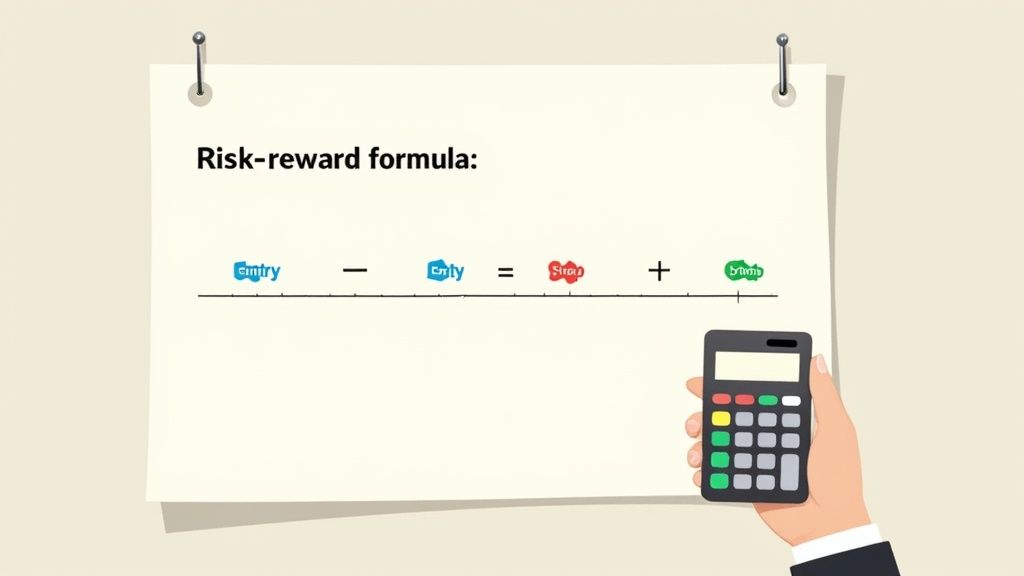
A visual representation of the risk-reward ratio formula with icons.

Ready for the formula? I promise it’s way easier than your high school algebra class.

Figuring out your risk reward ratio just means plugging three simple numbers into one equation. Seriously, this little piece of math is your secret weapon for making smarter, logical trades instead of just guessing.

The formula is: (Target Price – Entry Price) / (Entry Price – Stop-Loss Price)

It might look a bit formal, but let's break down what each part actually means. Think of it like planning a road trip- you need to know your starting point, your destination, and where you'll pull over if you run low on gas.

Getting Your Key Numbers Straight

Before you can do the math, you need the numbers. Every single trade you even think about making will have these three key prices.

  • Entry Price: This one's easy. It's the price you pay to buy the stock, crypto, or whatever you're trading. It’s your starting line.
  • Target Price: This is your goal- the price where you plan to sell and take your profit. It's the destination you're aiming for.
  • Stop-Loss Price: This is your safety net. It’s the price you set ahead of time where you'll sell to cut your losses if the trade goes against you.

Once you have these three numbers, you're ready to see if a trade is actually worth taking. This quick calculation is a fundamental tool investors use all over the world to weigh what they might lose against what they could gain.

For example, if you risk $200 for a potential $600 profit, your risk reward ratio is an awesome 1:3.

Let's Put It Into Action

Let's walk through a real-world scenario. Imagine you’re looking at a stock that's currently trading at $50.

You decide to buy it, so your Entry Price is $50. After some research, you set a profit goal, deciding you’ll sell if it hits $65. That's your Target Price. Finally, you decide that if the stock drops to $45, you’re out. This is your Stop-Loss Price.

Now, let's plug these into our formula:

  • Potential Reward: $65 (Target) – $50 (Entry) = $15
  • Potential Risk: $50 (Entry) – $45 (Stop-Loss) = $5
  • The Ratio: $15 / $5 = 3

This gives you a risk reward ratio of 1:3. In simple terms, for every $1 you're risking, you stand to make $3. That's a solid setup that many professional traders actively look for.

Before you start applying this to every trade, you can really sharpen your skills by exploring our guide on how to backtest trading strategies. And if you want to go deeper into the probability side of things, it’s worth learning how to calculate Expected Value.

Why a Good Ratio Is Your Secret Weapon

Let’s get one thing straight: successful trading isn't about having a crystal ball. It’s not about being right on every single trade. It's about making sure your winning trades are big enough to completely crush your losing ones.

Think of a solid risk reward ratio as your statistical advantage. Many pro traders are profitable on less than half of their trades. Their secret isn't magic; it's math. They've mastered the art of letting their winners run and cutting their losers short.

Making a Profit While Being Wrong Most of the Time

This might sound weird, but it's where the power of this concept really shines. Let's walk through a quick scenario.

Imagine you decide on a 1:3 risk reward ratio for your next 10 trades. For every trade, you're willing to risk $100 with the goal of making a $300 profit.

  • You hit your profit target on 4 of those trades: 4 x $300 = +$1,200
  • You get stopped out on the other 6 trades: 6 x $100 = -$600

Even though you were wrong more often than you were right, you still ended up with a $600 net profit. That’s the cushion a disciplined ratio builds into your strategy. It allows you to handle the losses that will inevitably happen without blowing up your account.

This approach also has a huge psychological benefit. When you've defined your max loss and your potential gain is worth the risk, you're far less likely to make emotional decisions fueled by fear or greed.

"The most important thing in making money is not letting your losses get out of hand." – Marty Schwartz

History backs this up. While the U.S. stock market has generated awesome long-term returns, it’s also had some absolutely brutal years. In 1931, during the Great Depression, the market crashed by a mind-blowing -43.54%. Having a personal risk management plan helps protect you from that kind of catastrophic loss. You can dive into more historical market performance data to see these swings for yourself.

Ultimately, a good risk reward ratio doesn't just manage your risk- it builds your entire path to long-term profitability.

How to Find Your Risk and Reward Levels

Okay, so how do you actually pick your target and stop-loss prices without just throwing a dart at a board? It all comes down to looking for clues in a stock's past behavior. This is where we go from just knowing the formula to actually using it with confidence.

One of the most powerful tools for this is understanding support and resistance levels. Just think of these as invisible floors and ceilings for a stock's price.

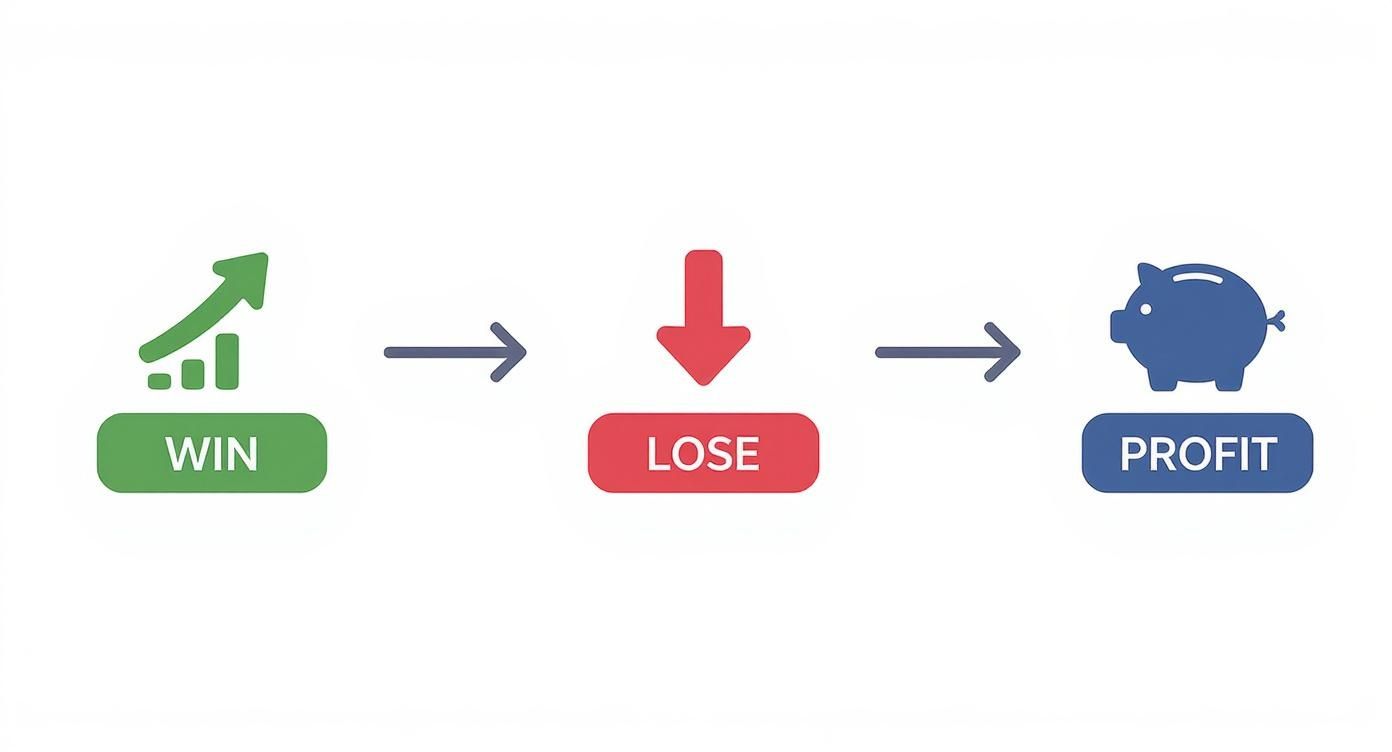
This infographic really shows how a disciplined approach to your wins and losses is what ultimately leads to profit over time.
Infographic about how to calculate risk reward ratio

The big takeaway here? Your winning trades need to be way bigger than your losing ones if you want to build a profitable track record. It's that simple.

Using Price History to Your Advantage

A support level is a price point where a stock has historically bounced back up after falling. It's like a floor where buyers tend to jump in and defend the price. This makes it a really logical place to set your stop-loss- just a little bit below that floor. If the price breaks through that historical safety net, it’s a strong signal that things might be headed down, fast.

On the other side, you have a resistance level. This is a price ceiling where a stock has struggled to break through in the past. It's where sellers often take control again. That makes it a great spot to set your profit target, maybe just a little below that ceiling to make sure your order gets filled.

Learning to spot these levels on a chart is a total game-changer. For a deeper dive, our simple guide on how to read forex charts is a great resource, as the principles are exactly the same for stocks.

Of course, there are other ways to do it. Another simple method is using a fixed percentage. For example, you might decide to always set your stop-loss 5% below your entry price, no matter what. This strategy is super simple and keeps your risk consistent across all your trades.

Ultimately, using techniques like these helps you define the exact numbers you need to plug into your risk reward ratio calculation. No more guesswork.

Common Trading Mistakes You Can Easily Avoid

Learning from the mistakes of others is one of the smartest shortcuts any trader can take. When you calculate your risk reward ratio, you're not just doing math; you're creating a battle plan. And the biggest mistake is abandoning that plan when things get intense.

So many traders fall into the emotional trap of moving their stop-loss down because they feel like a trade is about to turn around. This is a classic rookie mistake that can quickly turn a small, controlled loss into a huge one. Your original plan is your anchor in a stormy market- stick to it.

Another painful mistake is letting a winning trade turn into a losing one. You hit your profit target, but greed whispers, "Just a little more." The market then reverses, and you watch your hard-earned gains disappear. As Warren Buffett famously says, the first rule of investing is "Never lose money," and the second rule is "Never forget rule number one." Discipline, not hope, is your most valuable asset here.

Don't Use a One-Size-Fits-All Ratio

Applying the exact same risk reward ratio to every trade is a subtle but dangerous habit. Think about it: a volatile tech stock like Nvidia is a completely different beast than a stable, blue-chip company like Coca-Cola. Your strategy has to be flexible enough to match the asset and the current market vibe.

This isn't just theory. The risk profiles of major global markets vary a lot. Research from 1901 to 2022 showed that while Australia's classic 60/40 portfolio had the best returns, it also came with a terrifying maximum drawdown of -54.61%. For comparison, the U.S. market's was -44.88%.

This data makes it crystal clear that even in strong markets, the potential for huge losses is very real. It’s a powerful reminder that you need a tailored approach to risk. You can explore the full market performance research to see just how much these numbers can differ.

Common Questions, Answered

We get it. When you're new to the game, a term like "risk reward ratio" can sound a little intimidating and bring up a bunch of questions. Let's walk through some of the most common ones to clear things up and get you trading with more confidence.

What's a Good Risk-Reward Ratio for a Beginner?

While there's no single "magic number" that fits every trading style, a fantastic starting point for anyone learning is a ratio of 1:2 or higher.

Think of it this way: for every single dollar you're willing to lose, your goal is to make at least two. This simple rule forces your winning trades to have a much bigger impact than your losing ones, giving you a valuable cushion as you find your footing in the markets.

Can I Use This for Crypto, or Is It Just for Stocks?

Absolutely! The risk reward ratio is a universal trading principle. It doesn't matter if you're trading stocks, crypto, forex, or even things like gold and oil.

The core logic- measuring your potential upside against your potential downside- is fundamental to smart decision-making in any market. It's especially critical in volatile markets like crypto, where prices can swing dramatically in the blink of an eye.

Does a Good Ratio Guarantee I'll Make Money?

No, and this is a super important point to understand. A solid risk reward ratio is a powerful risk management tool, not a crystal ball that predicts the future. It doesn't, on its own, guarantee any single trade will be a winner.

Your success still depends on having a solid strategy for knowing when to get in and out of trades. The ratio simply makes sure that, over the long run, your profitable trades can more than cover your losses. That's the real secret to staying in the game.

To really get a handle on the bigger picture and build a truly strong investment strategy, it's always a good idea to learn from the masters. You can explore highly recommended investing books that dive deep into these foundational concepts.


Ready to put this into practice without risking a single cent? At financeillustrated.com, we believe learning should be hands-on and fun. Check out our free Trading School, test-drive your strategies with our realistic simulators, and build real confidence before you ever place a trade. Get started at https://financeillustrated.com.

7 Actionable Daily Trading Tips for Young Investors in 2025

ye

Ever wondered how top traders seem to stay calm and consistently make smart moves? It’s not magic – it’s a system. They rely on a set of core rules they practice every single day, turning the crazy market into something they can manage. This isn't about complex math or needing a supercomputer. It’s about building smart habits, just like a pro athlete trains for a big game.

Forget the confusing jargon you see in movies. We're going to break down seven super practical, daily trading tips that anyone can understand and start using right away. Think of this as your personal trading playbook. We'll explore powerful ideas from legends like Paul Tudor Jones, who famously said, “The most important rule of trading is to play great defense, not great offense.” We'll even see how modern celebrities like Ashton Kutcher apply similar principles of smart risk-taking in their tech investments, focusing on solid strategies over wild gambles.

By the end of this guide, you’ll have a clear, actionable plan to approach the market with more confidence and control. You'll learn how to build a pre-market routine, manage risk like a pro, and review your moves to get better every single day. Let's dive in.

1. Start with a Solid Pre-Market Routine

Ever see pro athletes go through a strict pre-game ritual? It’s not just for show; it's about getting in the zone, focusing their energy, and preparing to win. As a trader, your "game" is the market, and your pre-market routine is your essential warm-up. It's the dedicated time you set aside before the opening bell to go from being a spectator to a prepared player.

This process means checking the news, looking at the economic calendar, and spotting potential trades before the market's chaos begins. By doing this, you create a game plan. This lets you trade with confidence instead of chasing every random price jump. Many successful traders, like Mike Bellafiore of SMB Capital, emphasize that your prep work directly predicts how well you'll perform.

How to Build Your Pre-Market Checklist

A good pre-market routine is like a pilot's pre-flight checklist – structured and repeatable. Here’s a simple framework you can use:

  • Global Market Check (30 mins): What happened while you were asleep? Look at major Asian and European markets (like the Nikkei or DAX). This gives you a feel for the overall market vibe. Did a major economic report from another country shake things up?
  • Economic Calendar Review (15 mins): Check for big economic news scheduled for the day, like inflation data (CPI) or job reports. These events can cause huge price swings, and you need to know when they’re happening.
  • Build Your Watchlist (30-45 mins): Use a pre-market scanner (you can find these on platforms like TradingView) to find stocks that are already busy with high trading volume. These are the "stocks in play." Instead of watching 50 stocks, narrow your focus to the top 3-5 that fit your strategy.
  • Chart Your Key Levels (15 mins): For each stock on your shortlist, find the key price levels where it previously bounced up (support) or got rejected (resistance). Mark these on your charts. This is your battle map for the day.

By following a consistent routine, you replace emotional guessing with a smart, strategic approach. This is one of the most crucial daily trading tips for long-term success. You're not just hoping for a good day; you're preparing for one.

2. Use the 1% Risk Management Rule

Imagine playing a video game where one mistake makes you lose everything. Super frustrating, right? Trading can feel that way without a good defense. The 1% rule is your ultimate shield. It's a simple rule: never risk more than 1% of your total account on a single trade. This isn't about limiting your profits; it's about making sure you stay in the game long enough to win.

Use the 1% Risk Management Rule

This simple rule is loved by legendary trading coaches because it mathematically prevents a few bad trades from wiping you out. A losing streak of five trades only results in a 5% account loss, which is totally manageable. Without this rule, the same streak could be a disaster. It forces you to focus on protecting your money, which is the real secret to lasting in trading. Fun fact: Even billionaire investor George Soros, known for his massive bets, was obsessed with risk management. He famously said, "It's not whether you're right or wrong that's important, but how much money you make when you're right and how much you lose when you're wrong."

How to Apply the 1% Rule

Applying this rule is a simple, two-step calculation you must do before entering any trade. To use this rule and manage any financial strategy, you need a good grasp of basic math concepts like understanding percentages. Here’s how it works:

  • Calculate Your Max Dollar Risk: First, figure out what 1% of your trading account is. If you have a $10,000 account, your maximum risk per trade is $100 ($10,000 x 0.01). This is the absolute most you can lose if the trade goes south.
  • Determine Your Stop-Loss: Before you trade, you must know your exit point if you're wrong. Let's say you want to buy a stock at $25 and your analysis says to put a stop-loss at $24.50. Your risk per share is $0.50.
  • Calculate Your Position Size: Now, divide your max dollar risk by your per-share risk. In our example: $100 (max risk) / $0.50 (risk per share) = 200 shares. That's the maximum number of shares you can buy for this trade.
  • Adjust for Every Trade: Your position size will change depending on the trade's stop-loss, but your max dollar risk (1% of your current account) stays the same. This disciplined approach is one of the most powerful daily trading tips for consistency.

By making this rule non-negotiable, you take emotion and fear out of your decisions. You're no longer gambling; you're managing risk like a pro.

3. Trade Only During High-Liquidity Sessions

Imagine trying to surf on a calm lake versus the ocean. The ocean has powerful waves and momentum, while the lake is flat and boring. The stock market is similar. Trading during high-liquidity sessions is like surfing in the ocean; there are more buyers and sellers (more "waves"), which means faster trades, better prices, and more reliable price movements.

Trade Only During High-Liquidity Sessions

This means you should focus your energy when the market is most active, usually the first and last hours of the trading day. Most of the day's action happens in these windows. By avoiding the slow, boring midday period, you can focus on the best opportunities and avoid the frustration of a market that's going nowhere. Pro traders often make most of their money during these key hours and use the midday lull for analysis, not for trading.

How to Focus on High-Liquidity Windows

Timing is everything. Knowing when to trade is as important as knowing what to trade. Here’s how to sync up with the market's most energetic periods:

  • The Golden Hours: For U.S. stock traders, the best times are usually 9:30 AM – 11:00 AM EST and 3:00 PM – 4:00 PM EST. Most pro day traders are done by 11:00 AM.
  • Avoid the Opening Chaos: The first 5-15 minutes after the market opens can be pure chaos. It’s often driven by overnight news and hype. Let the market settle and show its real direction before you jump in.
  • The Midday Dead Zone: From about 11:30 AM to 2:30 PM EST, trading volume often dries up. Big institutional traders are at lunch, and the market tends to drift sideways. This is a high-risk, low-reward time-perfect for practice, but not for your real money.
  • Watch for Overlaps in Forex: If you trade currencies, the best time is when major market sessions overlap. For the Euro vs. the US Dollar (EUR/USD), the sweet spot is when the London and New York markets are both open (8:00 AM – 12:00 PM EST). You can learn more about how to track these forex market hours on financeillustrated.com.

By using this timing strategy, you put the odds in your favor. This is one of the most effective daily trading tips because it forces you to trade when the market offers the clearest opportunities, helping you save your money and mental energy for when it counts.

4. Follow the Trend with Moving Average Confirmation

Ever heard the saying, "the trend is your friend"? It's one of the oldest trading rules for a reason. Instead of fighting the market's momentum, smart traders learn to ride its waves. Following the trend means you trade in the same direction the market is already going, and moving averages are the best tool to see which way that current is flowing.

Follow the Trend with Moving Average Confirmation

A moving average (MA) is a line on your chart that smooths out all the noisy price wiggles, making it easier to see the real trend. When the price is consistently above the moving average, it signals an uptrend; when it's below, it suggests a downtrend. Legendary traders like Paul Tudor Jones built their careers on this idea, knowing it's way more profitable to go with the flow than to swim against the tide.

How to Use Moving Averages for Trend Confirmation

Using moving averages is like having a GPS for the market. They give you clear, visual signals to guide your trades. Here’s a simple way to get started:

  • Identify the Main Trend: Use longer-term MAs like the 50-period and 200-period on a daily chart. When the 50 MA crosses above the 200 MA (a "Golden Cross"), it signals a strong bullish trend. A cross below (a "Death Cross") signals a bearish trend.
  • Find Your Entry Points: On a shorter timeframe (like a 5-minute chart), use faster MAs like the 9-period and 20-period Exponential Moving Averages (EMAs). In a strong uptrend, a common strategy is to buy when the price pulls back and touches the 20 EMA, which acts like a moving support line.
  • Combine with Other Clues: For a stronger signal, combine MAs with volume. If a stock bounces off its 20 EMA with a huge spike in buying volume, it’s a much more reliable signal than a bounce with low volume.
  • Know When to Stay Out: If the price is just chopping back and forth across the moving average, it means the market has no clear trend. This is a sign to be patient and wait for a clearer direction.

By using moving averages, you stop guessing and start making informed decisions based on the market's actual momentum. This is one of the most powerful daily trading tips for building a consistent and disciplined approach.

5. Set Multiple Profit Targets and Scale Out

Ever closed a winning trade just to watch it double in price without you? It’s a terrible feeling. On the other hand, holding on for a huge gain only to see it reverse and turn into a loss is even worse. This is where a pro technique called "scaling out" comes in. It’s a strategy that lets you lock in profits while still giving you a shot at a bigger move.

Instead of an all-or-nothing approach where you sell everything at one price, scaling out means selling parts of your position at different, pre-planned price levels. This powerful method, used by legendary traders like Linda Raschke, helps reduce stress and removes the emotional guesswork. It turns taking profits from one big, scary decision into a calm, multi-step process.

How to Scale Out of Your Trades

The key is to have your exit plan figured out before you even enter the trade. This pre-planning is one of the most vital daily trading tips for staying disciplined. Here’s a practical way to do it:

  • Define Your Targets Before Entry: Let's say you buy 300 shares of a stock. Before you click "buy," decide on your exit points. For example, your plan could be to sell 150 shares at your first target (e.g., +$0.50), another 100 at your second target (e.g., +$1.00), and let the final 50 shares run.
  • Move Your Stop-Loss to Breakeven: This is a game-changer. Once your first profit target is hit, move your stop-loss for the remaining shares up to your original entry price. This makes the rest of the trade "risk-free," since you can't lose money on it anymore. This one move can dramatically improve your trading psychology.
  • Use Charts to Set Realistic Levels: Don't just pick profit targets out of thin air. Use your chart to find logical resistance levels or other technical points where the price might struggle. The Average True Range (ATR) indicator is also a great tool for setting realistic targets based on the stock's typical daily movement.
  • Adjust Based on the Market: Be flexible. In a choppy, uncertain market, you might want to scale out faster, taking more profit at your first target. In a strong, trending market, you might let a bigger piece of your position run for a larger gain.

By scaling out, you pay yourself along the way. It’s a disciplined approach that balances greed and fear, allowing you to lock in gains while still having a chance at those massive home-run trades.

6. Wait for Confirmation Before Entry

Ever jumped into a trade thinking it was a "sure thing," only to see the price immediately go against you? This happens when you act on what you think will happen instead of what is actually happening. Waiting for the market to confirm your idea is like waiting for the green light before crossing the street; it’s a simple rule that makes you much safer and more successful.

This means you let the price action prove you're right before you put your money on the line. For instance, instead of buying a stock the second it touches a support level, you wait for a clear signal that other buyers are actually showing up. Legendary traders like Peter Brandt, who is a master of chart patterns, built their careers on this discipline. They know that a potential setup isn't the same as a valid one.

How to Practice Patient Confirmation

Confirmation turns your trading from a guessing game into a methodical process. Here’s a checklist to help you wait for the right signals:

  • Define Your Signal Clearly: What does confirmation look like for your strategy? Write it down. Is it a 5-minute candle closing clearly above a resistance line? Is it a breakout with a big spike in volume? Be specific.
  • Use Price Action Patterns: Look for validating candlestick patterns on your chart. For a long entry at support, you might wait for a bullish engulfing candle (a big green candle that "eats" the previous red one) to form. This shows that buyers have taken control.
  • Combine Your Signals: Don't rely on just one thing. A stronger setup might be a price breaking above a key moving average and being confirmed by a surge in buying volume. Two signals are better than one.
  • Set Price Alerts: Instead of staring at the chart and getting tempted to jump in too early, set an alert at your confirmation level. This frees up your mental energy and forces you to wait for the market to come to you.

Adopting this practice is one of the most powerful daily trading tips for filtering out weak trades and avoiding emotional, impulsive decisions. You might miss the very beginning of a move, but you will catch more of the reliable, high-quality trades that actually make you money.

7. Review and Journal Every Trade

Imagine a pro athlete watching game tapes to find their mistakes and strengths. That's exactly what a trading journal does for you. It's your personal "game tape," helping you learn from your experiences. Journaling is what separates a novice trader who gets lucky or unlucky from a professional who understands their own performance.

This process involves writing down every single trade-not just the wins, but especially the losses. You record why you took the trade, your entry and exit points, and even how you were feeling. A famous trading psychologist, Brett Steenbarger, often says that self-awareness is a trader's greatest asset. A journal is the best tool for building that awareness, turning your trading data into a roadmap for improvement. Even someone like Oprah Winfrey, a master of self-reflection, has championed journaling for years as a way to understand one's own patterns and achieve goals.

How to Build Your Trading Journal

A great journal is more than just a list of wins and losses; it’s a story of your decision-making. Here’s a simple framework to get started:

  • Capture the Essentials: For every trade, log the date, stock ticker, entry price, exit price, stop-loss, and final profit or loss. This is your basic data.
  • Explain Your "Why": Why did you take this trade? Was it a chart pattern? A news story? Write down your reasoning. Also, take a screenshot of the chart when you entered and exited, and draw your notes on it. This visual context is priceless.
  • Track Your Mindset: Rate your emotional state on a scale of 1-5. Were you feeling confident, fearful, or greedy? You might discover that your worst trades happen when you're feeling emotional.
  • Review and Find Patterns: Every weekend, review your week's trades. Look for patterns. Do you always lose money on Fridays? Do your best trades come from a specific setup? This is where your data turns into powerful insights. To take it a step further, you can learn how to backtest your trading strategies to see if your patterns hold up over time.

By keeping a journal, you create a feedback loop that helps you learn faster. This is one of the most powerful daily trading tips because it forces you to be your own coach, helping you find your strengths and eliminate costly mistakes.

7 Key Daily Trading Tips Comparison

Strategy 🔄 Implementation Complexity ⚡ Resource Requirements 📊 Expected Outcomes 💡 Ideal Use Cases ⭐ Key Advantages
Start with a Solid Pre-Market Routine Medium (30-90 min daily early start) Requires access to news, futures, alerts Better prepared trades, reduced impulsivity Day traders preparing for market open Reduces emotions, identifies setups early
Use the 1% Risk Management Rule Low-Medium (requires precise calculations) Basic math tools, position size calculator Capital preservation, steady account growth All traders prioritizing risk control Protects capital, promotes discipline
Trade Only During High-Liquidity Sessions Low (time-restricted trading hours) Requires trading during key sessions Tighter spreads, better execution, clearer trends Day traders focusing on volatile market periods Lower costs, higher quality setups
Follow the Trend with Moving Average Confirmation Medium (requires indicator setup) Charting software with MA indicators Higher win rates, clearer trend direction Trend followers and technical analysts Clear entry signals, removes guesswork
Set Multiple Profit Targets and Scale Out Medium-High (complex position management) Advanced order management capability Reduced regret, improved risk-reward Traders managing profits on longer intraday/swing trades Locks partial profits, eases exit-related anxiety
Wait for Confirmation Before Entry Medium (requires patience and rules) Alert systems, charting tools Higher win rate, fewer false signals Traders seeking improved trade quality Reduces false breakouts, builds discipline
Review and Journal Every Trade Medium-High (ongoing daily commitment) Journal software or spreadsheets Improved performance via self-analysis All traders committed to continuous improvement Identifies patterns, enforces accountability

Your Daily Checklist for Smarter Trading

You've just learned seven powerful daily trading tips that form a blueprint for a disciplined and successful trading routine. Think of this as your new daily checklist. From the Pre-Market Routine that sets you up for success to the non-negotiable 1% Risk Management Rule that protects your money, you now have the tools to trade with a plan, not just a feeling.

The journey to becoming a consistent trader is a marathon, not a sprint. Legendary investor Warren Buffett once said, "The stock market is a device for transferring money from the impatient to the patient." This wisdom is at the heart of the tips we've discussed. Waiting for confirmation, trading only during the busy hours, and scaling out of positions are all acts of patience. They are the small, smart actions that separate pro traders from amateurs.

Making These Habits Stick

Knowing these tips is one thing, but making them habits is what really matters. Your trade journal is your personal coach, helping you learn from every win and loss. Your pre-market analysis is your strategic map for the day ahead.

Staying this disciplined day after day takes mental stamina. A trader's performance is tied directly to their mindset. It's crucial to create an environment that helps you focus. For practical strategies on this, you can explore ways to stay focused and boost productivity during your most critical trading hours. Mastering your focus is just as important as mastering your strategy.

Your Path Forward: From Knowledge to Action

The difference between reading about trading and becoming a trader is practice. The tips in this article are your building blocks. But you have to be the one to put them together. By committing to this checklist, you build a professional framework for your trading decisions. This structure will guide you through market ups and downs and help you make calculated moves instead of impulsive guesses. Start tomorrow. Choose one tip to master this week, then add another next week. Before you know it, these practices will become second nature, paving your way toward smarter, more confident trading.


Ready to turn these daily trading tips into real skills without risking a single dollar? Visit financeillustrated.com to access our interactive trading simulator, educational games, and in-depth courses. It's the perfect environment to practice everything you've learned here and build the habits of a pro trader in a fun, risk-free setting.