Stock Market Investing for Dummies Made Simple

ye

Let's pull back the curtain on stock market investing. At its heart, it's a super simple idea: you're buying a tiny piece of a real business.

When you buy a stock, you become a part-owner in a company like Apple or Nike. You get to share in its future wins (and yeah, sometimes its losses). The goal? To grow your money over time as these companies get bigger and better.

Your First Guide to the Stock Market

Welcome to the world of investing. It might look like some complicated game for Wall Street pros in suits, but honestly, it’s for everyone – especially young people who have time on their side.

Forget the crazy charts and fast-talking experts you see in movies. Investing is way simpler than that.

The stock market is basically a giant marketplace, kind of like an eBay for companies. Here, people buy and sell tiny pieces of ownership, called shares. When a company is crushing it, more people want a piece, and the price of its shares goes up. If the company struggles, the price usually goes down.

From Saver to Investor

Just stashing cash in a savings account is like hiding it under your mattress. It’s safe, but it’s not growing. In fact, thanks to inflation (the reason a coffee costs more today than it did ten years ago), your saved money actually loses its buying power over time.

Investing is different.

Investing is like planting a tree. You start with a small seed (your first investment), and with time and patience, it can grow into a huge tree that gives you fruit (your returns). This is how you build real, long-lasting wealth. The investing legend Warren Buffett, who bought his first stock when he was just 11 years old, said it perfectly:

"Someone's sitting in the shade today because someone planted a tree a long time ago."

The Language of Wall Street in Plain English

Before you dive in, you'll need to know a few key terms. They sound way more complicated than they actually are.

Think of this table as your quick cheat sheet for the most important words you'll see. It's a simple, no-jargon dictionary to get you started.

Key Investing Terms in Simple English

Term What It Really Means
Stock A small slice of ownership in one company. Owning a stock makes you a shareholder.
Stock Market The place where stocks are bought and sold. Think of big names like the New York Stock Exchange (NYSE) or Nasdaq.
Portfolio Your personal collection of all the investments you own – stocks, funds, and whatever else.
Dividend A bonus cash payment that some companies give to their shareholders. It's like a 'thank you' for being an owner.
Bull Market A time when the stock market is generally going up and people are feeling optimistic.
Bear Market A time when the stock market is generally going down, and people are feeling pretty pessimistic.

Getting these basic ideas down is your first real step. You don’t need to be a math genius or an economics professor to do this.

Just remember, you're not buying a random ticker symbol on a screen – you're investing in the future of real businesses. Our goal here is to take the fear out of finance and show you that you've totally got this.

Why You Should Start Investing Now

Think you need a huge pile of cash to get started in the stock market? That's probably the biggest myth holding people back. The truth is, your most powerful asset isn't a fat wallet – it's time. Starting right now, even with just a few dollars, can make a massive difference in your financial future.

The secret sauce is something called compound interest. It sounds complicated, but it's not. You earn a return on your original investment, and then you start earning returns on those returns. It’s a snowball effect where your money literally starts working for you, making more money all by itself.

It's so powerful that Albert Einstein supposedly called it the "eighth wonder of the world." This is the real magic behind building wealth, turning small, regular contributions into a fortune over the long run.

The Power of Compounding in Action

Let’s play this out. Imagine you start investing just $50 a month at age 18. Assuming a pretty standard average stock market return of 10% per year, by the time you're 65, that small habit could turn into over $580,000. Wild, right? But if you wait until you’re 28 to start, you'd have to invest almost three times as much every month just to catch up.

This isn't just theory; it’s how financial freedom is built. The whole game is about giving your money as much time as possible to grow. Even the legendary Warren Buffett, one of the richest people on the planet, got his start early. He bought his first stock when he was just 11 years old.

"The rich invest in time, the poor invest in money." – Warren Buffett

This quote nails the mindset. While many people wait for a big paycheck to start, smart investors know that starting early is the ultimate cheat code. Your youth is your single biggest financial advantage.

Don't Just Save – Grow Your Money

Saving money is a great habit, but it's not enough to build serious wealth. Cash sitting in a regular savings account barely grows and, thanks to inflation, often loses its buying power. Investing, on the other hand, puts your money to work in the economy.

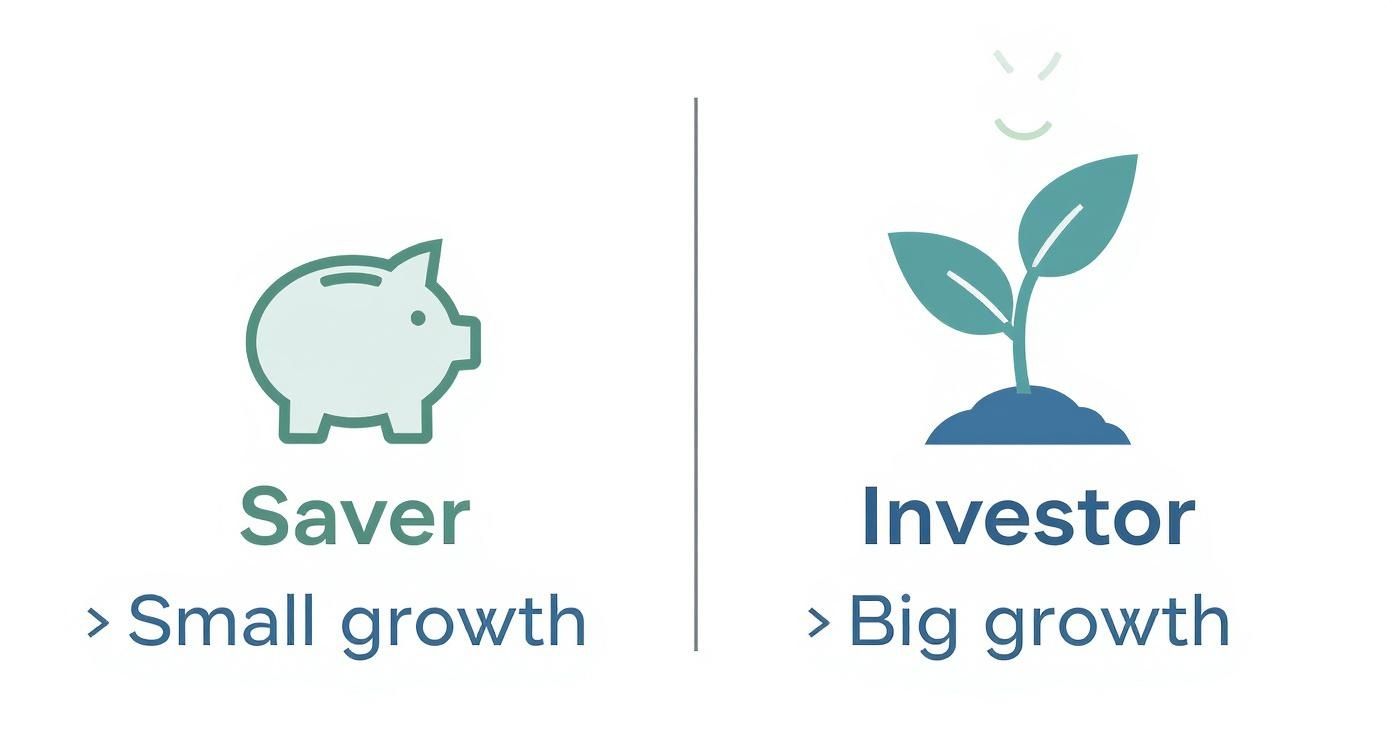
This infographic paints a clear picture of how an investor’s money can grow like crazy compared to a saver’s.
Infographic about stock market investing for dummies

As you can see, the saver's piggy bank doesn't grow much. Meanwhile, the investor's plant shows the incredible power of compounding. Investing is what gives your money the potential to beat inflation and build a truly secure financial future.

This visual shows a simple choice: do you want your money to sleep, or do you want it to work? Plenty of celebrities get this. Ashton Kutcher, for example, is a well-known tech investor who turned his acting paychecks into a massive fortune by investing early in companies like Uber and Airbnb. He didn't just stash his cash; he put it to work.

Kicking off your journey into stock market investing for dummies is less about how much you start with and more about when you start. You have the gift of time on your side – don’t waste it.

How to Open Your First Investment Account

Okay, you get why starting early is a huge deal. Now it's time to take that first real step: opening an account.

This part might sound like a pain, but honestly, it's about as complicated as signing up for TikTok or Instagram. Thanks to modern tech, you can get it all done from your phone in about 15 minutes. You just need some basic personal info (like your Social Security Number) and a bank account to link up.

The best part? You don’t need to be rich to start. Most of the big-name brokers have $0 account minimums, meaning you can get in the game with whatever you feel comfortable with.

Choosing Your Account Type

Before you pick an app, let's quickly talk about the two main "flavors" of accounts you'll see. Think of them as different wrappers for your investments, each with its own special perks.

  1. Standard Brokerage Account: This is your basic, do-it-all investment account. It’s super flexible with no limits on how much you can put in, and you can take your money out whenever you need to. It’s the perfect, no-fuss starting point for general goals.

  2. Roth IRA (Individual Retirement Account): This account is like a superhero for your long-term goals, especially retirement. The deal is simple: you put in money you've already paid taxes on, and in exchange, your investments grow 100% tax-free. That’s a huge deal. It means when you pull that money out in retirement, you won't owe the government a single dime on all those years of growth.

For most young investors, a Roth IRA is an absolute game-changer. You have decades for that tax-free growth to work its magic. You can even have both types of accounts, but starting with one is a fantastic first step.

Finding the Right Broker for You

So, what’s a broker? It’s just the company that gives you access to the stock market. Not long ago, you had to call a guy in a suit to buy a stock. Today, it’s all done through slick, easy-to-use apps on your phone.

When you're starting out, you want a broker that’s known for being beginner-friendly. This usually means they have:

  • Low or zero fees: Most top brokers now offer commission-free trading on U.S. stocks and ETFs. This is a must-have.
  • A simple, clean app: A good mobile app makes the whole process feel way less scary.
  • Helpful learning resources: They should offer articles and videos to help you along the way.

The chart below shows a few popular choices that consistently get high marks for being great for beginners.

Platforms like Fidelity and Charles Schwab are solid choices because they hit all these points and have a long history of being trustworthy. They really make the whole process of stock market investing for dummies as painless as possible.

The Step-by-Step Setup Process

Ready to go? Here’s a quick rundown of what setting up an account looks like, no matter which platform you choose.

  1. Pick Your Broker and Get the App: Do a little research, pick a company you like, and download their official app.
  2. Enter Your Personal Info: You'll fill out a standard application with your name, address, birthday, and Social Security Number. This is a legal requirement to verify who you are.
  3. Answer a Few Financial Questions: They'll ask about your income and your goals. Don't sweat this part – just be honest. It helps them suggest the right products.
  4. Fund Your Account: The last step is linking your bank account to make your first deposit. You can start with any amount you're comfortable with, whether that's $20 or $200.

Once your account is open and funded, that's it. You're officially an investor!

After you’re set up, a crucial next step is getting comfortable reading your monthly or quarterly broker statements. This is how you'll track your progress. It can look a little confusing at first, but it's a great habit to build.

It's also smart to understand what you're being charged. You can get a clearer picture by comparing brokerage fees to make sure you're not giving up too much of your returns to hidden costs.

Smart Ways to Pick Your First Investments

Okay, so your account is open, funded, and ready to go. Now for the fun part – what do you actually buy?

If you're picturing yourself as a Wall Street hotshot trying to find that one magic stock that's going to blow up, let's just slow down for a second. For most people starting out, that's not the smartest (or least stressful) way to begin.

Instead of hunting for one needle in the haystack, what if you could just buy the whole haystack?
An illustration of a diverse investment portfolio with various icons representing different industries

Embrace the Power of Index Funds and ETFs

Instead of stressing over whether to buy Apple, Tesla, or Nike, what if you could own a tiny piece of all of them – plus hundreds more – with a single click? That's the simple genius behind an index fund or an Exchange-Traded Fund (ETF).

Think of it like this: an index fund is just a giant basket holding hundreds, sometimes thousands, of different stocks. The most famous one is the S&P 500 index fund.

When you buy one share of an S&P 500 ETF, you instantly become a part-owner in 500 of the biggest and most successful companies in America. This is a total game-changer because it gives you instant diversification. If one company hits a rough patch, you've got 499 others to help balance things out.

Even billionaire investor Mark Cuban is a huge fan of this strategy for new investors. He's famously said that a low-cost S&P 500 index fund is the single best investment most people can make.

"The S&P 500 is your best friend. It’s a great way to participate in the market without needing to be an expert." – Mark Cuban

This approach is way safer than betting all your money on one single company. Historically, betting on the overall market has been a winning move. The S&P 500, which makes up over 80% of the U.S. stock market, is the benchmark everyone watches. Over the decade ending in late 2024, it delivered a total return of 261%, which is an incredible 13.6% average return per year. You can discover more insights about these market returns on Nasdaq.com.

While index funds and ETFs are very similar, they have some small differences. For a deeper look, check out our guide on the differences between ETFs and mutual funds.

A Stress-Free Investing Technique

Now that you know what to buy, let's talk about how to buy it without losing sleep. The secret is a simple but super powerful technique called dollar-cost averaging.

It sounds fancy, but the idea is simple: you invest a fixed amount of money on a regular schedule, no matter what the market is doing.

Here’s how it works:

  • You decide to invest $50 every two weeks.
  • When the market is up and prices are high, your $50 buys fewer shares.
  • When the market is down and prices are low, your $50 buys more shares.

Over time, this automatically helps you buy more shares when they're cheap and fewer when they're expensive. Most importantly, it saves you from trying to "time the market" – which is basically impossible.

This disciplined, automated approach has huge benefits:

  • It builds a consistent habit: Investing just becomes a normal part of your routine.
  • It takes emotion out of the equation: You won’t be tempted to panic-sell when the market dips or get greedy when it's soaring.
  • It simplifies everything: Just set it and forget it. Your portfolio builds itself in the background.

This is how real wealth is built – steadily and calmly over the long haul. By pairing a simple investment like an S&P 500 ETF with dollar-cost averaging, you're using a proven, powerful strategy that successful investors use every day.

How to Stay Calm During Market Swings

Let’s be real: the stock market is a rollercoaster. There are amazing climbs and stomach-dropping dips. One day your account is up, the next it’s down. This up-and-down movement is called volatility. It’s a totally normal part of investing, so you might as well get used to it.

A historical stock market chart showing long-term upward growth despite short-term dips

Watching your hard-earned money seem to disappear, even for a bit, is scary. But the key is to understand that these swings aren't a sign you did something wrong. They're just the price you pay for long-term growth.

Zoom Out and Look at the Big Picture

When the market gets shaky, our gut reaction is to panic and hit the "sell" button. That’s almost always the worst thing you can do. The most powerful tool you have during a downturn isn't some fancy trading strategy; it's perspective.

If you zoom in on any single day or week, the market looks like pure chaos. But when you zoom out and look at its performance over decades, a clear pattern shows up: it consistently goes up.

Despite major crashes, wars, and recessions, the stock market has always recovered and climbed to new highs. This history is your best friend as an investor. It’s a constant reminder that patience is your ultimate superpower.

"The real key to making money in stocks is not to get scared out of them." – Peter Lynch

This gem from investing legend Peter Lynch says it all. Your biggest enemy often isn't a bad stock – it's your own fear.

Your Behavior Is Your Biggest Advantage

Controlling your emotions is way more important than trying to be a stock-picking genius. Reacting to scary news headlines or a friend's panic is a recipe for losing money. Instead, focus on what you can actually control.

Here are a few tips for staying cool when the market gets heated:

  • Don't Check Your Portfolio Daily: Seriously, stop. Looking at your balance every day will only make you anxious. Check once a month or even once a quarter to keep your eyes on the long-term prize.
  • Remember Why You Started: Think about your original goals. Are you saving for retirement in 30 years? If so, a dip today is just a tiny blip on a very long timeline.
  • Keep Investing (Especially During Dips): If you're using a dollar-cost averaging strategy, a market dip means you're buying shares on sale. Think of it as your favorite store having a massive discount.

Diversification: The Built-In Safety Net

We've talked about diversification before, but it really shines during market swings. If all your money is in one company and that company has a bad year, your whole portfolio suffers.

But if you own a broad market index fund, you own hundreds of companies across different industries. A problem in one area gets balanced out by success in others. It's like having a full sports team – if one player is having an off day, the others can still win the game.

This strategy helps smooth out the ride. Over the past century, the U.S. stock market has delivered an average annual return of about 10%. But that average hides some wild years. For example, the market shot up 33.8% in 1995 but crashed 36.61% in 2008. This is exactly why patience and diversification are so important. You can discover more about average stock market returns on Carry.com.

Ultimately, successful investing is about discipline and thinking long-term. Accept that downturns will happen, stay diversified, and trust in the market's long history of growth.

Where Do You Go From Here?

Give yourself a pat on the back. Seriously. You've just built a solid foundation for your financial future, and the world of stock market investing is no longer some confusing, secret club. You've learned how to get in the game, from understanding the basics to knowing how to keep your cool when things get wild.

Let's do a quick recap of your new investor toolkit:

  • You get the basics: A stock is just a small piece of a company, and the market is where those pieces are traded.
  • You're thinking long-term: Time is your secret weapon. You know to let the magic of compounding do the heavy lifting.
  • You can open an account: Getting started with a beginner-friendly broker takes just a few minutes. No excuses!
  • You know how to keep it simple: Index funds and ETFs are your best friends for building a diverse portfolio without the stress.
  • You're ready to stay disciplined: When things get rocky, patience and consistency are your superpowers.

Keep the Momentum Going

Think of this guide as just step one. One of the best habits any investor can build is curiosity. To keep learning, check out some of these trusted resources – they're perfect for beginners.

  • Podcasts: Shows like "The Ramsey Show" are great for practical, everyday money advice. If you want to understand the big picture, NPR's "Planet Money" makes complex economic ideas genuinely fun and easy to follow.
  • Websites: You can't go wrong with financial news from The Wall Street Journal or Bloomberg. And for those "what does that even mean?" moments, Investopedia is basically the dictionary for every financial term you'll ever see.

Broaden Your Horizons

Once you're comfortable with your simple, U.S.-focused index fund strategy, you might want to look beyond our borders and add international stocks to your mix. This just means investing in companies based in other countries. Why? It adds another powerful layer of diversification.

While the U.S. stock market has been a beast, having a global footprint can help smooth out the ride. Sometimes, international markets do well when the U.S. market is taking a break. Just look at the S&P 500 between 1995 and 2024 – it saw incredible gains of 33.8% and stomach-turning drops of -36.61%. The long-term trend has been amazing, but a little global balance never hurts. You can see for yourself how global markets perform on morningstar.com.

The main takeaway is simple: you're in charge now. You have the knowledge to start building a better financial future, one small, smart investment at a time. This is a journey, not a race. You’ve already taken the most important step – just getting started.

Frequently Asked Questions About Investing

Let's run through some questions that always pop up when you're just starting. Think of this as a quick-fire round to bust some myths and give you the confidence to get going. Clearing these hurdles is a huge part of learning stock market investing for dummies.

How Much Money Do I Really Need to Start Investing?

Honestly? You can start with whatever's in your pocket right now. I'm not kidding – even as little as $1.

These days, almost every online broker lets you buy "fractional shares." It's a game-changer. It means you don't need to save up hundreds of dollars to buy a full share of a big company. You can buy $5 worth of Amazon or $10 worth of Apple and own a real piece of that business. How much you start with is way less important than just starting.

Is Investing in Stocks Just Like Gambling?

Not even close. Gambling is a game where the odds are mathematically stacked against you. The house always wins in the long run.

Investing, on the other hand, is about owning a piece of a real, productive business. You're buying into a company that makes things, sells services, and has the potential to grow. While nothing is guaranteed, long-term investing in a diverse portfolio has historically been one of the most reliable ways to build wealth. It’s about being a business owner, not pulling a slot machine lever and hoping for the best.

What Is the Difference Between a Stock and an Index Fund?

Let's use an analogy. Think of a single stock as one apple tree. If a storm hits it, you might lose your entire crop for the year. Pretty risky, right?

Now, an index fund is like owning a huge orchard with 500 different kinds of fruit trees. If the apple trees have a bad year, it's no big deal – you've still got oranges, pears, and 496 other fruits that are probably doing just fine. A single stock ties your fortune to one company, while an index fund spreads your investment across hundreds, making it a much safer way for a beginner to invest.

Will I Have to Pay Taxes on My Investments?

Yes, but how and when depends on the type of account you choose. With a standard brokerage account, you’ll pay capital gains tax on your profits when you sell an investment for more than you paid for it.

But here's the pro tip: if you use a retirement account like a Roth IRA, your investments can grow for decades and you can pull the money out in retirement completely tax-free. That’s a massive advantage that can save you tens of thousands of dollars over your lifetime. It's why so many experts tell young investors to start with a Roth IRA.

As you get more comfortable, you might wonder when to get professional help. It’s a natural next step, and a common question is, Do I Really Need a Financial Planner for Retirement?. Knowing when to call in an expert can be one of the smartest moves you make.


Ready to put your new knowledge into action? At financeillustrated.com, we make learning simple and fun. Explore our free Trading School, practice with risk-free simulators, and access easy-to-read guides to build your confidence before you invest a single dollar. Start your journey at https://financeillustrated.com.

ETF vs Mutual Funds: A Simple Guide for Young Investors

ye

So, what's the real difference between ETFs and mutual funds? It really comes down to one simple thing: how you trade them. ETFs (Exchange-Traded Funds) trade all day on a stock exchange, just like a share of Tesla or Nike. On the other hand, you can only buy or sell mutual funds once per day, at a price that’s set after the market closes for the night.

Think of it this way: buying an ETF is like grabbing a snack from a vending machine-you can do it anytime you want, and the price is right there. A mutual fund is more like placing an order for pizza delivery-you place your order, but you have to wait until the end of the day for it to show up at a set price.

ETF vs Mutual Fund At a Glance

You're looking at these two popular ways to invest and wondering where to even begin. It might seem complicated, but the main idea for both is super simple. Both are basically "baskets" that hold a mix of investments, like stocks and bonds. This lets you own a bunch of different things at once without having to buy each one individually.

Instead of betting all your money on one company, you're buying a tiny piece of hundreds of them. The real debate isn't about which one holds "better" stuff; it's about how they work. And that small difference in how they operate changes everything, from how much they cost to how you can use them to build your wealth.

"The stock market is filled with individuals who know the price of everything, but the value of nothing." – Phillip Fisher

This classic quote reminds us to look beyond just the price tag. The way these funds are built can either help you stick to a smart plan or tempt you into making emotional mistakes. One gives you the power to react instantly to market drama, while the other encourages you to be more patient and chill.

Let's do a quick breakdown of the main differences.

Here is a quick summary of what sets ETFs and mutual funds apart.

Feature ETF (Exchange-Traded Fund) Mutual Fund
Trading Style Traded all day on a stock exchange, like a single stock. Priced and traded only once per day after the market closes.
Typical Minimum Investment As low as the price of one share (sometimes under $100). Often requires a higher starting amount (like $1,000 to $3,000).
Cost (Expense Ratio) Usually have lower fees, since many just copy the market. Can have higher fees, especially if a manager is trying to be a stock-picking genius.
Best For Hands-on investors who want flexibility and low costs. "Set-it-and-forget-it" investors who prefer to automate their savings.

This table gives you the bird's-eye view. Now, let's dive into what each of these points really means for your money.

Understanding the Building Blocks of Your Portfolio

Two people looking at charts on a computer screen, discussing investments

Before we get into the weeds, let's get a feel for what ETFs and mutual funds really are. I like to think of them as investment playlists. Instead of trying to find every hit song one-by-one, you just buy a ready-made "Greatest Hits" album.

With one click, you can own a slice of hundreds of companies. This instant diversification is their superpower. It's like not putting all your eggs in one basket. Did you know that even rap mogul Jay-Z is a big believer in diversification? He didn't just stick to music; he invested in art, tech companies like Uber, and real estate. Spreading your risk is a key to building lasting wealth.

Even the most famous investor in the world, Warren Buffett, champions this idea, although he says it with his classic humor:

"Diversification is protection against ignorance. It makes very little sense for those who know what they're doing." – Warren Buffett

For most of us who aren't spending all day analyzing stocks, that "protection" is a lifesaver. ETFs and mutual funds are your straightforward ticket to owning a piece of the entire market.

The New Kid on the Block: ETFs

ETFs, which stands for Exchange-Traded Funds, are the more modern of the two. They showed up in the 90s and have become super popular, especially with younger investors.

Their main feature? They trade on a stock exchange, just like a share of Apple or Amazon. This means you can buy and sell them anytime during the day when the market is open (usually 9:30 AM to 4:00 PM EST). Their prices go up and down in real-time, giving you a ton of control.

The Original Portfolio-in-a-Box: Mutual Funds

Mutual funds are the old-school champs, the original workhorses of investing. They've been around for almost 100 years and became the foundation of retirement plans like 401(k)s. For a long time, they were the main way for regular people to invest for the future.

Here’s the main difference: mutual funds only trade once per day. All the buy and sell orders get bundled together and happen at a single price that's calculated after the market closes. This price is called the Net Asset Value (NAV). This system naturally makes you a more patient, long-term investor, since you can't panic-sell the second the market gets a little shaky.

The Trillion-Dollar Shift in How We Invest

The amount of money pouring into these funds is mind-blowing, and it tells a really interesting story. More and more, people are choosing simple, "passive" funds that just copy the market instead of "active" funds that try (and often fail) to be stock-picking heroes.

Just look at the numbers. The combined cash in U.S. ETFs and mutual funds has ballooned to a massive $34.87 trillion. Of that, $18.00 trillion is in simple index funds that just try to match the market. You can see the details in this report on combined asset flows.

This shows just how much people trust these tools to build wealth. Both are awesome, but the way they work creates different experiences and makes them better for different goals.

How Trading Fees and Taxes Impact Your Money

When you first start investing, it’s easy to get excited about finding the "perfect" stock. But the real secret to getting rich isn't just picking winners-it's about keeping what you earn. Fees and taxes are like silent partners that can take a surprisingly big bite out of your money over time.

Think of it like a subscription service you forgot about. A few bucks a month doesn't seem like much, but over years, it adds up to a ton of wasted money. Investment costs work the same way. A tiny fee can cost you thousands of dollars that could have been growing for you.

This is where the differences between ETFs and mutual funds really start to hit your wallet. Their unique structures lead to very different costs and taxes, which directly affects how much money you end up with. Let's see how this works in the real world.

Trading Flexibility and Associated Costs

One of the first things you'll notice is how you buy and sell these funds. ETFs trade just like stocks-you can buy or sell them anytime the market is open, watching prices change by the second. This gives you laser-point control.

Mutual funds are different. They only trade once per day, after the market closes, at a calculated price called the Net Asset Value (NAV). All the buy and sell orders from that day get processed at that one price. It’s a small detail with big effects on your investing style.

  • ETFs offer instant access: If you see the market dip and want to buy, or need to sell your shares fast, you can do it right away. This flexibility is a huge plus for more active investors.
  • Mutual funds build discipline: The once-a-day pricing stops you from making rash decisions based on market drama. For many, this forced patience is a feature, not a bug.

This all-day trading for ETFs does come with a small catch, though. You'll probably run into the bid-ask spread-a tiny price difference between what buyers are willing to pay and what sellers are willing to accept. For popular ETFs, it's often just a penny, but it's still a small cost to be aware of.

The Power of Low Fees

The biggest and most important cost is almost always the expense ratio. This is an annual fee, charged as a percentage of your investment, that covers the fund's operating costs. And this is where ETFs usually win.

ETFs, especially simple "passive" ones that just track an index like the S&P 500, are famous for their super-low expense ratios. On the other hand, many mutual funds, especially those with managers actively trying to beat the market, charge a lot more for that service.

"The miracle of compounding returns is overwhelmed by the tyranny of compounding costs." – John C. Bogle, Founder of Vanguard

That quote from the guy who basically invented index investing says it all. A small difference in fees might not seem like a big deal in one year, but over decades, it can have a huge impact on your final account balance. Less money paid in fees means more money is left working for you.

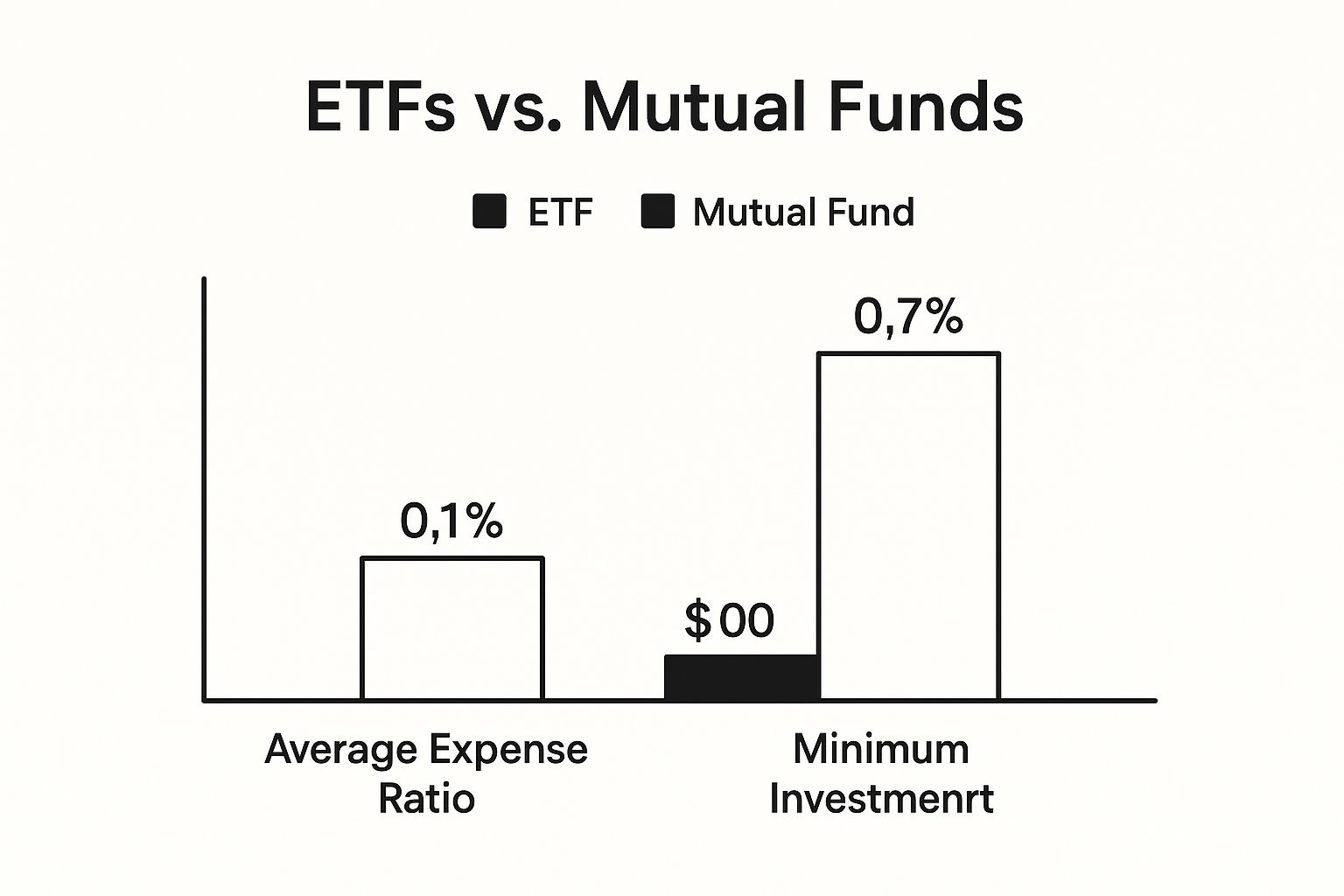
This chart makes the point crystal clear, showing how different the average costs and starting amounts can be.

Infographic comparing average expense ratios and minimum investments for ETFs versus mutual funds.

As you can see, ETFs usually make it easier and cheaper to get started, both in how much you need upfront and how much it costs you each year.

The Hidden Advantage of Tax Efficiency

Here’s a secret weapon that many new investors miss: taxes. When a fund manager sells a stock inside the fund for a profit, that profit-a capital gain-gets passed on to you. And guess what? You owe taxes on it, even if you never sold a single share yourself.

This is where ETFs have a superpower. Because of the clever way they are built, ETFs are masters at avoiding these taxable events. They can swap stocks in and out without "selling" them in a way that creates a tax bill for you.

The numbers are pretty wild. In 2024, only 5.08% of stock ETFs had to pay out taxable capital gains. Compare that to a whopping 64.82% of stock mutual funds. With an ETF, you usually only pay capital gains tax when you decide to sell, giving you way more control. To make sure you're being as smart as possible with your money, it's always good to stay informed about investment tax. Over a lifetime, this tax advantage can save you a fortune.

Active vs. Passive: The Real Battle for Your Returns

A chess board with pieces set up, symbolizing strategic investment decisions.

When you get right down to it, the "ETF vs. mutual fund" debate is really about a much bigger fight: active versus passive investing. This is the real tug-of-war for your money, and figuring out which team you're on is key to making smart choices.

Think of it like this. An active manager is like a celebrity chef trying to invent a new, mind-blowing dish. A passive manager is like a chef who perfectly follows a classic, beloved recipe every single time.

Most ETFs are firmly on the passive team. They don’t try to be heroes. Their one job is to perfectly copy a market index, like the famous S&P 500. If the S&P 500 goes up 10%, the ETF aims to give you a 10% return (minus a tiny fee).

In the other corner, many mutual funds are active. They’re run by professional managers who hand-pick investments they think will crush the market. They're trying to be better than average, and you pay them a higher fee for that effort.

The Surprising Truth About Beating the Market

So, who wins more often? The highly-paid expert trying to find the next big thing, or the simple fund that just copies everyone else? The answer might shock you. Over and over, studies show the same thing: the vast majority of active fund managers fail to beat their simple, passive competition over the long run.

It feels weird, right? You'd think paying more for an expert should get you better results, but in investing, it usually doesn't. It’s like paying extra for a "gourmet" burger only to find out the classic one from the diner next door tastes better and costs half as much.

This simple truth is what made investing legends like John C. Bogle, the founder of Vanguard, so famous. He built a massive company on what was, at the time, a crazy idea.

"Don't look for the needle in the haystack. Just buy the haystack." – John C. Bogle

Bogle's idea was beautiful in its simplicity: instead of trying (and probably failing) to pick the few winning stocks, just own a tiny piece of all the stocks. That way, you're guaranteed to get your fair share of the market's overall growth.

Why Being Average Is a Winning Strategy

Trying to be "average" by just matching the market’s return might sound boring, but it's one of the most powerful ways to build wealth. It all comes down to two big things: lower costs and human mistakes.

  1. Lower Costs: Active funds charge higher fees to pay their managers, research teams, and for all the trading they do. These costs act like a constant anchor, dragging down your returns.
  2. Human Error: Even the smartest people on Wall Street can't predict the future. They can get emotional, chase hype, or just be wrong. A passive index fund takes all that human guesswork out of the picture.

It’s a bit like driving in traffic. You could be the hero, constantly switching lanes trying to get ahead. Or you could just pick a lane, set your cruise control, and enjoy a much smoother, less stressful-and often faster-trip to your destination.

Of course, just picking an ETF doesn't automatically mean you'll win. Fun fact: some research has found that about 60% of ETFs actually performed worse than the overall market, which is surprisingly close to their active mutual fund cousins. You can find more insights about these ETF performance findings.

This just shows that the secret isn't just choosing "ETF" over "mutual fund." The key is picking the right kind of fund-usually one that tracks a big, diverse, low-cost index.

Choosing the Right Fund for Your Investing Style

A person sitting at a desk with a laptop, looking at charts and graphs, making an investment decision.

Okay, we've gone through all the techy differences between ETFs and mutual funds. Now for the part that really matters: figuring out which one is right for you. The truth is, there's no single "best" fund. It's about finding the right tool for your goals and, just as important, your personality.

Think of it like buying a car. A sports car is fun and gives you total control, but a simple sedan is perfect for getting you where you need to go without any drama. Neither is better; they just fit different people with different needs.

Let's look at how this plays out for different types of people. See which one sounds most like you.

The Hands-On Trader

Do you check stock prices on your phone all the time? Does the idea of buying when the market dips sound exciting? If you like being in the driver's seat of your money, ETFs are probably your new best friend.

Since ETFs trade like stocks, they give you amazing flexibility. You can buy shares at 10 AM and sell them by 2 PM if you want. This kind of real-time control is perfect for active investors who want to manage their portfolios closely and jump on opportunities as they happen.

  • You want control: ETFs let you use more advanced trading moves, like setting specific prices where you want to buy or sell.
  • You're a strategic thinker: Maybe you want to invest in a specific trend, like robotics or clean energy. The ETF world is full of these kinds of specialized funds.

This approach takes more attention, for sure. But for many people, being that involved is half the fun.

The Automatic Saver

On the other hand, maybe looking at market charts makes your eyes glaze over. You just want to build wealth slowly and steadily, like a subscription service for your future. If you're a "set it and forget it" kind of person, mutual funds were made for you.

Their best feature is automation. You can set it up so that $50 or $100 is automatically moved from your bank account and invested into your fund every payday. This simple but powerful trick is called dollar-cost averaging, and it's an amazing way to build wealth without any stress or effort.

"The individual investor should act consistently as an investor and not as a speculator." – Benjamin Graham

Warren Buffett's teacher, Benjamin Graham, knew that the slow-and-steady tortoise usually beats the hare in the long run. Mutual funds make it super easy to put that wisdom into action. It’s the perfect engine for a retirement account or any long-term goal where being consistent is more important than being a genius.

Real-World Scenarios: Which One Are You?

To make it even clearer, let's look at a couple of common situations.

Scenario 1: The New Investor with $50

You just got paid from your part-time job and have an extra $50 you want to invest. You're excited to get started right now.

  • Your Best Bet: ETFs. You can easily buy a single share of an ETF that tracks the whole S&P 500, often for much less than $500. Even better, most brokers now offer fractional shares, so you can start with as little as $1. In contrast, many mutual funds require you to start with $1,000 or more, which can be a huge barrier.

Scenario 2: The Future Retiree

You're opening your first retirement account, like a Roth IRA, and want to contribute a little bit from every paycheck for the next 40 years.

  • Your Best Bet: Mutual Funds. Here, the power of automation is a total game-changer. By setting up a recurring investment into a low-cost index mutual fund, you make sure you're always building that nest egg without even thinking about it. It takes the emotion and effort out of the equation-the perfect strategy for long-term saving.

How to Start Investing in Just a Few Steps

Alright, knowing the difference between ETFs and mutual funds is a great start, but knowledge only turns into wealth when you take action. It’s time to put your money to work.

Let’s walk through a simple roadmap to get you from square one to making your first investment.

Honestly, the whole idea of "investing" can sound kind of formal and scary. You might picture old guys in suits on Wall Street, but today it's so much simpler. As the famous author Morgan Housel says, “The most important thing you can do is increase the amount of time you’re investing for.” The sooner you start, the more time your money has to grow on its own.

Your Quick Decision Checklist

To figure out where to start, just answer these three quick questions. There are no right or wrong answers-it’s all about what fits your life.

  • How much cash do you have to start? If you’re starting with a smaller amount, like under a few hundred dollars, ETFs are your best friend. Many brokers let you buy fractional shares, so you can start with just a few dollars.
  • How hands-on do you want to be? If you like the idea of checking on your investments and want the freedom to trade whenever you want, ETFs give you that flexibility. If you'd rather "set it and forget it," mutual funds are perfect for setting up automatic, scheduled investments.
  • How important are costs to you? While you can find cheap options for both, ETFs generally have lower average fees. Keeping costs low is one of the most powerful secrets to long-term success.

Making Your First Investment

Ready to do it? It’s genuinely easier than you think. You can be up and running in less time than it takes to watch an episode of your favorite show.

  1. Choose Your Brokerage: A brokerage is just the company that lets you buy and sell investments. Great, easy-to-use options for beginners include Fidelity, Schwab, and Robinhood. They all make opening an account online super fast and simple.
  2. Fund Your Account: Next, just link your bank account and transfer whatever amount you want to start with. It can be as little as $5 or $10.
  3. Find Your Fund and Buy: Use the search bar on the app to look up a fund. A great starting point for most new investors is a broad market index fund, like one that tracks the S&P 500. Just type in the dollar amount you want to invest, click "buy," and that's it-congratulations, you're officially an investor!

The single most important step is just getting started. If you want a bit more guidance, our free online stock trading course breaks down the basics even more.

As the old saying goes, "The best time to plant a tree was 20 years ago. The second best time is now."

Your Top Questions About ETFs and Mutual Funds, Answered

Let's be real, the world of investing is full of confusing words. It's easy to get lost. So, let's cut through the noise and answer some of the most common questions people have when comparing ETFs vs. mutual funds.

Can I Lose All My Money in a Fund?

This is usually the first question on everyone's mind, and it's a smart one. While every investment has some risk, the chances of losing all your money in a diversified fund that owns hundreds of stocks is incredibly small.

Think about it: for an S&P 500 index fund to go to zero, all 500 of the biggest companies in the U.S.-like Apple, Microsoft, and Amazon-would have to go bankrupt at the same time. Not very likely, right? The real risk isn't losing everything, but watching your account go down during a market dip. That's why thinking long-term is so important-it gives your investments time to recover and grow.

Which Is Better for a Roth IRA?

Great question! Both ETFs and mutual funds work perfectly inside a Roth IRA. A Roth account already gives you amazing tax breaks-your money grows tax-free and you can take it out tax-free in retirement. Because of that, the famous tax-efficiency of ETFs isn't as big of a deal here.

The best choice really comes down to your personality:

  • Hands-Off & Automated: If you love the "set it and forget it" idea, a low-cost mutual fund is a perfect choice. You can easily set up automatic investments from every paycheck.
  • Hands-On & Flexible: If you want more control, want to trade during the day, or want to invest in specific areas like AI or clean energy, ETFs give you that freedom.

"The stock market is a device for transferring money from the impatient to the patient." – Warren Buffett

This classic line from Warren Buffett is especially true for retirement saving. The goal is to pick the option that makes it easiest for you to stay patient and stick with the plan for the long run.

Do I Need a Financial Advisor to Start?

Nope, you definitely don't need a pro to get started. Thanks to modern apps and online brokerages, opening an account and buying your first fund is easier than ever. These platforms are designed for beginners and are filled with tools to help you learn as you go.

That said, if your finances get more complicated later on or you just want a second opinion from an expert, talking to a fee-only advisor is never a bad idea. For some great free advice, you can also check out some of the best investing podcasts to listen to for market news on the go. The most important thing is to just get started.


At financeillustrated.com, our mission is to make investing clear and approachable. Our free trading school and interactive simulators are here to help you build real skills and confidence before you invest a single dollar. Explore our resources today!

ETF vs Mutual Funds: A Simple Guide for Young Investors

ye

So, what's the real difference between ETFs and mutual funds? It really comes down to one simple thing: how you trade them. ETFs (Exchange-Traded Funds) trade all day on a stock exchange, just like a share of Tesla or Nike. On the other hand, you can only buy or sell mutual funds once per day, at a price that’s set after the market closes for the night.

Think of it this way: buying an ETF is like grabbing a snack from a vending machine-you can do it anytime you want, and the price is right there. A mutual fund is more like placing an order for pizza delivery-you place your order, but you have to wait until the end of the day for it to show up at a set price.

ETF vs Mutual Fund At a Glance

You're looking at these two popular ways to invest and wondering where to even begin. It might seem complicated, but the main idea for both is super simple. Both are basically "baskets" that hold a mix of investments, like stocks and bonds. This lets you own a bunch of different things at once without having to buy each one individually.

Instead of betting all your money on one company, you're buying a tiny piece of hundreds of them. The real debate isn't about which one holds "better" stuff; it's about how they work. And that small difference in how they operate changes everything, from how much they cost to how you can use them to build your wealth.

"The stock market is filled with individuals who know the price of everything, but the value of nothing." – Phillip Fisher

This classic quote reminds us to look beyond just the price tag. The way these funds are built can either help you stick to a smart plan or tempt you into making emotional mistakes. One gives you the power to react instantly to market drama, while the other encourages you to be more patient and chill.

Let's do a quick breakdown of the main differences.

Here is a quick summary of what sets ETFs and mutual funds apart.

Feature ETF (Exchange-Traded Fund) Mutual Fund
Trading Style Traded all day on a stock exchange, like a single stock. Priced and traded only once per day after the market closes.
Typical Minimum Investment As low as the price of one share (sometimes under $100). Often requires a higher starting amount (like $1,000 to $3,000).
Cost (Expense Ratio) Usually have lower fees, since many just copy the market. Can have higher fees, especially if a manager is trying to be a stock-picking genius.
Best For Hands-on investors who want flexibility and low costs. "Set-it-and-forget-it" investors who prefer to automate their savings.

This table gives you the bird's-eye view. Now, let's dive into what each of these points really means for your money.

Understanding the Building Blocks of Your Portfolio

Two people looking at charts on a computer screen, discussing investments

Before we get into the weeds, let's get a feel for what ETFs and mutual funds really are. I like to think of them as investment playlists. Instead of trying to find every hit song one-by-one, you just buy a ready-made "Greatest Hits" album.

With one click, you can own a slice of hundreds of companies. This instant diversification is their superpower. It's like not putting all your eggs in one basket. Did you know that even rap mogul Jay-Z is a big believer in diversification? He didn't just stick to music; he invested in art, tech companies like Uber, and real estate. Spreading your risk is a key to building lasting wealth.

Even the most famous investor in the world, Warren Buffett, champions this idea, although he says it with his classic humor:

"Diversification is protection against ignorance. It makes very little sense for those who know what they're doing." – Warren Buffett

For most of us who aren't spending all day analyzing stocks, that "protection" is a lifesaver. ETFs and mutual funds are your straightforward ticket to owning a piece of the entire market.

The New Kid on the Block: ETFs

ETFs, which stands for Exchange-Traded Funds, are the more modern of the two. They showed up in the 90s and have become super popular, especially with younger investors.

Their main feature? They trade on a stock exchange, just like a share of Apple or Amazon. This means you can buy and sell them anytime during the day when the market is open (usually 9:30 AM to 4:00 PM EST). Their prices go up and down in real-time, giving you a ton of control.

The Original Portfolio-in-a-Box: Mutual Funds

Mutual funds are the old-school champs, the original workhorses of investing. They've been around for almost 100 years and became the foundation of retirement plans like 401(k)s. For a long time, they were the main way for regular people to invest for the future.

Here’s the main difference: mutual funds only trade once per day. All the buy and sell orders get bundled together and happen at a single price that's calculated after the market closes. This price is called the Net Asset Value (NAV). This system naturally makes you a more patient, long-term investor, since you can't panic-sell the second the market gets a little shaky.

The Trillion-Dollar Shift in How We Invest

The amount of money pouring into these funds is mind-blowing, and it tells a really interesting story. More and more, people are choosing simple, "passive" funds that just copy the market instead of "active" funds that try (and often fail) to be stock-picking heroes.

Just look at the numbers. The combined cash in U.S. ETFs and mutual funds has ballooned to a massive $34.87 trillion. Of that, $18.00 trillion is in simple index funds that just try to match the market. You can see the details in this report on combined asset flows.

This shows just how much people trust these tools to build wealth. Both are awesome, but the way they work creates different experiences and makes them better for different goals.

How Trading Fees and Taxes Impact Your Money

When you first start investing, it’s easy to get excited about finding the "perfect" stock. But the real secret to getting rich isn't just picking winners-it's about keeping what you earn. Fees and taxes are like silent partners that can take a surprisingly big bite out of your money over time.

Think of it like a subscription service you forgot about. A few bucks a month doesn't seem like much, but over years, it adds up to a ton of wasted money. Investment costs work the same way. A tiny fee can cost you thousands of dollars that could have been growing for you.

This is where the differences between ETFs and mutual funds really start to hit your wallet. Their unique structures lead to very different costs and taxes, which directly affects how much money you end up with. Let's see how this works in the real world.

Trading Flexibility and Associated Costs

One of the first things you'll notice is how you buy and sell these funds. ETFs trade just like stocks-you can buy or sell them anytime the market is open, watching prices change by the second. This gives you laser-point control.

Mutual funds are different. They only trade once per day, after the market closes, at a calculated price called the Net Asset Value (NAV). All the buy and sell orders from that day get processed at that one price. It’s a small detail with big effects on your investing style.

  • ETFs offer instant access: If you see the market dip and want to buy, or need to sell your shares fast, you can do it right away. This flexibility is a huge plus for more active investors.
  • Mutual funds build discipline: The once-a-day pricing stops you from making rash decisions based on market drama. For many, this forced patience is a feature, not a bug.

This all-day trading for ETFs does come with a small catch, though. You'll probably run into the bid-ask spread-a tiny price difference between what buyers are willing to pay and what sellers are willing to accept. For popular ETFs, it's often just a penny, but it's still a small cost to be aware of.

The Power of Low Fees

The biggest and most important cost is almost always the expense ratio. This is an annual fee, charged as a percentage of your investment, that covers the fund's operating costs. And this is where ETFs usually win.

ETFs, especially simple "passive" ones that just track an index like the S&P 500, are famous for their super-low expense ratios. On the other hand, many mutual funds, especially those with managers actively trying to beat the market, charge a lot more for that service.

"The miracle of compounding returns is overwhelmed by the tyranny of compounding costs." – John C. Bogle, Founder of Vanguard

That quote from the guy who basically invented index investing says it all. A small difference in fees might not seem like a big deal in one year, but over decades, it can have a huge impact on your final account balance. Less money paid in fees means more money is left working for you.

This chart makes the point crystal clear, showing how different the average costs and starting amounts can be.

Infographic comparing average expense ratios and minimum investments for ETFs versus mutual funds.

As you can see, ETFs usually make it easier and cheaper to get started, both in how much you need upfront and how much it costs you each year.

The Hidden Advantage of Tax Efficiency

Here’s a secret weapon that many new investors miss: taxes. When a fund manager sells a stock inside the fund for a profit, that profit-a capital gain-gets passed on to you. And guess what? You owe taxes on it, even if you never sold a single share yourself.

This is where ETFs have a superpower. Because of the clever way they are built, ETFs are masters at avoiding these taxable events. They can swap stocks in and out without "selling" them in a way that creates a tax bill for you.

The numbers are pretty wild. In 2024, only 5.08% of stock ETFs had to pay out taxable capital gains. Compare that to a whopping 64.82% of stock mutual funds. With an ETF, you usually only pay capital gains tax when you decide to sell, giving you way more control. To make sure you're being as smart as possible with your money, it's always good to stay informed about investment tax. Over a lifetime, this tax advantage can save you a fortune.

Active vs. Passive: The Real Battle for Your Returns

A chess board with pieces set up, symbolizing strategic investment decisions.

When you get right down to it, the "ETF vs. mutual fund" debate is really about a much bigger fight: active versus passive investing. This is the real tug-of-war for your money, and figuring out which team you're on is key to making smart choices.

Think of it like this. An active manager is like a celebrity chef trying to invent a new, mind-blowing dish. A passive manager is like a chef who perfectly follows a classic, beloved recipe every single time.

Most ETFs are firmly on the passive team. They don’t try to be heroes. Their one job is to perfectly copy a market index, like the famous S&P 500. If the S&P 500 goes up 10%, the ETF aims to give you a 10% return (minus a tiny fee).

In the other corner, many mutual funds are active. They’re run by professional managers who hand-pick investments they think will crush the market. They're trying to be better than average, and you pay them a higher fee for that effort.

The Surprising Truth About Beating the Market

So, who wins more often? The highly-paid expert trying to find the next big thing, or the simple fund that just copies everyone else? The answer might shock you. Over and over, studies show the same thing: the vast majority of active fund managers fail to beat their simple, passive competition over the long run.

It feels weird, right? You'd think paying more for an expert should get you better results, but in investing, it usually doesn't. It’s like paying extra for a "gourmet" burger only to find out the classic one from the diner next door tastes better and costs half as much.

This simple truth is what made investing legends like John C. Bogle, the founder of Vanguard, so famous. He built a massive company on what was, at the time, a crazy idea.

"Don't look for the needle in the haystack. Just buy the haystack." – John C. Bogle

Bogle's idea was beautiful in its simplicity: instead of trying (and probably failing) to pick the few winning stocks, just own a tiny piece of all the stocks. That way, you're guaranteed to get your fair share of the market's overall growth.

Why Being Average Is a Winning Strategy

Trying to be "average" by just matching the market’s return might sound boring, but it's one of the most powerful ways to build wealth. It all comes down to two big things: lower costs and human mistakes.

  1. Lower Costs: Active funds charge higher fees to pay their managers, research teams, and for all the trading they do. These costs act like a constant anchor, dragging down your returns.
  2. Human Error: Even the smartest people on Wall Street can't predict the future. They can get emotional, chase hype, or just be wrong. A passive index fund takes all that human guesswork out of the picture.

It’s a bit like driving in traffic. You could be the hero, constantly switching lanes trying to get ahead. Or you could just pick a lane, set your cruise control, and enjoy a much smoother, less stressful-and often faster-trip to your destination.

Of course, just picking an ETF doesn't automatically mean you'll win. Fun fact: some research has found that about 60% of ETFs actually performed worse than the overall market, which is surprisingly close to their active mutual fund cousins. You can find more insights about these ETF performance findings.

This just shows that the secret isn't just choosing "ETF" over "mutual fund." The key is picking the right kind of fund-usually one that tracks a big, diverse, low-cost index.

Choosing the Right Fund for Your Investing Style

A person sitting at a desk with a laptop, looking at charts and graphs, making an investment decision.

Okay, we've gone through all the techy differences between ETFs and mutual funds. Now for the part that really matters: figuring out which one is right for you. The truth is, there's no single "best" fund. It's about finding the right tool for your goals and, just as important, your personality.

Think of it like buying a car. A sports car is fun and gives you total control, but a simple sedan is perfect for getting you where you need to go without any drama. Neither is better; they just fit different people with different needs.

Let's look at how this plays out for different types of people. See which one sounds most like you.

The Hands-On Trader

Do you check stock prices on your phone all the time? Does the idea of buying when the market dips sound exciting? If you like being in the driver's seat of your money, ETFs are probably your new best friend.

Since ETFs trade like stocks, they give you amazing flexibility. You can buy shares at 10 AM and sell them by 2 PM if you want. This kind of real-time control is perfect for active investors who want to manage their portfolios closely and jump on opportunities as they happen.

  • You want control: ETFs let you use more advanced trading moves, like setting specific prices where you want to buy or sell.
  • You're a strategic thinker: Maybe you want to invest in a specific trend, like robotics or clean energy. The ETF world is full of these kinds of specialized funds.

This approach takes more attention, for sure. But for many people, being that involved is half the fun.

The Automatic Saver

On the other hand, maybe looking at market charts makes your eyes glaze over. You just want to build wealth slowly and steadily, like a subscription service for your future. If you're a "set it and forget it" kind of person, mutual funds were made for you.

Their best feature is automation. You can set it up so that $50 or $100 is automatically moved from your bank account and invested into your fund every payday. This simple but powerful trick is called dollar-cost averaging, and it's an amazing way to build wealth without any stress or effort.

"The individual investor should act consistently as an investor and not as a speculator." – Benjamin Graham

Warren Buffett's teacher, Benjamin Graham, knew that the slow-and-steady tortoise usually beats the hare in the long run. Mutual funds make it super easy to put that wisdom into action. It’s the perfect engine for a retirement account or any long-term goal where being consistent is more important than being a genius.

Real-World Scenarios: Which One Are You?

To make it even clearer, let's look at a couple of common situations.

Scenario 1: The New Investor with $50

You just got paid from your part-time job and have an extra $50 you want to invest. You're excited to get started right now.

  • Your Best Bet: ETFs. You can easily buy a single share of an ETF that tracks the whole S&P 500, often for much less than $500. Even better, most brokers now offer fractional shares, so you can start with as little as $1. In contrast, many mutual funds require you to start with $1,000 or more, which can be a huge barrier.

Scenario 2: The Future Retiree

You're opening your first retirement account, like a Roth IRA, and want to contribute a little bit from every paycheck for the next 40 years.

  • Your Best Bet: Mutual Funds. Here, the power of automation is a total game-changer. By setting up a recurring investment into a low-cost index mutual fund, you make sure you're always building that nest egg without even thinking about it. It takes the emotion and effort out of the equation-the perfect strategy for long-term saving.

How to Start Investing in Just a Few Steps

Alright, knowing the difference between ETFs and mutual funds is a great start, but knowledge only turns into wealth when you take action. It’s time to put your money to work.

Let’s walk through a simple roadmap to get you from square one to making your first investment.

Honestly, the whole idea of "investing" can sound kind of formal and scary. You might picture old guys in suits on Wall Street, but today it's so much simpler. As the famous author Morgan Housel says, “The most important thing you can do is increase the amount of time you’re investing for.” The sooner you start, the more time your money has to grow on its own.

Your Quick Decision Checklist

To figure out where to start, just answer these three quick questions. There are no right or wrong answers-it’s all about what fits your life.

  • How much cash do you have to start? If you’re starting with a smaller amount, like under a few hundred dollars, ETFs are your best friend. Many brokers let you buy fractional shares, so you can start with just a few dollars.
  • How hands-on do you want to be? If you like the idea of checking on your investments and want the freedom to trade whenever you want, ETFs give you that flexibility. If you'd rather "set it and forget it," mutual funds are perfect for setting up automatic, scheduled investments.
  • How important are costs to you? While you can find cheap options for both, ETFs generally have lower average fees. Keeping costs low is one of the most powerful secrets to long-term success.

Making Your First Investment

Ready to do it? It’s genuinely easier than you think. You can be up and running in less time than it takes to watch an episode of your favorite show.

  1. Choose Your Brokerage: A brokerage is just the company that lets you buy and sell investments. Great, easy-to-use options for beginners include Fidelity, Schwab, and Robinhood. They all make opening an account online super fast and simple.
  2. Fund Your Account: Next, just link your bank account and transfer whatever amount you want to start with. It can be as little as $5 or $10.
  3. Find Your Fund and Buy: Use the search bar on the app to look up a fund. A great starting point for most new investors is a broad market index fund, like one that tracks the S&P 500. Just type in the dollar amount you want to invest, click "buy," and that's it-congratulations, you're officially an investor!

The single most important step is just getting started. If you want a bit more guidance, our free online stock trading course breaks down the basics even more.

As the old saying goes, "The best time to plant a tree was 20 years ago. The second best time is now."

Your Top Questions About ETFs and Mutual Funds, Answered

Let's be real, the world of investing is full of confusing words. It's easy to get lost. So, let's cut through the noise and answer some of the most common questions people have when comparing ETFs vs. mutual funds.

Can I Lose All My Money in a Fund?

This is usually the first question on everyone's mind, and it's a smart one. While every investment has some risk, the chances of losing all your money in a diversified fund that owns hundreds of stocks is incredibly small.

Think about it: for an S&P 500 index fund to go to zero, all 500 of the biggest companies in the U.S.-like Apple, Microsoft, and Amazon-would have to go bankrupt at the same time. Not very likely, right? The real risk isn't losing everything, but watching your account go down during a market dip. That's why thinking long-term is so important-it gives your investments time to recover and grow.

Which Is Better for a Roth IRA?

Great question! Both ETFs and mutual funds work perfectly inside a Roth IRA. A Roth account already gives you amazing tax breaks-your money grows tax-free and you can take it out tax-free in retirement. Because of that, the famous tax-efficiency of ETFs isn't as big of a deal here.

The best choice really comes down to your personality:

  • Hands-Off & Automated: If you love the "set it and forget it" idea, a low-cost mutual fund is a perfect choice. You can easily set up automatic investments from every paycheck.
  • Hands-On & Flexible: If you want more control, want to trade during the day, or want to invest in specific areas like AI or clean energy, ETFs give you that freedom.

"The stock market is a device for transferring money from the impatient to the patient." – Warren Buffett

This classic line from Warren Buffett is especially true for retirement saving. The goal is to pick the option that makes it easiest for you to stay patient and stick with the plan for the long run.

Do I Need a Financial Advisor to Start?

Nope, you definitely don't need a pro to get started. Thanks to modern apps and online brokerages, opening an account and buying your first fund is easier than ever. These platforms are designed for beginners and are filled with tools to help you learn as you go.

That said, if your finances get more complicated later on or you just want a second opinion from an expert, talking to a fee-only advisor is never a bad idea. For some great free advice, you can also check out some of the best investing podcasts to listen to for market news on the go. The most important thing is to just get started.


At financeillustrated.com, our mission is to make investing clear and approachable. Our free trading school and interactive simulators are here to help you build real skills and confidence before you invest a single dollar. Explore our resources today!