
Stocks & investing
10 Best Free Investing Tools for Beginners (2026)
10 free investing tools for beginners: calculators, fee checkers, company filings, charts, screeners, trackers and a practice app, with each tool's limits.
ETFs and mutual funds are both baskets of investments. The label does not decide which one is cheaper. Learn to compare the full cost of two choices.

ETFs and mutual funds both hold many investments. The label alone does not decide the cost.
Both are : one pot of money from many people, used to buy many investments. Both can follow an index, which is a fixed list of shares that tracks a market. Or they can be run by a manager who picks investments. Both charge fees, and both can lose value.
The main difference is how you buy and sell. An (exchange-traded fund) trades on a stock exchange at a price that changes during the day. A sells and buys back its shares at one price a day, called the (net asset value). We explain this in how ETFs and mutual funds trade during the day.
| Question | ETF | Mutual fund |
|---|---|---|
| What price do I pay? | The market price, which can differ from NAV | The next NAV, plus any charges |
| What trading costs apply? | The , and sometimes a commission | Sometimes a sales or exit charge |
| Can it follow an index? | Yes | Yes |
| Is it automatically spread out? | Only if its holdings are | Only if its holdings are |
So the label "ETF" or "mutual fund" does not tell you what a fund owns or what it costs. Two funds with similar names can hold different things.
Every fund takes a yearly fee from inside the fund. This fee is called the . It is shown as a percentage of your money, and you never get a bill for it. It simply makes your balance a little smaller.
$70 may not sound like much. But money paid in fees cannot grow, and the gap repeats every year. Over a long time, it adds up to far more than $70 a year.
Funds that simply follow an index often have low fees. Funds where a manager picks the investments often charge more. But this is not a rule: some mutual funds are very cheap, and some ETFs are expensive. Always check the actual number.

Try it yourself
Press Race, then try changing Fund B's fee.
With $10,000 and the same assumed 6% a year before fees for 30 years, the fund charging 0.10% ends with about $58,450 and the fund charging 0.80% with about $47,430. The higher fee costs about $11,030, more than the $10,000 you started with.
What would you expect?
What this shows: A fee gap of 0.7% a year looks tiny. Over 30 years it costs more than your whole $10,000 starting amount.
Money taken as fees cannot grow, and the gap compounds every year. Both funds earn the same assumed return before fees; only the yearly fee is different.
The expense ratio is not the only cost. Add the costs of buying and selling:
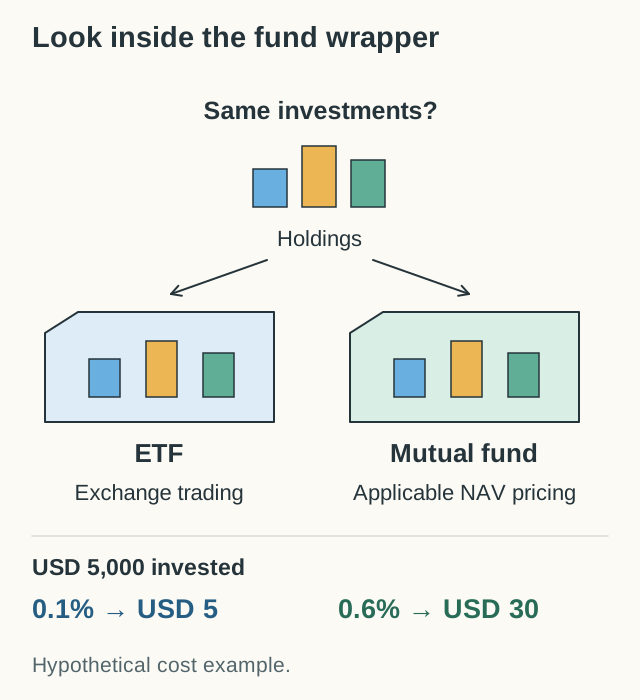
Fixed costs matter more on small amounts. Imagine two funds with the same holdings. One is an ETF at 0.10% a year. The other is a mutual fund at 0.60%. In your first year, your ETF purchases cost $8 in commissions and spreads, and the mutual fund costs nothing to buy.
So the cheaper choice depends on how much you invest and how often you trade. Our brokerage fee worksheet helps you add these up.
In the US, the SEC (the US markets regulator) says ETFs typically pay out fewer than mutual funds. These are profits a fund makes when it sells investments, and you are taxed on them. So an ETF can mean lower taxes in a taxable account. In a tax-advantaged account, such as an IRA (a US retirement account), the SEC says there is no tax difference between the two.
That is a general US guide, not a rule for every country. In Canada, the UK and Australia, tax depends on local law, your type of account and where the fund is based. Check your own country's rules before you let tax decide.
Also, tax only matters once the fund itself fits your goal. A tax benefit does not fix a fund that holds the wrong things. For the US details, read the SEC's comparison of mutual funds and ETFs.
Compare the same kind of investment first, then the costs. Imagine two made-up funds, North and South. Both say "large companies" on the label. But North holds 400 companies and South holds 30. They are not the same investment, even if one is cheaper.
| Item | North | South |
|---|---|---|
| Amount invested | $2,000 | $2,000 |
| Expense ratio | 0.15% | 0.45% |
| First-year fee | $3 | $9 |
Use this checklist for any two funds:
Then learn how to diversify a portfolio with the funds you choose.
No. Index ETFs often have low yearly fees, but some mutual funds are just as cheap and some ETFs are expensive. Spreads and commissions can also make an ETF cost more on small, frequent purchases. Compare the actual numbers.
There is no single answer, because funds that do different things cost different amounts. Compare funds that hold similar investments. Between two funds that hold the same things, the lower fee usually leaves you with more.
No. The fund takes it from its own assets a little at a time. You see it only as a slightly lower value, which is why it is easy to forget.
Yes. Both can fall in value when the investments inside them fall. A broad fund spreads your risk across many companies, but it can still drop a lot in a market crash.
10 free investing tools for beginners: calculators, fee checkers, company filings, charts, screeners, trackers and a practice app, with each tool's limits.
10 well-known dividend stocks, from Coca-Cola to Main Street Capital: their dividend records, risks and how to check them. A research list, not buy tips.