

Stocks & investing
How to Start Investing in Stocks: A Simple First Plan
Start investing in stocks step by step: give your money a job, choose what to own, check the broker, count every cost and place a first order.
Both are baskets of investments, but you buy them in different ways. Learn what happens between pressing buy and getting your price.

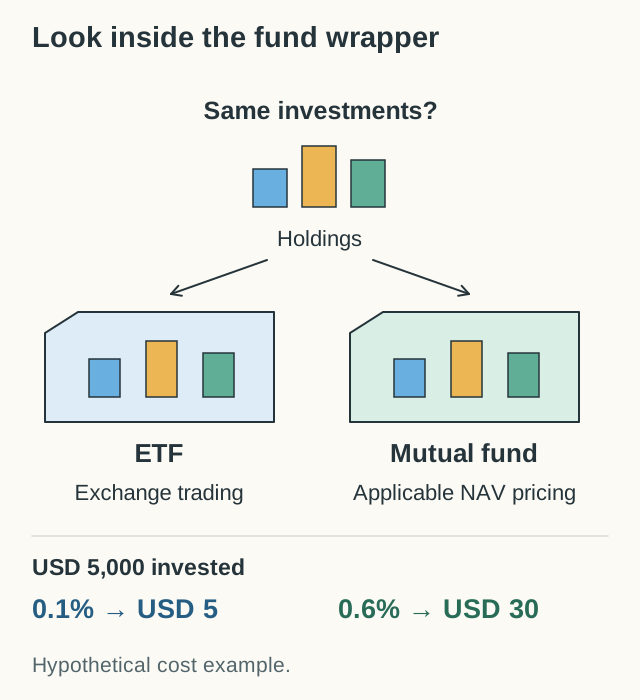
An and a can hold exactly the same investments. What differs is how you buy and sell them.
An ETF (exchange-traded fund) trades on a stock exchange, just like a share. You can buy or sell while the exchange is open. In the US, regular trading runs from 9:30 am to 4 pm New York time. The price changes from minute to minute, so you see roughly what you will pay before you click.
A mutual fund works differently. You send your order to the fund, through your broker or the fund company. The order waits. It is filled at the fund's next , its value per share, which is worked out once a day after the market closes. So you don't know your exact price when you place the order.
Other exchanges keep their own hours. See stock market opening hours for the US, Canada, the UK and Australia.
Try it yourself
Press Play to run one illustrative day of an ETF that opens at $50. Watch the high and the low appear. Then ask: which single price would a mutual fund order get?
In this illustration, the ETF opens at $50.00, dips to $49.77, climbs to $50.32 and closes at $50.20. ETF buyers that day paid anything from $49.77 to $50.32. A mutual fund order placed before the cut-off gets one price, set after the 4 pm close.
What would you expect?
What this shows: An ETF's price moves all day, so when you click matters. Every mutual fund order that day gets one price, worked out after the close.
The candle sums up the day: open, high, low and close. ETF buyers paid anything between the low and the high, depending on when they traded. A mutual fund values what it owns at the close, so all orders before the cut-off share one price.
In the US, most mutual funds work out their NAV once each business day, using prices from the 4 pm New York close. An order that arrives before the fund's cut-off gets that day's NAV. A later order gets the next business day's NAV. Some brokers set an earlier cut-off, so check yours.
The UK uses the same idea, called . Unit trusts and OEICs (open-ended investment companies) are the UK's versions of mutual funds. They deal at the price set at the next "valuation point", as the FCA's definition explains. In Canada and Australia, check each fund's documents for its .
Buying an ETF during the day comes with a small cost: the . You buy at the higher ask price and sell at the lower bid price. Some brokers also charge a commission.
Trading many times a day multiplies this cost. In a fast market, a market order can also fill at a worse price than you saw. A limit order lets you set your price.
A mutual fund has no spread, because everyone gets the NAV. But some charge a sales fee, ask for a minimum first investment, or charge a fee if you sell soon after buying. For a full cost comparison, read ETF vs mutual fund: which costs less.
For many long-term investors, the exact minute matters less than you might think. If you add money every month for years, small moves within one day mostly even out. What the fund owns, its yearly fee and tax usually matter more.
All-day trading also has a human side. Being able to sell at any minute can tempt you to react to scary news. A once-a-day price removes the minute-by-minute choice, but you can still sell in a panic.
Mutual funds have long made automatic investing easy, because you can invest an exact dollar amount. Today, some brokers also offer regular ETF purchases and fractional shares. Check what your broker offers. If you don't have one yet, our guide to stock trading apps for beginners compares some.
Before you use real money, try placing a few ETF orders in a practice account. Notice the bid, the ask and how the price moves.
You can place the order at any time, but it is filled at the next NAV, usually worked out after the close. You won't get a mid-day price.
An ETF's market price comes from buyers and sellers on the exchange, while NAV is the value of what the fund owns. The SEC notes the two can differ, sometimes by a lot. Compare them before you trade.
There is no reliable best minute. Prices can move a lot just after the open, and spreads can be wider then. A limit order lets you control the price you pay.
Some brokers offer early or late sessions, but fewer people trade then, so prices can be less stable and spreads wider. Check what your broker allows.
Start investing in stocks step by step: give your money a job, choose what to own, check the broker, count every cost and place a first order.

Market cap is share price × number of shares. See why a $5 share can belong to a bigger company than a $100 share, and how size groups and splits work.