
Stocks & investing
Fractional Shares: How They Work and What to Ask First
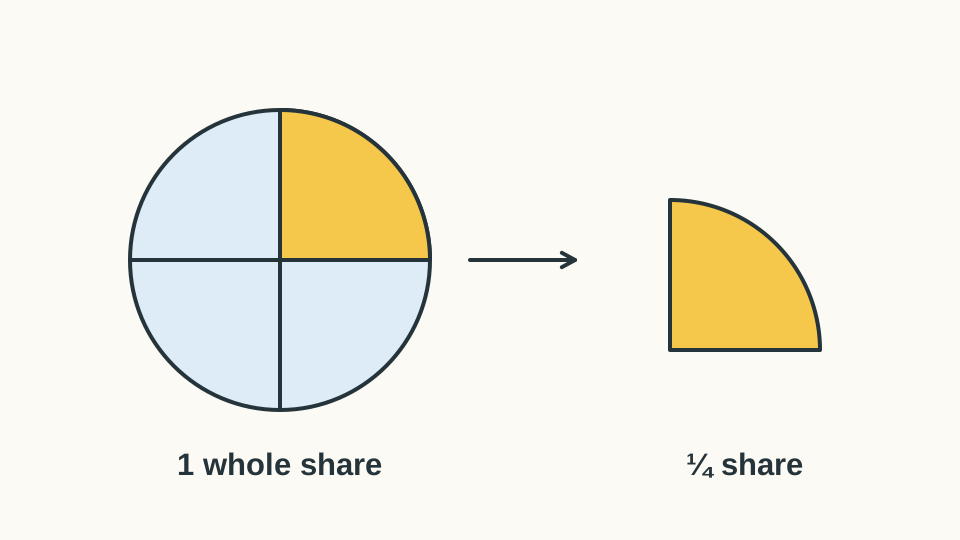
A fractional share lets $50 buy part of a $200 share. Learn how fractions move with the price, how dividends work and what to ask your broker first.
A share is a small piece of a real company. Learn what you own, why the price moves, and how to measure your real result after costs.

Shares are bought and sold on a . In the US, the biggest are the New York Stock Exchange and Nasdaq. Canada has the TSX, the UK has the London Stock Exchange and Australia has the ASX.
When you buy a share on an exchange, you usually buy it from another investor. Your money goes to that seller, not to the company. A company only gets the money when it sells new shares, for example when it first lists on an exchange.
The price is simply the last price at which a buyer and a seller agreed. Each of them is guessing about the company's future profits. So the price already includes what people expect.
This explains something that surprises many beginners. A company can report higher profits and still see its share price fall. That happens when investors had expected even better results.
Try it yourself
Read each news card about River Foods, a made-up company with a $20 share. Pick up, down or not sure, then watch what happens.
In these examples, a $20 share fell to $18.80 when 10% profit growth missed hopes of 25%. A $26 takeover offer lifted it to $25.50. A market-wide scare pulled it to $18.60.
What would you expect?
What this shows: A share price is a guess about the future. When news beats or misses what buyers expected, the price moves, even on good news.
The price is just where buyers and sellers last agreed. It already includes what they expect, so surprises move it most. A scare about the whole market can pull good companies down too.
A trading app shows more than one price for each share. Imagine a quote for a share with a last trade at $20.
| Price shown | Example | What it means for you |
|---|---|---|
| Last | $20.00 | The price of the most recent trade |
| $19.98 | About what you would get if you sold now | |
| $20.02 | About what you would pay if you bought now | |
| $0.04 | The gap between bid and ask: a cost to you |
The bid is the best price a buyer is offering right now. The ask is the lowest price a seller will accept. The gap between them is the spread. If you bought at $20.02 and sold a second later at $19.98, you would lose 4 cents per share.
A buys or sells at the best price available now, which may differ from the last trade. A sets the worst price you accept, but it may never fill. Read the SEC's order types or our lesson on market, limit and stop orders.
You can gain in two ways. The price can rise above what you paid, and the company may pay dividends. Your real result adds both, then takes away your costs.
The last ending shows an important point. A dividend does not cancel a bigger fall in the price. Always look at the whole result, not just the income.
Taxes can also change your result. The rules depend on your country and your type of account, so check them before you compare returns.
If you own one company, your money depends on that one business. Owning several companies spreads this risk. One company's bad year then hurts less.
But owning more shares does not stop all losses. When the whole stock market falls, most shares fall together. Ten companies in the same industry can also share the same problems. And two funds can secretly own the same big companies.
Your home currency matters too. A Canadian who owns US shares sees two changes in Canadian dollars: the share price and the . Read more in currency risk for Canadian investors.
Learn how to spread money well in how to diversify a portfolio. Funds that hold many companies are explained in ETF vs mutual fund.
A price chart shows what happened in the past. Research into a business shows how it earns money. Neither one can tell you the future for sure.
Be careful with fast price gains, excited social media posts and one-word labels like "buy". None of them is a plan.
Next, see why a cheap share is not a small company in what is market capitalization. Then build a first investment plan. To practise first, compare free stock market simulators.
In everyday English, yes. "Stock" often means shares in general, and "a share" is one unit of ownership in one company.
There is no fixed amount. Some brokers sell parts of a share, so a small sum can buy a slice. Fixed fees hurt small amounts more, and you should only invest money you will not need soon.
No, but both are risky. A share is part of a real business that can earn profits and pay dividends. Still, prices can fall a lot and companies can fail. Spreading your money and holding for years lowers some risks. It does not remove them.
No. Many companies keep their profit to grow the business. When a company does pay a dividend, it can still cut or stop it later.
A fractional share lets $50 buy part of a $200 share. Learn how fractions move with the price, how dividends work and what to ask your broker first.

Zero commission is not zero cost. Learn every fee a broker can charge, from spreads to currency conversion, and work out the total for your own habits.