
Stocks & investing
Fractional Shares: How They Work and What to Ask First
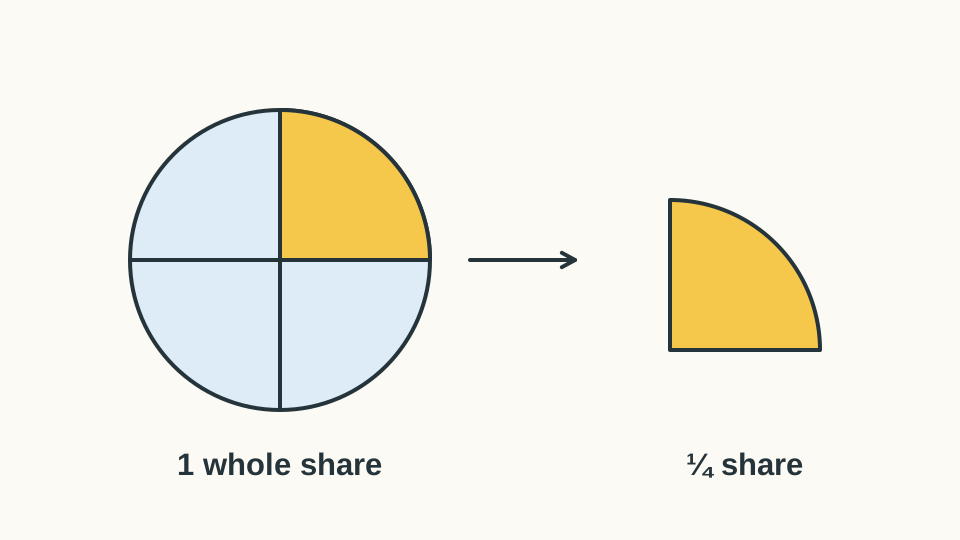
A fractional share lets $50 buy part of a $200 share. Learn how fractions move with the price, how dividends work and what to ask your broker first.
This free course takes you from 'what is a share?' to a written plan in six short modules. Each one ends with a task, so you know you have really learned it.

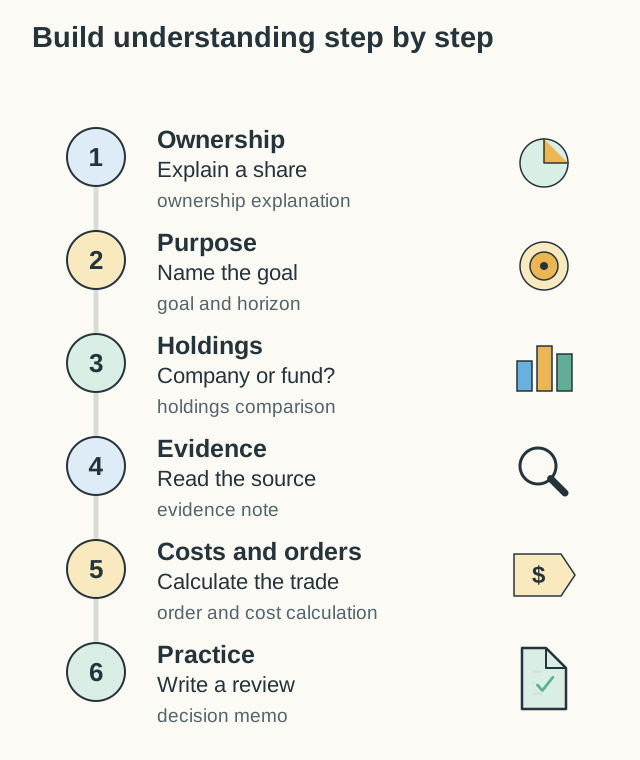
Six modules: ownership, goals, companies and funds, company reports, order costs, and practice.
This free course is a reading list with tasks. Work through it at your own pace with a notebook. It covers long-term investing and short-term trading, but you do not need to trade often to invest. By the end, you should be able to explain a decision, work out its costs and see what you don't know.
Start with stock market basics. A is a small piece of ownership in a company. Explain in your own words how owning a share differs from owning a fund, and from keeping cash in a bank.
When you buy a share on a stock exchange, your money usually goes to another investor who is selling, not to the company. The company raised its money when it first sold those shares.

Use the first investment plan to choose a made-up goal, a and a monthly amount you could afford. Then describe a situation where you might need the cash sooner than planned. This is practice, not an instruction to open an account today.
Read the SEC's guide to asset allocation. It explains why a mix of investments that suits one goal can be wrong for another. Your task: write two or three sentences on which losses your plan could survive, and which it could not.
How long you stay invested matters too, not just how much you put in. The tool below shows how growth builds up over the years, using an assumed 6% yearly return. Actual returns jump around and can be negative for years at a time. Inflation also cuts what your money will buy.
Try it yourself
Look at 20 years of saving $100 a month at an assumed 6% a year. See how the growth part of each bar gets bigger. Then press 'Start 10 years earlier'.
$100 a month at an assumed 6% a year, added monthly: after 20 years you have put in $24,000 and the total is about $46,204. After 30 years you have put in $36,000 and the total is about $100,452.
What would you expect?
What this shows: Starting earlier matters a lot. Saving $100 a month for 30 years instead of 20 adds only $12,000 of deposits but more than doubles the result.
At an assumed 6% a year, added monthly, $24,000 saved over 20 years grows to about $46,204. Over 30 years, $36,000 grows to about $100,452. Actual returns are not steady, and inflation shrinks what money buys.
Study market capitalization, which measures a company's size on the stock market. Then fill in a small worksheet for one company and one broad fund:
A fund is not automatically safer in every way. A narrow fund can still put most of your money into one industry. A broad fund still falls when the whole market falls.
The point of this module is to describe what you own before you talk about returns. Your task: write one sentence for each that starts, 'I would lose money if...'
Go to the source. US companies file their reports on SEC EDGAR. For Canadian companies, the CSA's national systems page explains where to find filings on SEDAR+. In each report, read three parts: the business description, the risks and the cash flow statement.
Write down the period each number covers. That way you won't compare a full year with a single quarter by mistake. Check the report's date too, because an old report can describe a business that has since changed.
Your task: write one claim that the report supports, and one question it leaves open. A report can name a risk without saying when it might happen. And a forecast in management's comments is not a result.
Work out every trade before you place it. Say a practice account holds $500. The , the lowest price a seller will accept right now, is $24.90, and the commission to buy is $2.
Twenty shares cost $498, plus $2, which uses all $500. If the price rises to $25 before your order fills, the same order costs $502 and no longer fits.
Now compare a market order with a at $24.90, using the SEC's order definitions. Explain why a limit order controls your price but may not fill. An order preview is not a promise of the price you will get. Remember the hidden costs as well: the gap between the buying and selling price, and currency conversion if you buy shares priced in another currency. To go deeper, read market, limit and stop orders.
| Skill | You can show it if you can... |
|---|---|
| Ownership | Describe what you own and your rights |
| Risk | Explain a realistic loss and how it affects your goal |
| Costs | Work out buying, selling and currency costs |
| Orders | Explain price control versus the risk of no fill |
| Research | Find a dated company report |
A practice portfolio lets you check orders, follow dividends and compare results with your original reasons. Use virtual money, but keep the balance close to what you might really invest, and add made-up fees.
Keep the losing trades in your record. Don't reset the account after a bad week, and don't count only the winners. A practice profit is not a qualification. A simulator may also differ from your broker's real prices, costs and rules. To pick one, see our stock market simulators guide.
Write each trade into a paper trading journal: what you planned, what happened and what you learned. Your task: complete five practice trades and review them. Before the first one, find three screens in your practice app: your cash, your open orders and your positions.
Take a made-up $1,000 portfolio. On one page, write your goal, how you would split the money, your evidence, the costs, the risks and a date to review it.
Repeat any module you can't explain clearly. If you want to try another course too, read our guide to finding a good free stock trading course. Ask any course for its syllabus, how it tests you, which country's rules it covers and how it makes money. A certificate, a leaderboard or a dramatic success story does not prove that someone can invest.
Yes, the basics. Regulators, universities and practice apps offer free lessons on how shares, funds, orders and costs work. What no course can give you is certainty. Practise with virtual money first, and expect real results to differ.
Many people can read one module in an evening, but take as long as you need. Move on only when you can answer the task in your own words. Repeating a module is part of the course, not a failure.
No. You need a web browser and a notebook. For Modules 5 and 6, a free practice app or simulator helps you try orders with virtual money.
No course can promise that. This one teaches you to explain a decision, work out its costs and spot what you don't know. Those skills help you avoid costly mistakes, but markets can still move against you.
A fractional share lets $50 buy part of a $200 share. Learn how fractions move with the price, how dividends work and what to ask your broker first.

ETF or mutual fund? Compare yearly fees, trading costs, sales charges and minimums, and see what a 0.10% vs 0.80% fee does over 30 years.