

Forex
Best Forex Brokers for Beginners: Compare by Country
Compare 8 brokers and apps for forex in the US, Canada, UK, EU and Australia: who each one suits, real costs, regulators and risks, plus a shortlist tool.
Headlines about broker bosses' pay often mix salary, share awards and personal wealth. Learn to separate them, and why none of it tells you if a broker is safe for you.

Salary, bonus, share awards, dividends and personal wealth are different numbers. Do not add them up.
In 2017, this page compared the pay of the bosses of big forex and CFD brokers. It named Asaf Elimelech of Plus500, Peter Hetherington of IG Group and Peter Cruddas, the founder of CMC Markets. All 3 companies were listed on the London Stock Exchange and published annual reports.
It also mentioned Brendan Callan of FXCM and Yoni Assia of eToro, but gave no published pay figures for them. These are the roles people held in 2017. They are not a claim about who holds each job today.
That comparison put very different numbers in one league table: salaries, a bonus, a and an estimate of personal wealth. That makes a ranking look exact when it is not.
Pay is still worth understanding. How a company rewards its bosses can shape its priorities. You just need to read the numbers carefully, one line at a time.





A CEO's pay can come in several parts. They are paid at different times, under different rules, and some may never be paid at all.
| Item | What it is | Common mistake |
|---|---|---|
| Fixed pay for the year | Calling it the whole package | |
| Annual bonus | Extra pay for hitting targets, sometimes partly delayed | Ignoring the delay or the conditions |
| Share award | Shares or options that may be received later, if conditions are met | Treating the value at grant as cash received |
| Payments on shares the person already owns | Adding them to salary without saying so | |
| Personal wealth | An estimate of everything owned, minus debts | Treating wealth as a year's earnings |
| of the company | Share price times the number of shares | Comparing companies by share price alone |
The words used in a pay report matter. A share award can be granted, vested or exercised. Granted means promised. Vested means the conditions were met. Exercised means the shares were actually taken. These are not the same thing.
Also check the units. Many reports show figures in thousands, so "575" can mean 575,000.
Try it yourself
Drag each item, or tap it and then tap a bin: cash pay for the year, maybe later, or not pay at all.
Cash pay for the year: a £500,000 salary and a £300,000 cash bonus. Maybe later: £700,000 of share options at grant value, and shares tied to profit targets. Not pay: £200,000 of dividends on owned shares, personal wealth and the company's market value.
What would you expect?
What this shows: A headline pay figure can mix cash, maybe-later share awards and wealth. Separate them first, and remember none of it shows how customers are treated.
Salary and cash bonus are pay for the year. Share awards depend on future conditions and prices. Dividends, wealth and company value are not pay at all.
IG Group's 2017 annual report has a detailed pay section. One table lists awards made in the year to 31 May 2017. It shows options valued at £2,061,739 awarded to P G Hetherington, for performance up to 31 May 2016.
The report describes them as nil-cost options with conditions still attached. So this is the value of an award when it was made. It is not his cash salary, his cash bonus or what he took home in 2017.
Notice the dates. IG's financial year ended in May, not December. A report published in 2017 can describe awards linked to an earlier year. If you copy the number without its dates and conditions, you change what it means.
For the other companies, start with the source. Plus500 and CMC Markets keep their older annual reports on the investor pages of their websites. The links are in the sources below. A news story can help you find a claim, but the report table and its notes tell you what was measured.
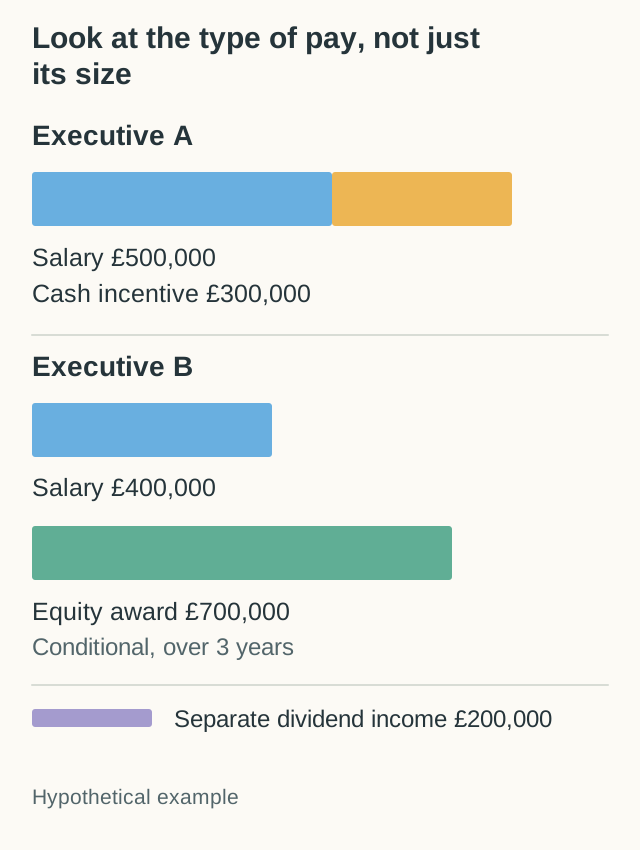
Compare one line at a time. Here is a made-up example:
A gets more cash now. B has the bigger headline total, £1.1 million. But neither fact tells you who will end up with more. B's shares could be worth much more, or nothing, by the time they vest.
Now say B also owns shares that pay £200,000 in dividends. That is income from owning shares, like any shareholder gets. It needs its own label. Adding it to pay would make a salary comparison misleading.
Before comparing, write down each person's role, the date the financial year ended and the currency. If a report has no matching figure, leave the cell empty and explain why. An empty cell is more honest than a total of unlike numbers.
No. Pay tells you about the company's choices, not about how it treats customers. A big package does not prove a broker is good, bad or safe.
Here is a real reminder from the same year. In February 2017, the CFTC, a US regulator, said FXCM had misled retail forex customers. It found that FXCM hid its ties to a that took the other side of most of its customers' trades. FXCM and its founders were ordered to pay a $7 million penalty. They also agreed to give up their CFTC registration.
If you read a pay report, look at what the bonus rewards. Are bosses paid for lasting results, fair treatment of customers and risk control? Or mainly for short-term growth?
It depends on what you count. Salary, bonus, share awards and dividends are different things, and the companies' financial years ended in different months. Compare like with like, from each company's annual report, before you rank anyone.
Listed companies publish it in their annual report. In the UK this section is called the directors' remuneration report. Read the single total figure table and the notes under it.
Not by itself. Size and pay do not show how customers are treated. Check the firm's licence where you live, how it holds client money and its regulatory history.
Compare 8 brokers and apps for forex in the US, Canada, UK, EU and Australia: who each one suits, real costs, regulators and risks, plus a shortlist tool.

Compare ten forex, learning and market apps. See which handle real currency trades, which offer virtual practice, and where eToro, GoForex and Trading Game fit.