

This is the same English book as our main Forex PDF page.
What’s inside the Forex PDF?
- The vocabulary: currency pairs, pips, spread and leverage.
- The trading day: market sessions and trading hours.
- Reading a chart: line, bar and candlestick charts, trends and multiple time frames.
- What moves currencies: inflation, interest rates, trade, politics and other market influences.
- Strategy examples: support and resistance, pin bars and the double-red setup, with illustrations to study.
- Putting ideas together: currency and commodity relationships, a glossary and trading tips to examine critically.
You do not need to know the jargon before you begin. Use the illustrations to connect a term to an example, then check your understanding with the exercise below. Strategy examples describe approaches to study, not a promise that they will make money.
Use a PDF as a workbook
After reading a forex PDF chapter, which task best tests understanding?
- Highlight every paragraph without explaining it
- Explain the quote units and calculate an invented price move with costs
- Assume a downloaded guide is always current
Answer and explanation
- Highlight every paragraph without explaining it
Highlighting can help navigation, but does not demonstrate understanding by itself.
- Explain the quote units and calculate an invented price move with costs
Correct. Reconstructing the example reveals whether the mechanics make sense.
- Assume a downloaded guide is always current
A PDF can preserve outdated product, platform or legal details.
Your answers stay on this page.
Make your first reading session useful
- Read a quote. Start with currency pairs and explain which currency measures the other.
- Find the costs. Label bid, ask and spread on a fictional quote.
- Try a calculation. Work out how a price change affects a position before introducing leverage.
Try it: follow the money in a currency pair
Suppose a fictional EUR 1,000 position is opened at EUR/USD 1.1000 and closed at 1.0900. Its value changes from USD 1,100 to USD 1,090: a USD 10 loss before costs. Under the 0.0001 pip convention used here for EUR/USD, the 0.0100 move is 100 pips.
What changes if the position is EUR 10,000?
The same price move produces a USD 100 loss before costs. The position is ten times larger. Now reverse the price movement and calculate the favourable result, remembering that costs still apply.
Use the free PDF as a small practice workbook
Downloading a book is the easy part. Getting comfortable with its ideas takes a few worked examples. This page is for the reader who wants a practical way to use the illustrated Forex book: open the PDF, keep one page beside your notes and leave each session with something you can explain. You do not need a funded account to do any of this.
First session: label the currencies and the prices
Open pages 6 to 9, which cover pips, spread, currency pairs, leverage and margin. Copy a made-up quote into your notebook: EUR/USD 1.1000 / 1.1002. Under EUR write “base”; under USD write “quote”. Then write the meaning in a sentence: the prices are US dollars per euro. Circle the ask, 1.1002, as the purchase price in this example. Underline the bid, 1.1000, as the sale price. CME Group’s quote-convention lesson provides a useful reference.
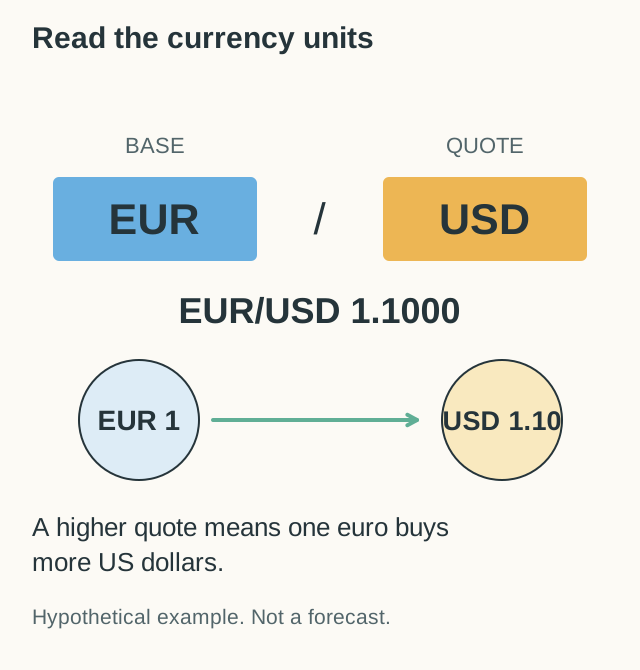
Now ask why there are two prices. If you bought 1,000 euros at 1.1002 and immediately sold at an unchanged bid of 1.1000, the difference would be a loss of 0.20 USD before other costs. The 0.0002 price gap is two pips for this pair. Increasing the position to 10,000 euros would increase that same gap to 2 USD. The lesson is about the relationship between price, cost and size, rather than selecting an amount to trade.

Second session: describe a chart without predicting it
Read the chart overview on page 14 and the trend and time-frame pages 24 to 26. Draw a candle with an opening price of 1.1000, a high of 1.1030, a low of 1.0990 and a close of 1.1020. Its body connects open and close; the wicks reach the high and low. These invented values tell you the interval’s range, but not the exact order of every price within it.
Give the candle a time frame. If it represents one hour, explain what information you would need to compare it with a daily chart. Then write two descriptions: one for the visible movement and one for an unanswered question. “The close is above the open” is an observation. “The next candle will rise” is a prediction that the drawing cannot establish.
Third session: give a strategy example a fair test
Pages 21 to 23 introduce support and resistance, a pin-bar example and the double-red setup. Choose one illustration. State the condition you think it shows before revealing later prices. Mark the point where that interpretation would no longer make sense. Include an example where the apparent setup fails, and record whether you changed your rule after seeing the result.
The macroeconomic pages 17 to 20 offer another exercise: choose one factor, such as interest rates, and list what you would need to know about both currencies. A headline alone is not a complete explanation. The commodity examples on page 27 also invite questions about when a relationship might change. Your notes should preserve those uncertainties.
Try this part
Which side of the pair?
Match the currency role to its meaning. Then translate EUR/USD 1.10 into words.
- Base currency
- The first currency in the pair, whose one-unit price is being quoted.
- Quote currency
- The second currency, in which the first currency’s price is expressed.
- Reciprocal quote
- The reversed price: divide one by the original quote and reverse the currency units.
Keep a simple record of each calculation
Use six fields: pair, direction, units, entry price, exit price and costs. For a hypothetical purchase of 1,000 EUR at 1.1002 followed by a sale at 1.1032, the gross result is 1,000 × 0.0030 = 3 USD. At a sale price of 1.0972 it is −3 USD. The spread is already reflected when actual ask and bid execution prices are used. Do not subtract it a second time. Any separate charges still need their own line.
One standard EUR/USD pip is usually 0.0001; the fifth decimal can be a meaningful fractional pip. OANDA Canada explains pips and fractional pips. Add the result’s currency to your record, particularly if your account uses a different currency.
Practical questions about using the book
Is this a different English edition?
This page links to the same Finance Illustrated English Forex book. Its purpose is to help you practise with that book, not to suggest that a second title means a new factual edition.
Can I read it on my phone?
Save the free English PDF and use your PDF reader’s zoom for charts. If a full page feels cramped, read the text first and revisit the illustration in landscape orientation. Keep calculations in a separate note so you can see your assumptions.
How long should a study session take?
Choose one task, such as explaining a quote or drawing a candle, and stop when you can repeat it without copying. Your pace matters more than completing a page quota. Return to a difficult example with different numbers to check that the method still makes sense.
What makes a useful practice journal?
Record the rule before the outcome, retain mistakes and write what you would check next. A journal of only successful examples hides the information you most need for learning. A simulated result is evidence of that exercise, not proof of future trading performance.
Keep learning after the book
Follow the Forex learning path for short lessons, explore our Forex app guide, or visit GoForex for another way to study. You can practice the calculations on paper without funding a trading account.
Looking for a translation? Find the available editions in our language library.
Read with your book
These notes correct parts of the book. Page numbers count the cover as page 1.
6 · Pips and cash value
A pip usually means 0.0001 in a currency quote, or 0.01 for yen quotes. A fifth decimal can represent a real fractional pip. Cash value depends on position size and quote currency: 1,000 EUR/USD units moving one pip change gross value by $0.10, not a fixed dollar amount for every USD pair.
6 · Leverage and location
The 2:1 to 30:1 passage describes the EU retail CFD intervention introduced in 2018. It is not a worldwide forex rule. Check your jurisdiction, product and account classification. Leverage magnifies losses as well as gains.
5 · Copying is still an investment decision
Copying a trader does not guarantee learning or profit. Past returns and a risk score cannot cap future losses; fees, execution differences and the copied positions still matter.
3, 15 · Dated broker comparisons
The book refers to a 2020 broker comparison. Its rankings, minimum deposits, loss percentages and platform terms are old examples. Check each broker’s current terms before you rely on them.
15 · A deposit does not set risk and reward
The claim that at least $300 produces an optimum risk to reward ratio is unsupported. Depositing more money does not set that ratio. Position size, price changes, planned exits, execution and costs determine the result.