

Stocks & investing
How to Start Investing in Stocks: A Simple First Plan
Start investing in stocks step by step: give your money a job, choose what to own, check the broker, count every cost and place a first order.
Both have an interactive school and virtual trading. Look at what you can try after a lesson, how the feedback helps, and what is included before paying.

Consider Trading Game for visual courses connected to annotated chart examples, teaching-focused AI and review. Consider Three Investeers for its interactive school, $100,000 virtual portfolio and chart-based game activities.
Try Trading Game · Visit Three Investeers
Trading Game is made by our team.
Trading Game links a short visual explanation to a prediction, virtual practice and feedback. Copy to Chart carries an annotated example into the practice chart. Max explains concepts and prompts reflection, while saved academy progress gives the next session a clear start. Its familiar, popular indicators are selected deliberately and taught with strategies for applying them, instead of leaving you to interpret a growing collection of lines.
Three Investeers also teaches. Its developer listing describes an interactive school, line and candlestick charts, leverage and a weekly leaderboard; the changelog mentions a Pattern Sniper quiz. Compare the explanation and practice you want, rather than assuming that one product has lessons and the other does not.
Trading Game’s trading, ETF and personal-finance courses are complemented by more than 20 visual Quick Reads on trading, investing, habits, psychology and market history. An idea from a different author can become a question to examine in your own practice.
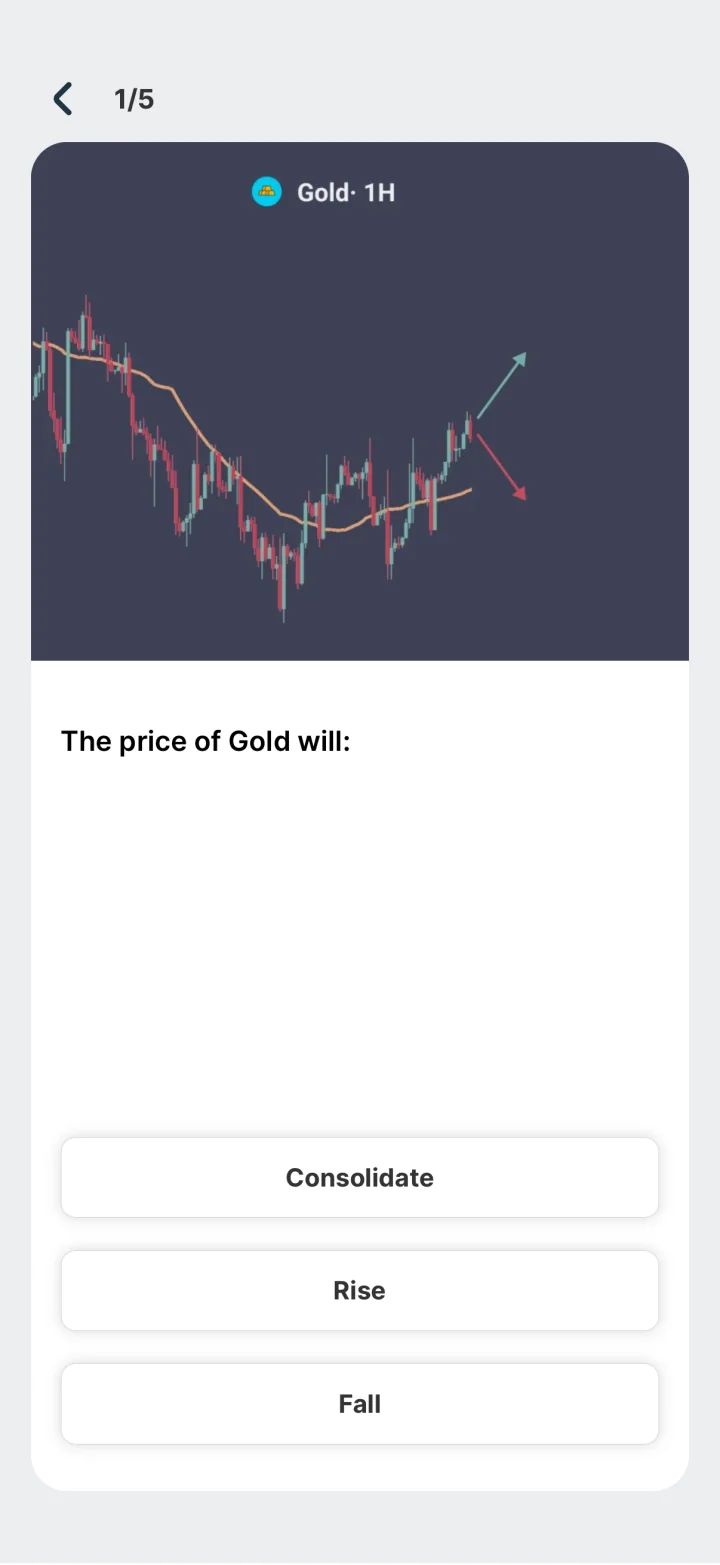
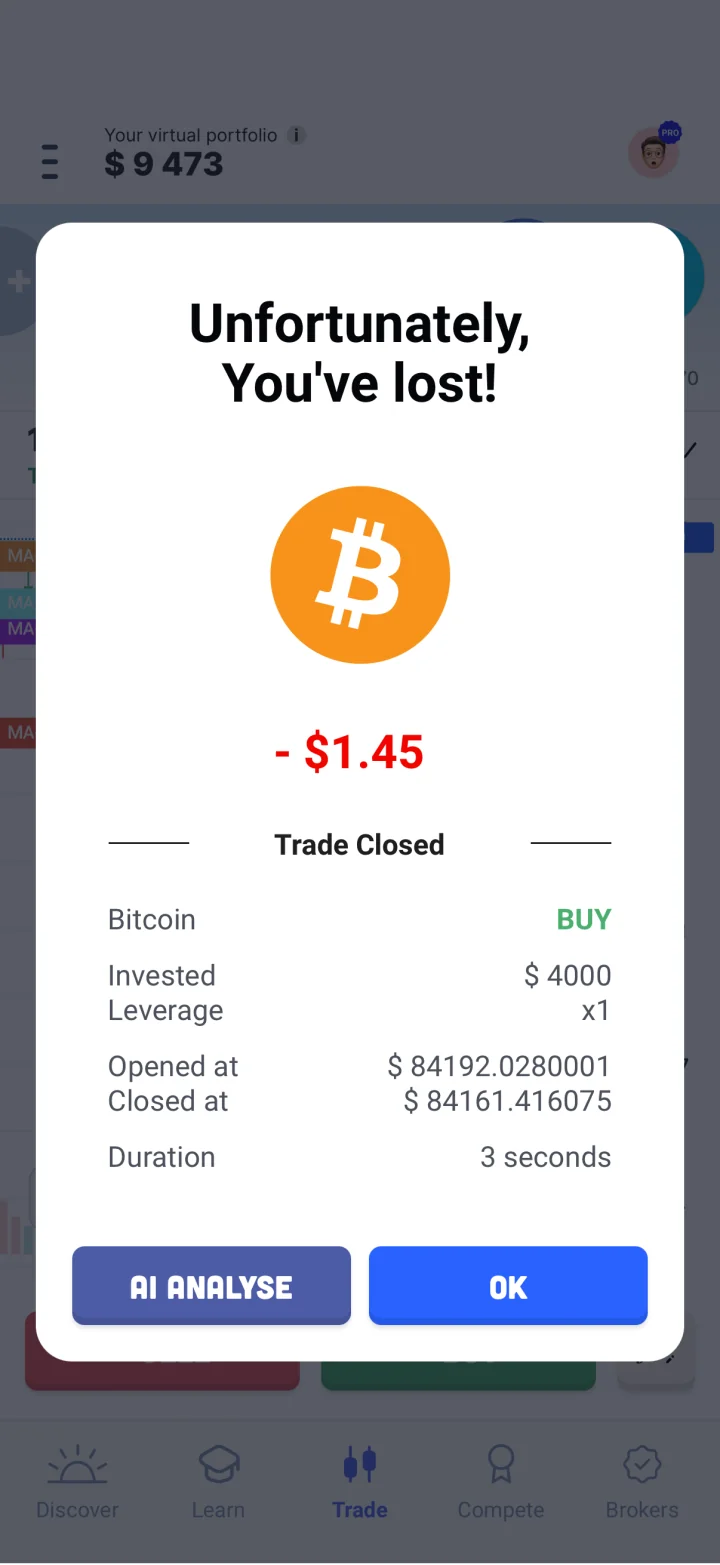
Trading Game screens captured in October 2026. Market values are illustrative; feature access can depend on the plan and app version.
Predict what happens if you double a position while its price move stays the same. Then inspect the virtual result and explain it. Trading Game shows losses with position size, stop-loss and take-profit settings. Three Investeers also lists stop losses and a real-time simulator. Either can supply a useful exposure exercise.
Trading Game’s beta analyser considers whether a chart has a setup and can advise waiting or no trade. When it presents entry and exit scenarios, examine the reasoning; analysis can be wrong. Its 10 timeframes run from 15-second candles to a monthly view. Composite prices refresh several times per second, independently of the candle interval. Use a longer view to check the context of a quick move, and light or dark mode for readability.
For a different pace, free ten-minute one-to-one battles let you compete with friends, AI or other traders. Review the choices after the match; the score and the explanation answer different questions.
Try it yourself
Sort these changes by whether they alter the position or only how you view a result.
Double the number of shares in the same trade: Changes the position’s exposure. With the same price move, twice the shares produces twice the gross gain or loss. Show the same result on a leaderboard: Changes the view or game context. A ranking displays a comparison; it does not change the position. Increase leverage while keeping deposited practice margin fixed: Changes the position’s exposure. More leverage increases the exposure supported by that margin. Switch a result from dollars to percentages: Changes the view or game context. The display changes, but the underlying position does not.
What would you expect?
What this shows: Position size and leverage affect exposure. A display or ranking can change how you perceive it.
Three Investeers advertises $100,000 of virtual money. Trading Game starts at $10,000 and permits lower budgets, including $200 or $500. A $250 position is half of $500 but 0.25% of $100,000. Use the amount that makes the decision relevant to you. Extra zeroes can make a mistake look surprisingly polite.
Three Investeers describes basics and learning materials as free with optional premium access. Its US and Canadian developer listings show different currencies and multiple purchase offers. Inspect the current local price, renewal period and included features.
Trading Game’s Free offering includes the simulator, chart tools, AI analysis, fundamental lessons and quizzes, battles and one featured Quick Read monthly. Max has limited weekly access, and Copy to Chart has two free uses. Pro adds the full coach, advanced courses, the full book-summary library and unlimited Copy to Chart. Those limits let you compare a concrete offer rather than a vague “free to start”.
Try one concept and keep the prediction beside the result. After the session, explain what changed your mind. If you can only report a bigger balance, revisit the reasoning before adding complexity.
Compare TradingView for a more extensible chart workspace, or the full simulator list for broker and classroom alternatives.
Competitor information checked 21 October 2026. Trading Game features and access reviewed 22 October 2026 using its current pricing information and owner-confirmed product details. We did not test order execution or measure comparative learning outcomes.
Yes. Its official site describes an interactive school and learning materials, and its developer listing describes chart activities.
No. Listings can use different currencies, offers and purchase options. Check the current price and renewal terms on your device.
No. Lessons and simulated results do not establish profitable real-money performance. Assess what you understand, and review the rules behind every practice result.
Start investing in stocks step by step: give your money a job, choose what to own, check the broker, count every cost and place a first order.

Market cap is share price × number of shares. See why a $5 share can belong to a bigger company than a $100 share, and how size groups and splits work.