
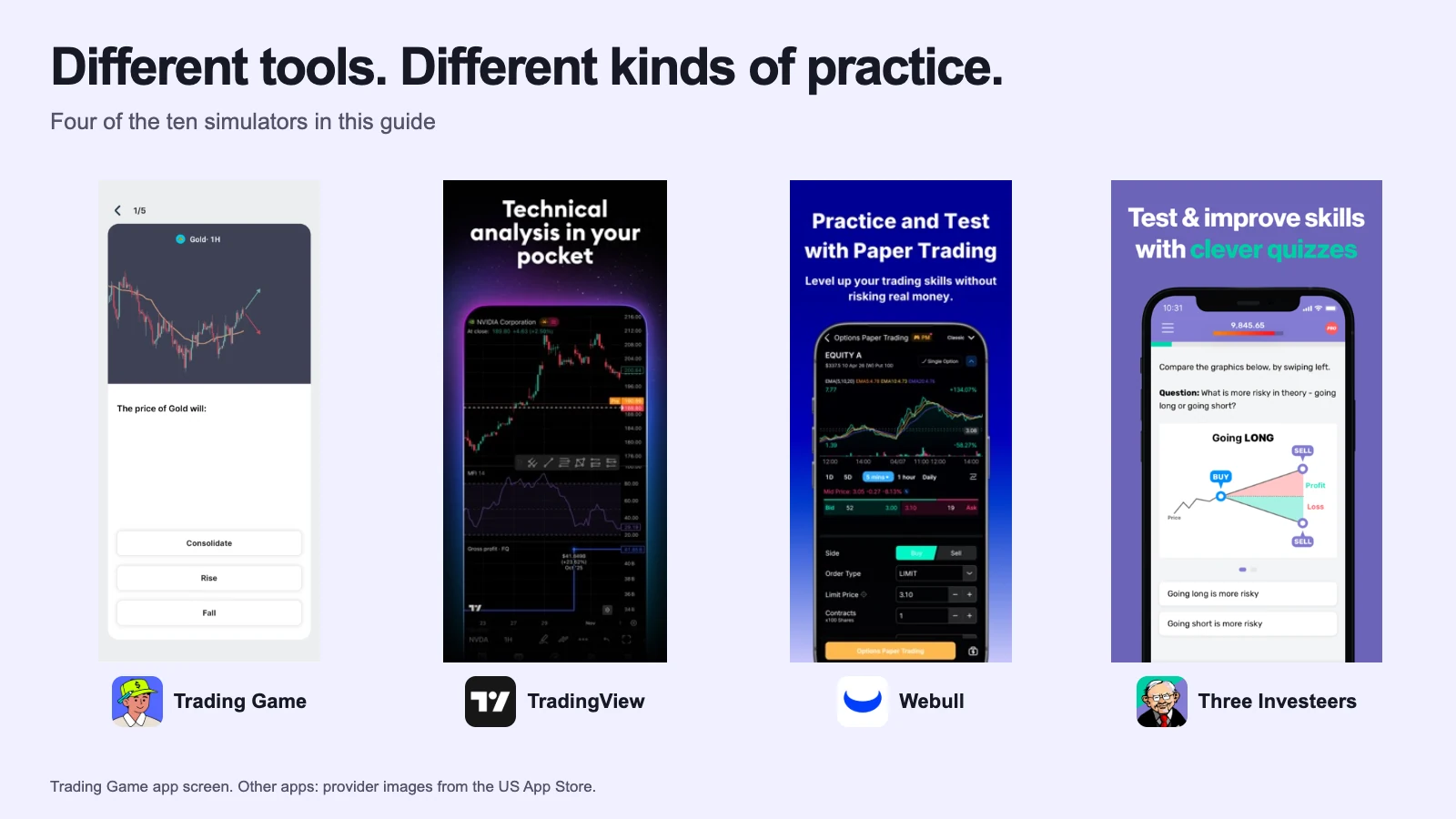
Stocks & investing
Best Stock Market Simulators (2026): 10 Compared
Ten stock market simulators compared on starting money, live or delayed prices, lessons, feedback, broker tickets and class tools, with the best fit for each.
Wall Street Survivor is a free browser contest with prizes and a delayed screen. Trading Game is a game wired to a coach. Which you want depends on whether you are after a rank or a skill.
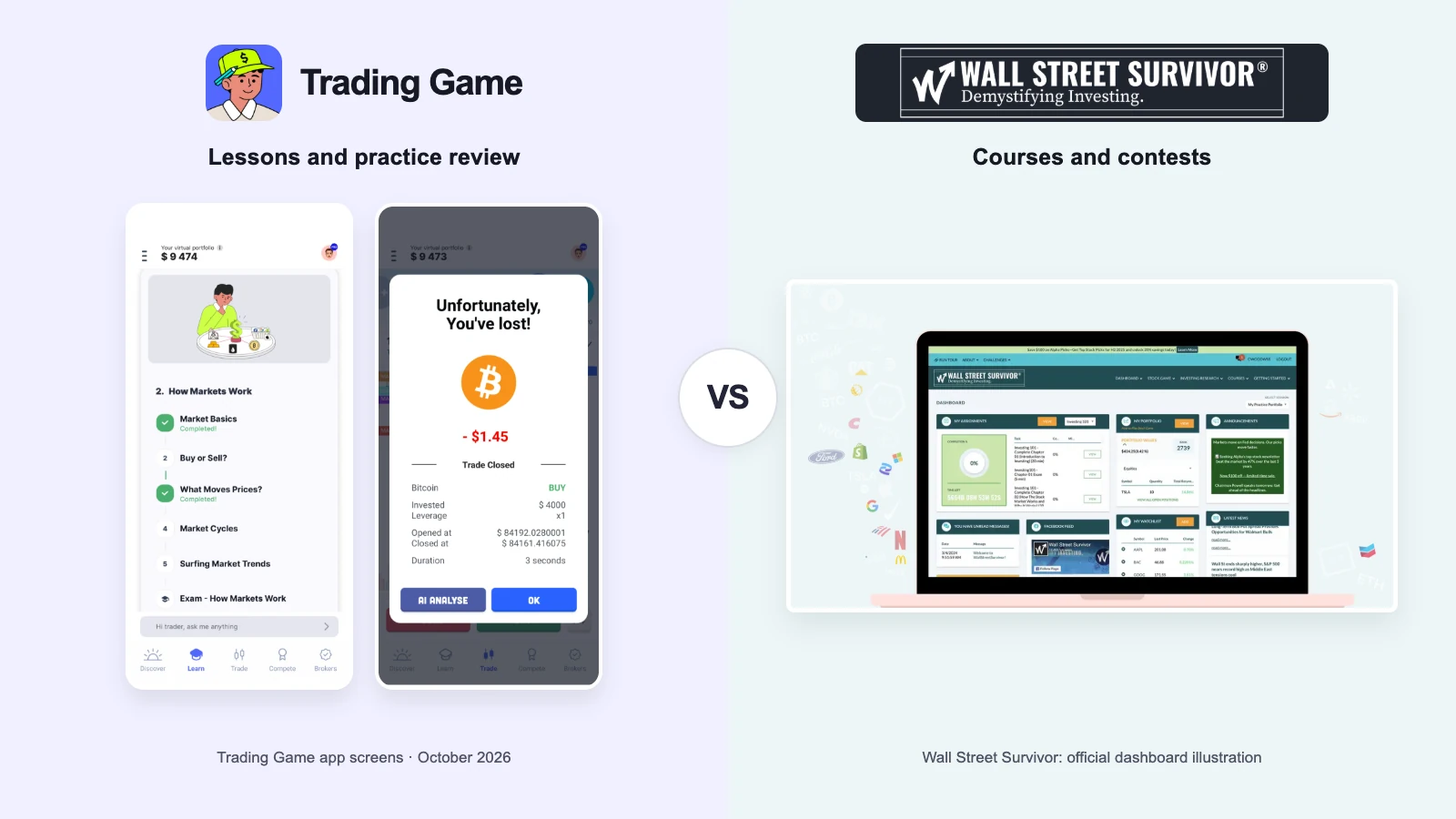
Wall Street Survivor fits a web player who wants options, shorting, free courses and a shot at a prize.
Wall Street Survivor is a free browser game with a real brokerage-style ticket, 36 short courses, and monthly contests that pay actual prizes. If you are an adult in the US or Canada and you want to practise options or short selling for nothing, with a chance at a gift card, it does that. It is the open-to-everyone version of HowTheMarketWorks, from the same company.
Two things to know first. The banner says real-time data, and that is true of the fill, not of the quote on your screen, which the footer puts fifteen to twenty minutes behind. And WSS is a game in the leaderboard sense: it ranks you, it does not teach you why you are where you are. If you want to get better rather than get ranked, Trading Game is the better start.
Trading Game is also a game, and a more deliberate one. Live prices, ten-minute battles against real people, a weekly leaderboard, a timed daily pattern quiz. But every piece of it is wired to a lesson, an analyst's example or a coach, so the game is the way in, not the point.
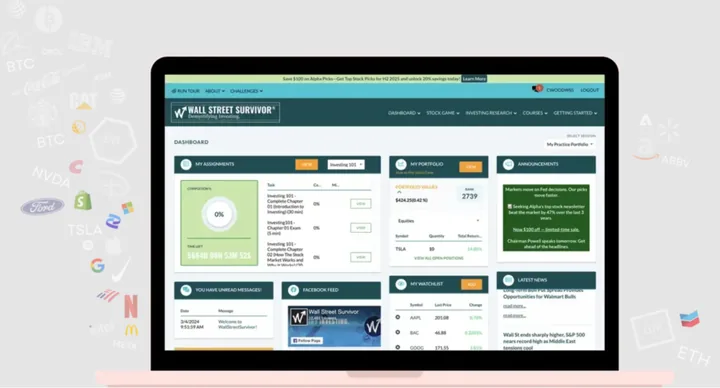
Wall Street Survivor. You sign up on the website and land in a dashboard: assignments, holdings, a watchlist, news, and an announcements box that, in the dashboard we saw, was advertising a paid newsletter. You have $100,000. The ticket takes market, limit and stop orders in whole shares; short selling and margin depend on the contest. Place a limit order and it may sit pending, because the price has not reached it, or because the market is shut, or because WSS holds any order over half the available volume. The quote you were looking at was fifteen minutes old. The courses are worth a look even if you never trade here: 36 short ones in four groups, from Investing Basics to Personal Finance, plus a ten-chapter starter. Log in at least every 90 days or the account goes stale.
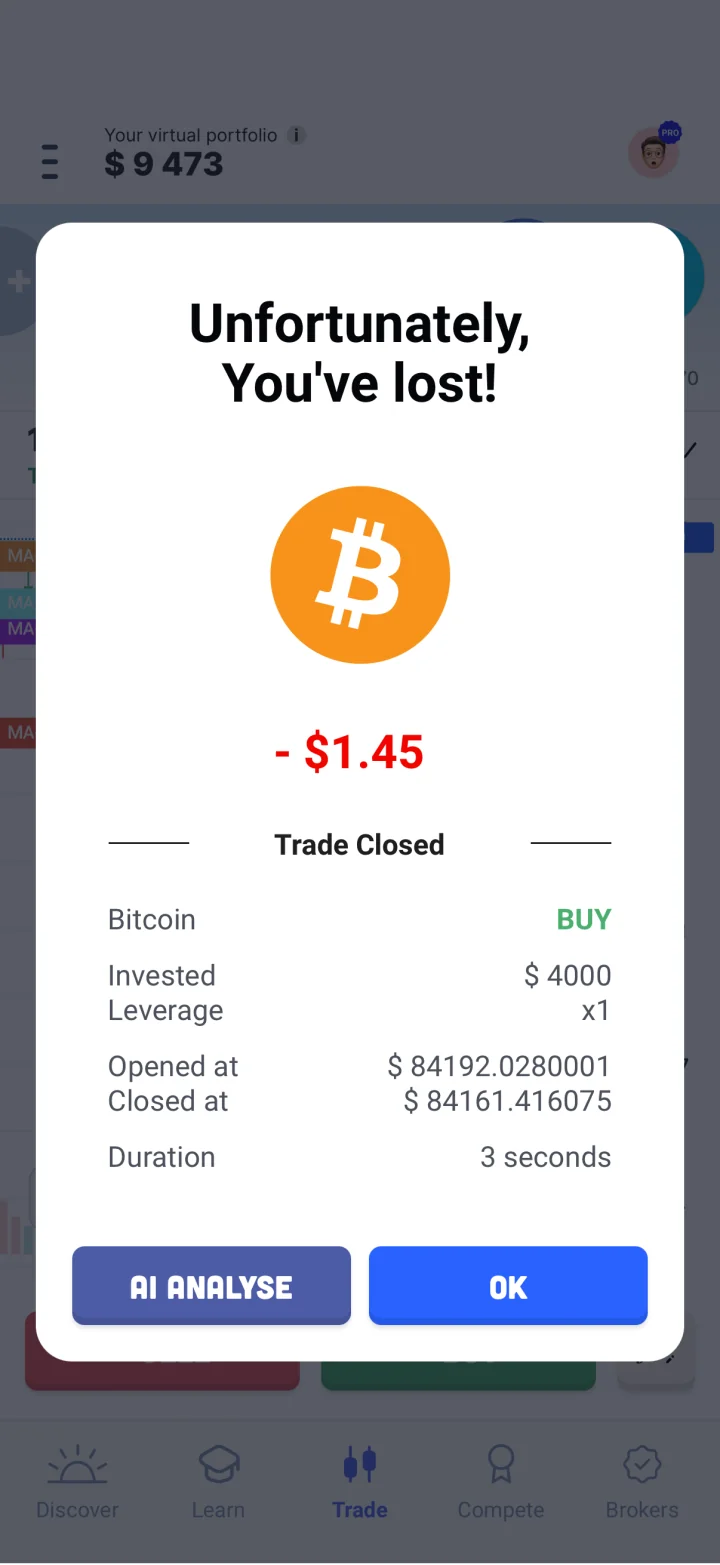
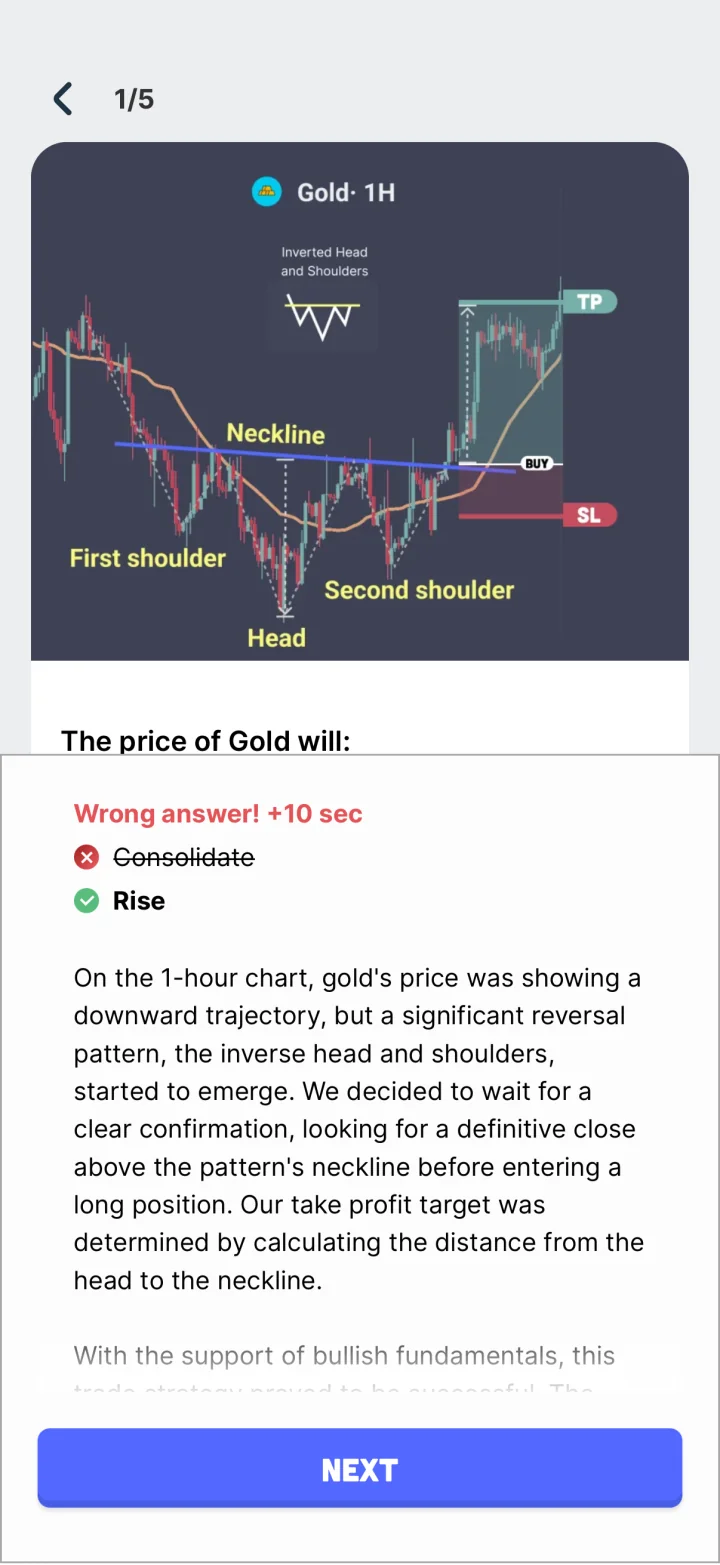
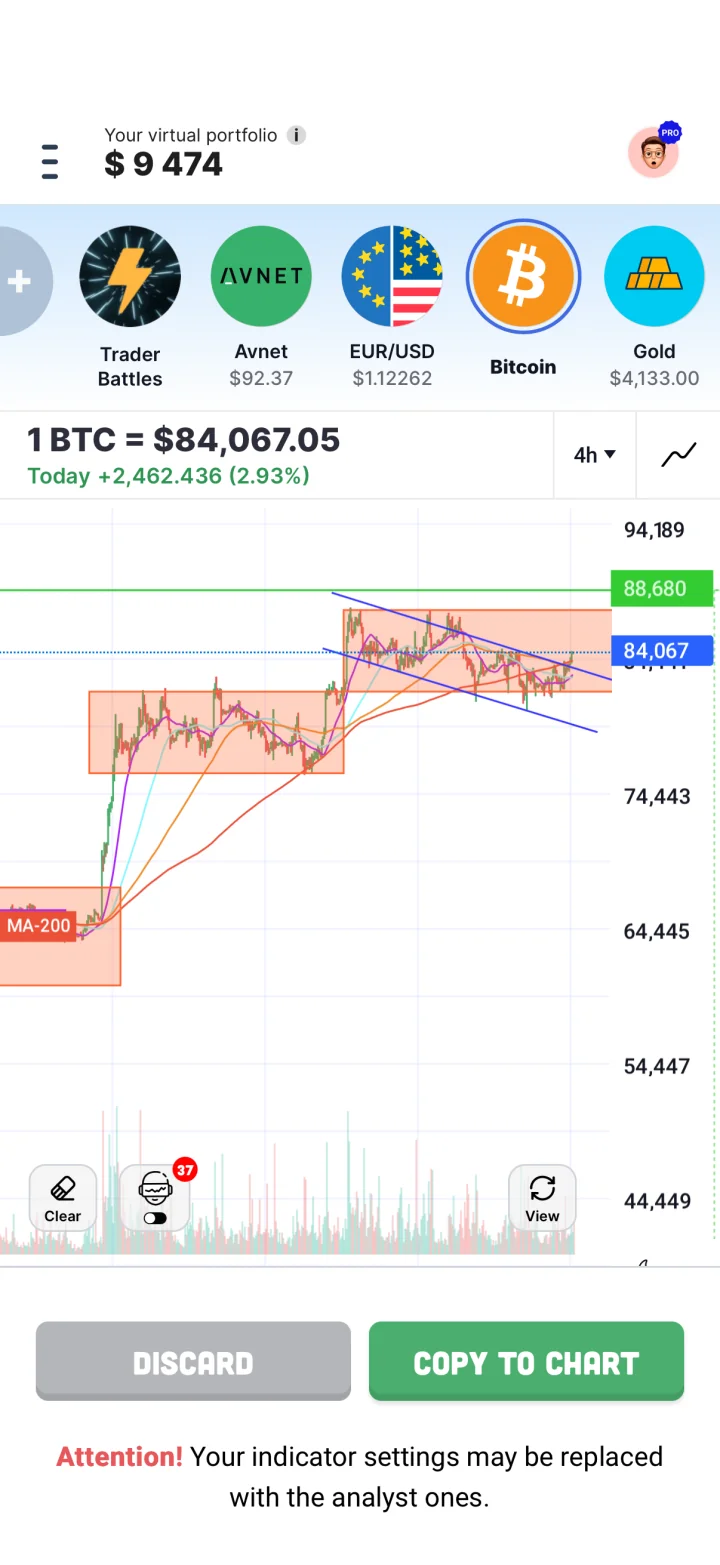
Trading Game. Install it and choose your balance: anything from $500 to $10,000 on the site's list, or $200. Chapter one, a chart question, then a first trade at the live price, with the stop and target chosen before you enter. Daily Insights has the day's two analyst setups, each drawn and explained, and a button to copy one onto your chart. Close the trade, tap AI Analyse, and the coach tells you what you did. Then, if you want the game, you challenge a friend to a ten-minute battle.

Both products have the word game somewhere in their pitch. They mean different things by it. WSS's game is a contest: a month, a leaderboard, a prize for the top. Trading Game's game is closer to a sports club: short matches, a weekly table, daily drills, and a coach who watches you play.
The matches. Trading Battles are ten minutes, one against one, against a friend, the AI or a stranger. You can see your opponent's positions but not their score. Play a friend and the app lets you sabotage them: my favourite is a ten-second internet blackout, so they cannot close a trade at the worst moment. It is petty and it is brilliant, because it teaches what a dropped connection feels like with nothing at stake.
The table. The weekly leaderboard ranks the week's return and shows the top three all week; it is the one people care about. There is a battles table and a friends table too. No prizes, by design.
The drills. Pattern Hunter is the daily drill: name the pattern against the clock, no hints; the Pattern Trainer behind it is the slower version with hints, on real historical charts. The Academy runs to 150-plus illustrated lessons across sixteen chapters, and a free 28-day plan decides what you study next. Quick Reads are slide summaries of the trading books everyone recommends and nobody finishes; one free a month, with about 28 illustrations per chapter by my count, against about eight in the originals.
The coach. Two of them, really. Chart Intelligence reads the chart with you before the trade: the levels, a buy, sell or wait, a confidence figure, and the lesson that covers the pattern it found. Max reviews the trade after and names what went wrong: a late entry, an early exit, a bigger bet after a loss. Both are free with limits; we refined the review process over years of watching beginners. WSS's AI Wealth Wizard builds an allocation from a questionnaire, which is a different thing and not feedback on anything you did.
The demonstration. Two analyst setups every trading day, at the European open and the US open, drawn on the chart and explained. One tap and the drawing is on your own chart; two copies free, unlimited in Pro.
The stake. Trading Game starts at $500 so that a loss costs something, and there is no undo button on a trade: once it is open, it is open, as it would be with a broker. The aim is for the game to feel fun, challenging and possible, not easy. You find out what trading asks of you with pretend money, and then decide whether to put in the work. No lucky wheels, no gift boxes; the competition is the fun, the way it is in real markets, plus a few easter eggs they would not tell us about.
The gaps in Trading Game: limit orders, options, a web version (listed as coming soon), prizes, and a contest you can set up for a group. It is a club for one, with opponents.
You want a prize. Monthly contests with real rewards, and an AI trading contest this November and December with $500 in gift cards. Adults in the US and Canada only, not Quebec; under-18s can join prize-free contests.
You want options or short selling for free. Both are there, depending on the contest's rules. Trading Game has no options.
You want to browse courses by topic. The 36-course catalogue is organised by level and subject, free, and you can read it without ever placing a trade.
You run a group. Unlimited private contests with their own settings. For a full classroom, the sister site HowTheMarketWorks is built for it.
One caution. The limit order that sits pending is usually the price, the market hours or the volume rule, not a fault. Read the FAQ before concluding the button is broken.
Twelve things a beginner meets in the first week, and which fits each better. No totals; a prize hunter and a learner should not weigh these rows the same.
| What you need | Trading Game | Wall Street Survivor | Better fit |
|---|---|---|---|
| Starting money | $500 to $10,000 on the first screen, and a $200 option | $100,000 by default; a private contest can set its own | Trading Game. With $100,000 a bad week is a rounding error. With $500 it is a lesson. |
| Prices | Live, several updates a second, on screen | The banner says real time; the footer and FAQ say quotes are delayed 15 to 20 minutes | Trading Game. True of the fill, not of the quote you see. Go by the footer. |
| Markets | 220+ assets: stocks from four exchanges, ETFs, indices, forex, commodities, crypto | US stocks, ETFs, options and 300+ cryptocurrencies | Either. WSS for options and a long crypto list. Trading Game for forex, gold and oil. |
| The order ticket | Preset size, leverage 1x to 50x, stop and target; no limit orders | Market, limit and stop; short selling and margin per contest; whole shares only; big orders wait for volume | Wall Street Survivor. WSS has the limit order and the short sale. It also has pending orders that look like a bug and are not. |
| Learning what to do | 150+ lessons in a 16-chapter path, a free 28-day plan, Pattern Trainer, book summaries | 36 free short courses in four groups, plus a 10-chapter starter course | Either. WSS's courses are good for browsing a topic. Trading Game's path is for being taken through them in order. |
| Feedback on a trade | AI reads the chart before, the coach reviews the trade after | An "AI Wealth Wizard" that builds an allocation from a questionnaire; nothing reviews a trade | Trading Game. WSS's AI hands you a portfolio. Trading Game's tells you why your last trade lost. Only one of those is feedback. |
| Charts | Drawing tools, volume, RSI, VWAP, Bollinger, SuperTrend, Volume Profile, four MAs; 10 timeframes | "Interactive charts" in a research centre; nothing more is published | Trading Game. WSS does not say what its charts do. Trading Game does, and teaches each tool. |
| Phone | iPhone, iPad and Android apps | Website only; works in a phone browser | Trading Game. No WSS app that we could find. |
| Price | Free with ads; Pro $19.99 a month or $54 a year on the current offer | Free simulator and courses; a paid tier is mentioned in the terms with no price we could find | Wall Street Survivor. WSS's whole listed offer is free. Trading Game keeps the deep courses and the full coach for Pro. |
| Playing against people | 10-minute 1v1 battles with sabotage, weekly leaderboard, daily Pattern Hunter | Monthly public contests with prizes, unlimited private contests, an AI trading contest with $500 in gift cards | Wall Street Survivor. WSS pays real prizes, if you are an adult in the US or Canada outside Quebec. Trading Game pays in a friend's ten-second blackout. |
| Ads and upsells | Ads in the free app; Pro removes them | Affiliate promotions for paid newsletters on the pages and inside the dashboard | Either. Both are ad-supported. WSS's ads are for paid newsletters. |
| When you can trade | Each market's own hours; forex most of the week, crypto all weekend; a market-hours screen shows what is open | US stock orders 9:30 to 16:00 Eastern; outside that they wait for the next business day | Trading Game. If your evening is not New York's afternoon, WSS's market is shut. |
WSS cells come from its home page, FAQ, rules, courses page and terms, read on 23 October 2026; its terms were last updated in 2015. Trading Game is ours, so its cells come from the app itself, its Pro page and its help centre.
| Trading Game | Wall Street Survivor | |
|---|---|---|
| Starting money | You choose: $500 to $10,000 on the site; $200 is offered as well (default $10,000). Reset in Settings to start over | $100,000 virtual cash by default; the amount is set per contest/league via Contest Parameters |
| What it costs | Free with ads. Pro $19.99 billed monthly, or $89 a year shown at $54 on the current offer: full AI coach, advanced courses, the full book library, unlimited Copy to Chart, no ads | Free simulator, no credit card. Terms mention paid course subscriptions but no price is published |
| Sign-up | Download and start; a free account saves progress | Free registration; accounts stay active if you log in at least once every 90 days |
| Where it runs | iPhone and iPad (iOS 15+), Android. Web version listed as coming soon | Web (desktop and mobile browser). No native iOS/Android app found |
| What you can trade | 220+ assets: stocks from NYSE, LSE, NSE and Tokyo, 15 ETFs, indices, commodities, forex pairs and crypto | US stocks, ETFs, options and crypto (300+ cryptocurrencies via separate crypto ); some non-US exchanges with delayed prices |
| Price data | Real time; prices update several times a second | Marketing says real-time, but footer and FAQ state quotes delayed at least 15 minutes (FAQ: 15-20 minutes); US-exchange orders fill at real-time bid/ask per rules |
| Order types | Market entry with preset trade sizes and leverage from 1x to 50x; take profit and stop loss set on the ticket | Market, limit, stop; short selling, margin (example up to 50% of portfolio) and day trading per contest settings; whole shares only |
| Simulated fees | None; buy and sell prices differ like real markets | A brokerage commission applies to all trades; amount set per contest, default not published |
| Lessons | 150+ illustrated Academy lessons with quizzes in a 16-chapter path (fundamental courses free, advanced in Pro); a 28-day plan; Pattern Trainer and a timed daily pattern game; Quick Reads book summaries (one free a month) | 36 free short courses ('Over 30') in four groups; a 10-chapter getting-started course; articles and videos |
| AI and feedback | Chart Intelligence reads the open chart, draws the levels, gives a buy, sell or wait scenario with a confidence level and checks your own drawings (beta; its help page says it can be wrong). Max, the AI coach, reviews a closed trade and answers questions (limited free, full in Pro). Daily analyst setups at the EU and US open; Copy to Chart puts them on your chart (2 free, unlimited in Pro) | 'AI Wealth Wizard' (ChatGPT-powered) builds a diversified allocation from a questionnaire; an 'AI Trading Contest' 2 Nov to 11 Dec 2026 with US$500 in Amazon gift cards |
| Charts | Candlestick and line charts, 5 drawing tools, indicators including volume, RSI, Bollinger Bands, VWAP, SuperTrend, Volume Profile and four moving averages, 10 timeframes from 15 seconds to 1 month | Research Center with interactive charts, screeners and analyst ratings; charting details not specified |
| Games and contests | 10-minute 1v1 Trading Battles against a friend, the AI or anyone; weekly, battles and friends leaderboards (no prizes); daily timed pattern game | Semi-monthly/monthly public contests with real prizes; unlimited free private contests; one prize per household, claim within 30 days |
| Who can use it | Worldwide; the site says 100+ countries, including the US, Canada, UK and Australia. App Store age rating 4+ | Anyone can open an account; prize contests need age 18+ and US or Canada residency (not Quebec); under-18 students only in prize-free contests. Operated by Stock-Trak Inc., Quebec law |
| Languages | Six in the app (the App Store listing shows English) | English only |
| Trading hours | Follows each market; forex generally 24/5 and crypto 24/7; a market-hours screen shows what is open in your time zone | US market hours 9:30 to 16:00 ET; orders placed when closed process next business day |
| Starting over | Pick a new balance when you start over (statistics and history are deleted) | Multiple portfolios through unlimited contests, each with its own balance; a reset option not documented |
Try it yourself
Sort each goal to the tool that fits it better, by the facts above.
Trading Game for live prices, battles, drills and feedback. Wall Street Survivor for options, shorting, prizes and free courses.
What would you expect?
What this shows: WSS ranks you. Trading Game coaches you. Decide which one you came for.
Wall Street Survivor offers a fuller ticket, prizes and free short courses on a delayed screen. Trading Game offers live prices, short battles, daily drills and a coach that reviews each trade. Pick by whether you want a rank or a skill.
Pick Wall Street Survivor if you want a free browser ticket with limit orders, options and short selling, a shot at a prize, or a course catalogue to browse.
Pick Trading Game if you learn on a phone, you want live prices on the screen, you want a coach, not a rank, and a game that makes you better, not busier.
Give each one a question. In WSS, start with "why is my limit order still pending?" and read the rules until you can answer it. In Trading Game, start with "what would make this setup wrong?", draw the level, and see whether the coach agrees. A simulator that helps you answer a question is worth keeping. A rising balance alone is not.
Yes. WSS says the simulator is free with no subscription fee or credit card. Its terms mention paid course subscriptions, but we found no price. Trading Game is free with ads; Pro includes the deeper courses and full AI coach.
The banner says real-time data. The footer says quotes are delayed at least 15 minutes, the FAQ says 15 to 20, and the rules say fills use real-time bid and ask. Trading Game shows real-time prices on screen.
Adults resident in the US or Canada, excluding Quebec, one prize per household, claimed within 30 days. Anyone can trade; students under 18 can join prize-free contests.
Yes. Both belong to Stock-Trak Inc. HTMW is built for classrooms; WSS is the open, individual sign-up version.
Ten stock market simulators compared on starting money, live or delayed prices, lessons, feedback, broker tickets and class tools, with the best fit for each.
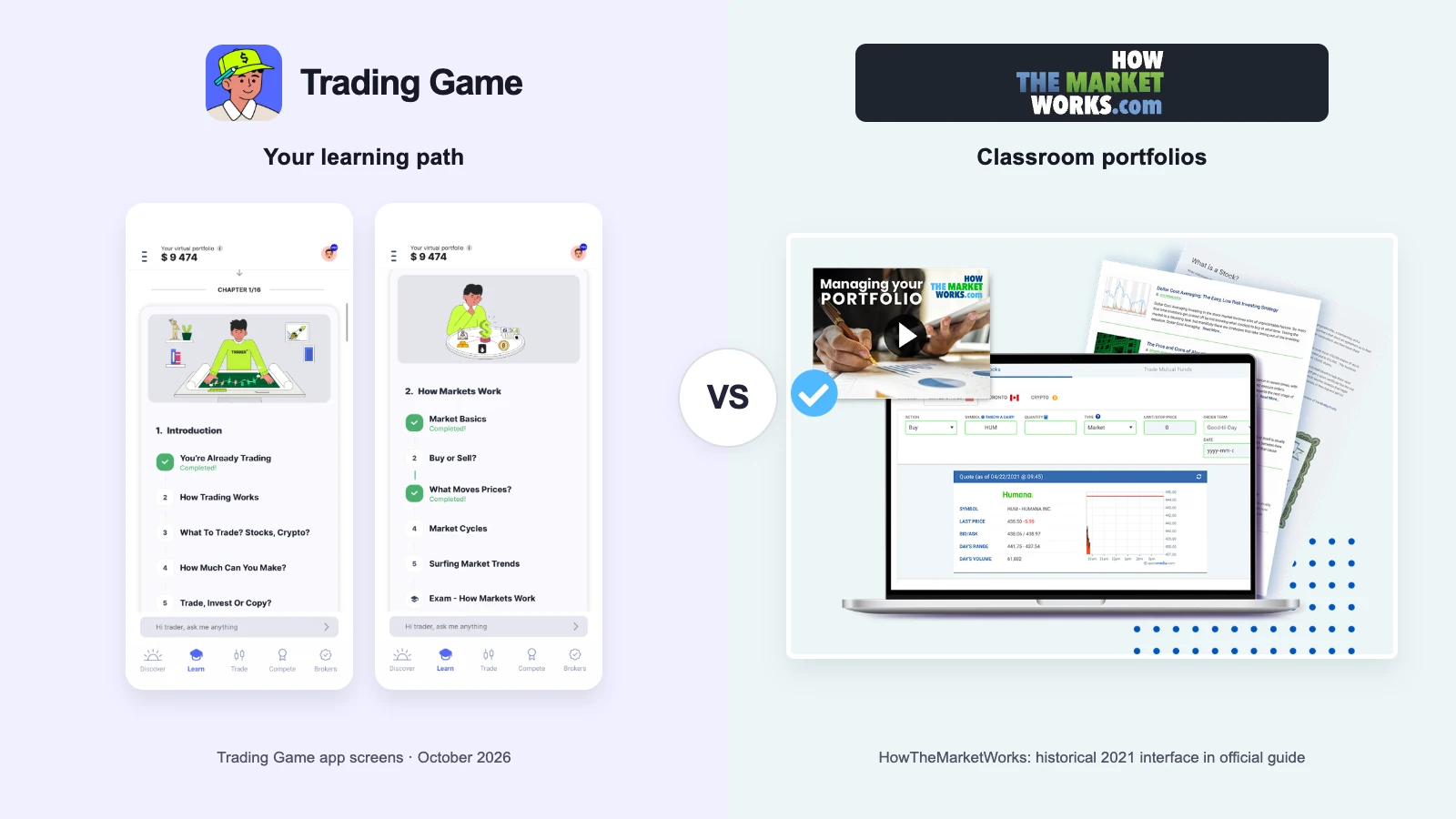
HowTheMarketWorks vs Trading Game, stock market simulators compared: classroom contests, order types, the 15-minute delay, phone lessons and AI feedback.