

No email signup is required.
What’s inside the crypto book?
- The building blocks: types of cryptoassets and an introduction to blockchain.
- The language: a glossary with terms such as FOMO, HODL, forks and altcoins.
- Price movements: Bitcoin volatility, supply and demand, news and other market influences.
- Reading a chart: line, bar and candlestick charts, with bullish and bearish examples.
- Strategy examples: approaches including trend trading and holding, for comparison and discussion.
- The human side: a visual look at the emotions traders can experience.
It is a starting point for complete beginners who want to recognize the terms and understand what a chart shows. Use a chapter as a prompt: draw the idea, explain it in your own words, then try a small exercise. A strategy illustration is an example to study, not evidence of future profit.
Make a crypto book reading plan
Which activities belong in a first reading session?
- Send real coins to learn by trial and error
- Explain what a private key controls without writing a real key down
- Work through one hypothetical fee and drawdown example
- Mark platform and legal claims that need current verification
Answer and explanation
- Send real coins to learn by trial and error
A first exercise can be simulated without an irreversible transfer.
- Explain what a private key controls without writing a real key down
Describe key control using invented examples; real recovery phrases are sensitive.
- Work through one hypothetical fee and drawdown example
Arithmetic makes the costs and risk concepts more concrete.
- Mark platform and legal claims that need current verification
A PDF’s platform details can age even when basic concepts remain useful.
Your answers stay on this page.
Try a first exercise: include both fees
Imagine buying two units of a fictional asset at USD 50 each, with a USD 1 purchase fee. Later, both units sell for USD 48 each, with a USD 1 sale fee. Before opening the answer, calculate the total paid, the final proceeds and the difference.
Show the calculation
You paid USD 101: 2 × 50 + 1. You received USD 95 after the sale fee: 2 × 48 − 1. The net loss is USD 6. These are invented teaching figures, excluding tax and currency conversion.
Build on what you read
Our Crypto learning path turns the next questions into short lessons. Start with Bitcoin basics, find out who controls a wallet, then explore orders and fees. You can complete the written exercises without depositing money.
Interested in the project featured in the book? Bitcoin Flip’s official page currently announces a forthcoming return. Check it for news; an available download and launch date have not been confirmed.
A closer look inside your free crypto book
Begin with crypto vocabulary, then move to charts and strategy examples. Page numbers include the cover.
Pages 6–8: build your vocabulary first
The cryptoassets page introduces different types of assets, followed by a blockchain explanation and a glossary. Start by separating three ideas. Bitcoin is a particular network, and bitcoin is its native asset. A blockchain is a way of organizing a shared record into linked blocks. A token can be created on an existing network through a smart contract, a program that runs on that network. For example, Ethereum’s ERC-20 standard describes common token functions such as transfers and balance checks. A token is not automatically a separate blockchain. See the Bitcoin project’s introduction and Ethereum’s token explanation.
After the glossary, write one ordinary sentence using “bullish” and one using “bearish.” Both describe an outlook, not a fact about what happens next. Then explain FOMO without using the abbreviation. That small translation exercise helps you notice when a message is describing a market and when it is trying to hurry you into a decision.
Pages 9–13: turn a picture into information
The volatility pages lead into line, bar and candlestick charts. Use the chart illustrations to identify the time period first, then the opening, highest, lowest and closing prices of a candle. In a made-up hourly candle with an open of USD 40, a high of USD 46, a low of USD 38 and a close of USD 43, the close is above the open. The price still visited USD 38 during that hour. One upward candle therefore does not mean the whole hour was a smooth climb.
Pages 15–24: compare explanations and decisions
The later pages discuss supply and demand, news, strategy examples and trader emotions. Treat the dated market stories as historical examples. Try making two columns: “what was known at the time” and “what became clear afterward.” For each strategy, write its intended holding period and what would make the idea fail. A useful reading outcome is being able to explain a decision and its uncertainty, rather than memorizing a promise of returns.
Follow one transfer from wallet to blockchain
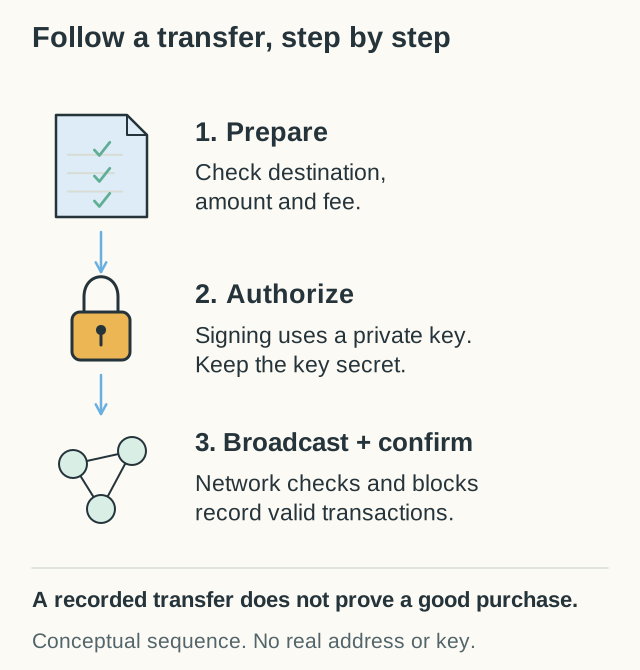
Imagine Maya wants to send a small amount of bitcoin to Leo. On paper, label his receiving destination LEO-DEMO-ADDRESS. This is a teaching label, not a valid address. Maya’s wallet prepares the amount, destination and fee. It uses a private key to sign the transaction, then broadcasts it for network checks. A miner may include the transaction in a block; later blocks add confirmations. Bitcoin’s overview explains this sequence.
The three objects have different jobs. An address identifies a receiving destination. A private key helps authorize spending and stays secret. A wallet manages keys and presents transaction information. In a custodial account, a provider controls the keys for you. Write “receiving label” and “secret authorization” on separate pieces of paper to remember the distinction. You can understand the idea without creating a wallet or handling money. The Bitcoin vocabulary explains addresses, wallets and keys.
Bitcoin also has a useful meaning of “change.” Suppose a transaction spends a previous output worth 10,000 satoshis, pays Leo 6,000 and uses 500 as a fee. A second output can return 3,500 to Maya. Nothing is missing: 6,000 + 500 + 3,500 = 10,000. These invented amounts explain bookkeeping, not an expected fee. The Bitcoin developer transaction guide describes inputs and outputs.
Try this part
Who can move the asset?
Match the control concept to its meaning before comparing wallet names.
- Signing control
- The ability to authorize a transfer using the required keys.
- Custodian
- A provider that controls assets or keys on the customer’s behalf under its terms.
- Recovery plan
- A way to regain authorized access after device loss, tested without exposing secrets.
Read a price change alongside the costs
A quoted price movement and your result are different calculations. Here, one fictional token costs USD 100, plus a USD 2 purchase fee. Selling also costs USD 2. The table holds those fees constant so you can see their effect. It excludes tax, spreads, conversion and network costs.
| Later sale price | Price change | After sale fee | Net gain or loss |
|---|---|---|---|
| USD 110 | +10% | USD 108 | +USD 6 |
| USD 100 | 0% | USD 98 | −USD 4 |
| USD 90 | −10% | USD 88 | −USD 14 |
In the first row, the token rose 10%, but the net return on the USD 102 paid is about 5.9%: 6 ÷ 102 × 100. An unchanged price still produces a loss after fees. Network charges are another category: Ethereum calls its network processing fees gas, and those fees vary with demand. Read Ethereum’s gas explanation before assuming a platform’s trading fee is the whole cost.
Pause and think. A token costs USD 100 plus a USD 2 purchase fee, then sells for USD 100 with a USD 2 sale fee. What is the result?
Compare your reasoning
The initial payment is USD 102 and sale proceeds are USD 98. The net result is a USD 4 loss, before the other costs excluded by the example.
Questions before you open the book
Is this a Bitcoin-only PDF?
No. Bitcoin features throughout, but the book also introduces wider cryptoasset vocabulary, blockchain, charts, market influences and trading approaches. It is an introductory crypto trading book, rather than a technical Bitcoin manual.
Do I need an exchange account to use it?
No. Download the PDF, read the illustrations and work through the written examples with a calculator. You can practise describing a candle, checking a percentage change and accounting for fees without registering or depositing money.
Does the PDF teach wallet setup?
Its main focus is crypto vocabulary and trading concepts. Use the transfer example above to learn the basic roles, then continue with our wallets and custody lesson for a fuller explanation of control and recovery.
Is the book a fully current edition?
It is the original Finance Illustrated book, including historical market examples and product references. The compact reader notes below explain specific corrections. Use the book for its illustrated introduction, and check current official sources for product terms or rules in your country.
Can a chart pattern tell me the next price?
A chart organizes prices that have already occurred. A pattern can help you describe an observation or form a question, but it does not establish the next outcome. Try writing two different ways the same setup could develop.
Can I save the PDF and read offline?
Yes. Open the free book and use your browser or PDF reader’s save option. Keep this page bookmarked for the accompanying examples and reader notes, which are separate from the downloadable book.
Download the free 25-page Crypto Trading for Beginners PDF. Keep the book beside these examples and work through one section at a time.
Explore the other free books
Compare the ideas with our stock market PDF and Forex PDF. Each gives you a different set of market mechanics to understand.
Read with your book
These notes correct parts of the book. Page numbers count the cover as page 1.
4 · A small stake is not a return forecast
The suggestion that $100 could become thousands by next year is unsupported. A smaller stake limits the dollars initially committed, but does not establish a lower percentage risk or a higher potential return than every other market. A crypto investment can lose all its value.
4 · Shorting and leverage do not guarantee income
A market being open continuously does not create a dependable second income. Short and leveraged positions can lose money rapidly. A 100x illustration amplifies exposure and losses as well as gains; availability and protections depend on country and product.
3 · Bitcoin Flip product status
The official Bitcoin Flip site announces that the app is coming back. The book’s download instructions are out of date: the original app is not available to download yet. Apps with similar names from other publishers are not Bitcoin Flip.
5 · Copying and dated terms
Copying a trader does not guarantee profit. The provider loss percentage and platform description are historical and cannot be presented as current without verifying the applicable entity and terms.
2 · Claims about authors and student earnings
The book’s claims about the authors’ experience and about students earning thousands come with no evidence. Do not treat them as a guide to what you might earn.