
Crypto
Crypto Trading for Beginners PDF: Free Download and Study Guide
Get the free 25-page crypto trading PDF for beginners: what is inside, which old claims to read with care, and the six free lessons to read next.
Bitcoin is a shared record of who can spend which coins. Learn how a payment gets recorded, why you own keys rather than coins, and why you can buy part of one coin.
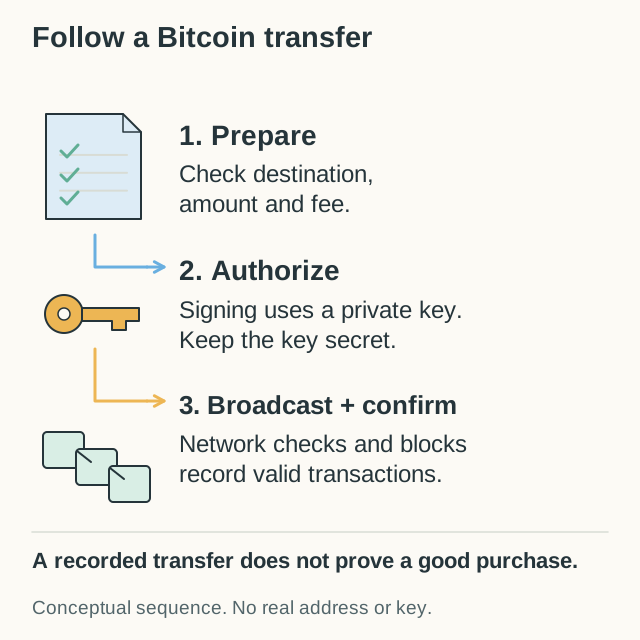
Bitcoin is two things with one name. Bitcoin with a capital B is a network for sending money over the internet. The coin that moves on that network is bitcoin with a small b. Its short code is BTC.
No bank keeps the accounts. Instead, many computers around the world keep copies of one shared record, called the . It lists every payment that the network has confirmed. That is how everyone knows who can spend which coins.
The record is public and permanent. It shows addresses, not names, but an address can be linked to you. For example, a company that sells you coins knows who you are. So Bitcoin is not anonymous.
The price chart answers what buyers paid on one market. To understand a payment, ask a different question: who can authorise it? That takes you from the price to the keys.
Say Ana wants to send some bitcoin to Ben. Three things happen.
Each new block carries a code made from the block before it, called a . That links the blocks into a chain: the blockchain. The first confirmation usually comes within about 10 to 60 minutes.
Try it yourself
Change the amount in block 1. Watch what happens to the blocks after it. Then try to repair the chain.
There are 4 blocks. Change the amount in block 1, for example from 0.5 BTC to 5 BTC, and block 1 gets a new fingerprint (hash). Blocks 2, 3 and 4 still point to the old one, so all 3 links break. To repair the chain, you would have to redo every later block.
What would you expect?
What this shows: Change one old payment and every later block breaks. To fake the record, you would have to redo them all.
Each block stores a fingerprint, called a hash, of the block before it. Edit block 1 and its hash changes, so blocks 2, 3 and 4 no longer link up. Bitcoin's rules make this true for real blocks too. It is also part of why a confirmed payment can't be undone.
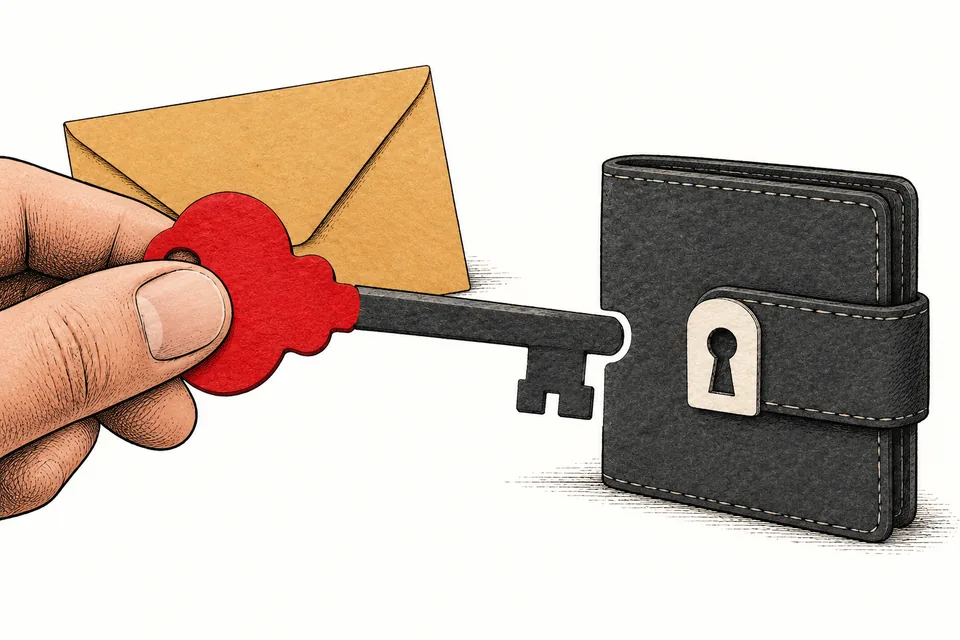
A wallet does not hold coins. The coins are entries in the shared record. The wallet holds the keys that let you spend them.
So what happens if you delete your wallet app? If you still have your , you can usually get access back in a wallet app that supports it. A seed phrase is a list of words, often 12 or 24, that can rebuild your keys. If you lose the keys and the phrase, no company can reset them. The coins stay on the record, but nobody can move them.
Three screens can show the same bitcoin balance and mean very different things:
Before you trust a balance, ask who can sign a transfer.
Yes. The price you see is for one whole coin, but you can buy a small part of it.
A price move changes what your coins are worth. It does not change how many you own. Only a payment, a purchase or a sale changes the amount.
A coin with a low price per unit is not cheaper in any useful sense. A coin at 50 cents and a coin at $50,000 can both fall 20% in a day. To compare, multiply the amount you own by the price. Then list what you still don't know: how many coins exist, what rights you have and what trading costs.
Bitcoin's price can rise or fall a lot in a short time. The Bitcoin Project's website, bitcoin.org, says to treat it as a high-risk asset. Some risks have nothing to do with the price:
The rules depend on where you live. In Canada, the Canadian Securities Administrators explain price, platform and technology risks. In the UK, read the FCA's guide to investing in crypto. In Australia, see ASIC Moneysmart. In the US, check which company you would deal with and the rules in your state.
A product that is easy to buy is not automatically right for you. Next, learn who really controls your coins in wallets and custody.
Not if you still have your seed phrase. The coins are on the shared record, and the phrase can rebuild your keys in a wallet app that supports it. If you lose both the keys and the phrase, nobody can reset them.
No. Once a payment is confirmed, no bank or helpline can cancel it. Only the person who received the coins can send them back. Check the address and the amount before you sign.
No. You can buy a small part of one. At an example price of $50,000, $100 buys 0.002 bitcoin. If the price drops to $40,000, you still own 0.002 bitcoin, but it is worth $80.
Not really. Every confirmed payment is stored publicly and permanently. Addresses are not names, but they can be linked to you, for example when you buy coins from a company that knows who you are.
Get the free 25-page crypto trading PDF for beginners: what is inside, which old claims to read with care, and the six free lessons to read next.

13 funny Bitcoin memes and two viral crypto videos, from chart-checking to AI meme-coin hype, with the real lesson behind each joke.