

Stocks & investing
ETF vs Mutual Fund: Which Costs Less and How to Compare
ETF or mutual fund? Compare yearly fees, trading costs, sales charges and minimums, and see what a 0.10% vs 0.80% fee does over 30 years.
When you buy US shares with Canadian dollars, two things move: the share price and the exchange rate. Learn to measure both, so a gain on screen doesn't surprise you in CAD.
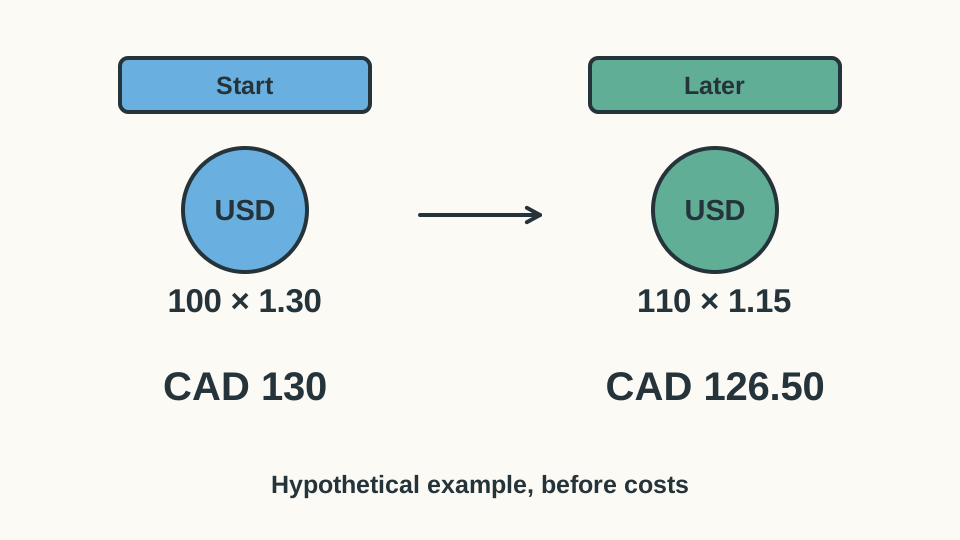
When a Canadian buys a US share, two things can change the result in Canadian dollars (CAD). The share price can move in US dollars (USD). And the between USD and CAD can move. A fee for changing your money is a third, separate item.
Your is the one you measure your money in: Canadian dollars, for a Canadian. The chance that exchange-rate moves cut your result in that currency is called .
First, be clear about which way the rate is written. In this lesson, 1.25 CAD per USD means one US dollar costs CAD 1.25. To turn a USD amount into CAD, multiply by that rate.
A good worksheet writes four things beside every amount:
Try it yourself
Your US share is up 10%. Now slide "USD against CAD" down to −12% and watch your result in Canadian dollars.
CAD 10,000 buys USD 8,000 at 1.25 CAD per USD. The share rises 10% to USD 8,800. If the rate falls 12% to 1.10, that is CAD 9,680: a 3.2% loss in Canadian dollars. The 10% gain is wiped out once the US dollar falls about 9.1%.
What would you expect?
What this shows: A US stock can rise in US dollars and still lose money in Canadian dollars. A 10% gain is gone once the US dollar falls about 9.1%.
Your CAD result multiplies the two moves: 1.10 × 0.88 = 0.968, a 3.2% loss when the US dollar falls 12%. Adding the percentages would wrongly suggest −2%.
All numbers here are made up. They are not real rates, forecasts or tax figures.
| Step | Working | Result |
|---|---|---|
| You convert CAD 10,000 at 1.25 | 10,000 ÷ 1.25 | USD 8,000 |
| The share rises 10% | 8,000 × 1.10 | USD 8,800 |
| The rate falls 12%, to 1.10 | 8,800 × 1.10 | CAD 9,680 |
| Your result in CAD | 9,680 − 10,000 | CAD −320, or −3.2% |
In US dollars you made 10%. In Canadian dollars you lost 3.2%. Both answers are true: they answer questions in different currencies.
Notice that you cannot just add the two moves. +10% and −12% would suggest −2%. The real answer multiplies them: 1.10 × 0.88 = 0.968, which is a 3.2% loss.
Here is the rule in words, with no fees or dividends. Divide the new USD value by the old one. Multiply by the new rate divided by the old rate. Then take away 1. For our example: (8,800 ÷ 8,000) × (1.10 ÷ 1.25) − 1 = −0.032, or −3.2%.
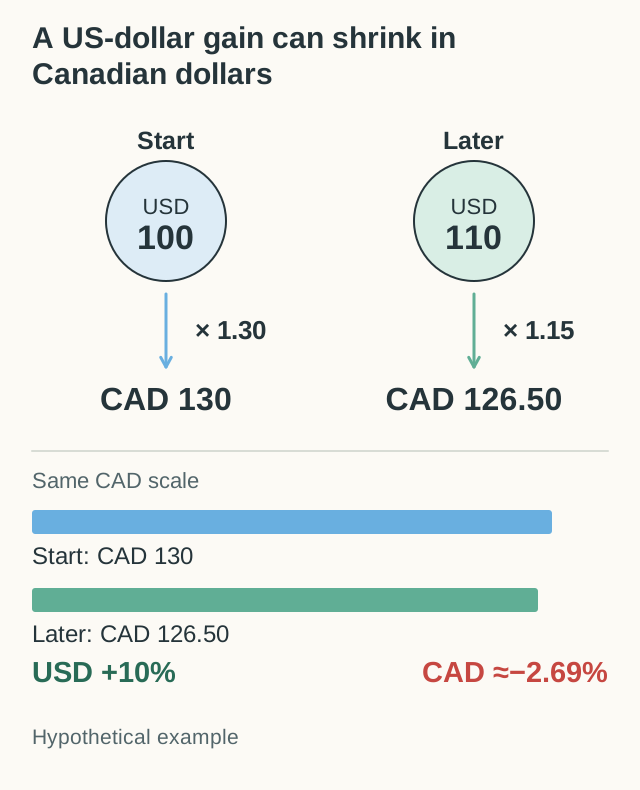
Keep the holding at USD 8,000 the whole time. At 1.25 it is worth CAD 10,000. If the rate falls to 1.10, it is worth CAD 8,800. You lost 12% in Canadian dollars while the share price stood still.
The opposite can happen too. If the rate rises 12%, to 1.40, the same USD 8,000 becomes CAD 11,200, a 12% gain. Currency moves can help as well as hurt. The point is to measure your exposure, not to guess the next move.
Keeping the money in US dollars after a sale avoids changing it straight away. But it does not stop its value in Canadian dollars from moving.
So check two numbers for each US holding. How did the share do in US dollars? And what is the holding worth in Canadian dollars today?
Put on their own line. Suppose, for practice, that each conversion costs a separate CAD 100.
These fees are made up, not a real broker's prices. Also check how a fee is charged. If the rate you are quoted already includes a , don't subtract the markup again. Commissions and dividends need their own lines too. Compare real conversion charges with the brokerage fee worksheet.
Not by itself. The Investor Office of the Ontario Securities Commission explains that foreign-listed ETFs can be affected by exchange rates and conversion costs. For any fund, ask three separate questions:
A fund can trade in CAD and still hold US shares. Paying in CAD does not remove the US dollar exposure inside it. A "hedged" label is not a promise either: read the fund's documents for what it hedges, what that costs and its limits. See how to diversify for country and currency exposure.
Tax depends on your account, such as an RRSP, a TFSA or a non-registered account, and on your situation. This worksheet is not a tax rule. Get Canadian tax guidance before you draw conclusions.
Before you use a real account, ask your broker three things. How does it hold foreign cash? How does it price a conversion? What records does it give you?
The same maths works anywhere. A UK investor in US shares measures results in pounds, and an Australian in Australian dollars. Only the exchange rate changes.
No. It works both ways. If the US dollar rises against the Canadian dollar, your US shares are worth more in CAD. The aim is to measure the effect, not to predict it.
Holding US dollars can save you from converting back and forth on every trade, which can save fees. But the CAD value of those US dollars still moves with the exchange rate.
It aims to reduce it, but hedging has costs and limits. Read the fund's documents to see what it hedges, how and at what cost.
No. Anyone who invests in another currency faces it. A UK investor in US shares measures results in pounds, and an Australian in Australian dollars.
ETF or mutual fund? Compare yearly fees, trading costs, sales charges and minimums, and see what a 0.10% vs 0.80% fee does over 30 years.

Start investing in stocks step by step: give your money a job, choose what to own, check the broker, count every cost and place a first order.