

Stocks & investing
Stock Market Opening Hours: US, Canada, UK and Australia
What time does the stock market open? See regular hours for NYSE, Nasdaq, TSX, LSE and ASX, plus holidays, daylight saving and extended hours.
A filled order is not the end of a trade. Learn when the shares and cash really change hands, why a Friday trade settles on Monday, and when you can use the money.

In the US and Canada, most share trades settle one business day after they fill (T+1).
When your order is filled, your trade has happened. But the shares and the cash have not officially changed hands yet. That final swap is called .
So there are three separate steps:
In , the T is the trade date: the day your order was filled. The +1 means one later. Weekends and market holidays don't count. So a Monday trade settles on Tuesday, but a Friday trade settles on Monday.
The clock starts when your order fills, not when you send it. A limit order that is still waiting has not traded, so there is nothing to settle yet.
Try it yourself
Tap a day in this October 2026 week to make a trade on it. Watch where settlement lands. Try Monday first, then Friday.
With T+1 in the US and Canada, a trade on Monday, October 19, 2026 settles on Tuesday, October 20. A trade on Friday, October 23 settles on Monday, October 26, because Saturday and Sunday don't count.
What would you expect?
What this shows: Settlement counts business days, not hours. A Friday trade settles on Monday, three calendar days later.
Weekends and holidays don't count. A Monday trade settles on Tuesday, but a Friday trade waits through the weekend. Settled money may still take longer to reach your bank.
Each market sets its own cycle. These are the normal cycles for ordinary shares, checked in October 2026:
| Market | Cycle | Since or from |
|---|---|---|
| US | T+1 | May 28, 2024 |
| Canada | T+1 | May 27, 2024 |
| UK | T+2 now, moving to T+1 | T+1 planned from October 11, 2027 |
| Australia (ASX) | T+2 | 2016 |
For any real trade, the settlement date on your is what counts. Ask your broker about exceptions.
Imagine you sell 20 shares at $50 each on a Monday. That is $1,000 before fees. Your app may show the sale at once, and under T+1 it settles on Tuesday.
Now ask three different questions:
One balance number cannot answer all three. Withdrawal also depends on your broker's rules and the bank transfer itself. Holds on new deposits, currency conversion or transfer processing can add time. T+1 is not a promise that money reaches your bank the next day.
So if you need cash for a bill on a set date, plan ahead. Allow one business day for settlement, then add your broker's and your bank's transfer time.
In the US, a means you pay for your shares in full, without borrowing from the broker. The SEC's guide to trading in cash accounts was updated on August 7, 2026. It explains what you must pay and when. It also covers money from a sale that has not settled yet.
Buying and then selling before you have paid can break those rules and lead to limits on your account. Being allowed to place an order does not remove that duty.
This is US guidance. Canadian readers should ask their own dealer for the rules on their account, and UK and Australian readers should ask their broker. Margin accounts, which let you borrow, have separate rules and costs.
Holidays push settlement back. Say you trade on a Friday and the next Monday is a holiday. Then settlement moves to Tuesday. A day when banks close is not always a day when the market or settlement closes, so check each one.
US and Canadian markets have different holiday calendars. For a trade in another country, check the calendar of the market where it trades. Your own bank's open days are not a settlement calendar.
Practice apps often make cash available at once and skip settlement. When you practise, use a practice journal. Write down the trade date, the expected settlement date and where the money came from. Keep real-account questions in a separate column.
For the steps before settlement, read market, limit and stop orders. For the costs taken from each trade, use the brokerage fee worksheet.
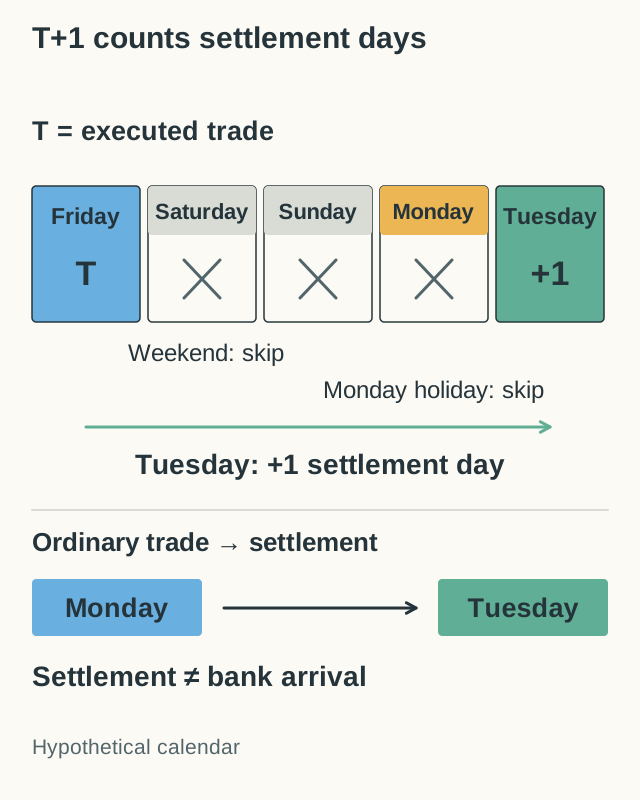
T is the trade date, the day your order is filled. +1 means settlement happens one business day later. Weekends and market holidays are skipped.
Not always. Settlement is the official swap of shares and cash. Your broker may have its own release rules, and the bank transfer takes time too. Ask what is available to withdraw and when it will arrive.
No. The US and Canada use T+1. The UK uses T+2 and plans to move to T+1 from October 11, 2027. Australia's ASX uses T+2. Always check the date on your trade confirmation.
Less than for frequent traders. It matters most when you sell and want to use or withdraw the money quickly, or when you buy and sell in a cash account.
What time does the stock market open? See regular hours for NYSE, Nasdaq, TSX, LSE and ASX, plus holidays, daylight saving and extended hours.

Start investing in stocks step by step: give your money a job, choose what to own, check the broker, count every cost and place a first order.