
Stocks & investing
10 Best Free Investing Tools for Beginners (2026)
10 free investing tools for beginners: calculators, fee checkers, company filings, charts, screeners, trackers and a practice app, with each tool's limits.
Every order trades speed against price control. Learn the four basic order types, and pick the one that matches what you want to happen.
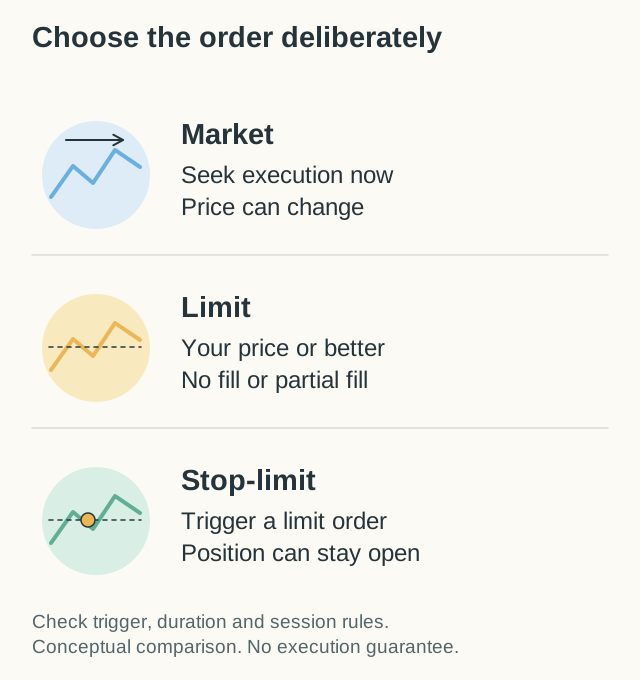
An order is your instruction to a broker to buy or sell. Each type makes a different trade-off between speed and price. We will use one made-up share for every example. Its , the best price buyers offer, is $19.95. Its , the best price sellers want, is $20.05.
| Order | What you tell the broker | The trade-off |
|---|---|---|
| Market | Trade now at the prices available | The price is not fixed |
| Limit | Trade only at my price or better | It may fill only partly, or not at all |
| Stop | When the trigger is hit, trade at market | The trigger is not your final price |
| Stop-limit | When the trigger is hit, trade only at my limit or better | You may be left holding the share |
FINRA's guide to order types explains these for US shares. Your broker's names and rules may differ, so read its own order instructions too.
A stop is a trigger, not a promise. Prices do not always move one cent at a time. Sometimes they jump. A jump with no trades in between is called a . It often happens overnight, when news comes out while the market is closed.
Say you own the share and have a sell stop at $18. Bad news comes out overnight, and the next morning the share opens at $17. Your stop triggers, but the first price available is about $17, not $18. So that is where it sells.
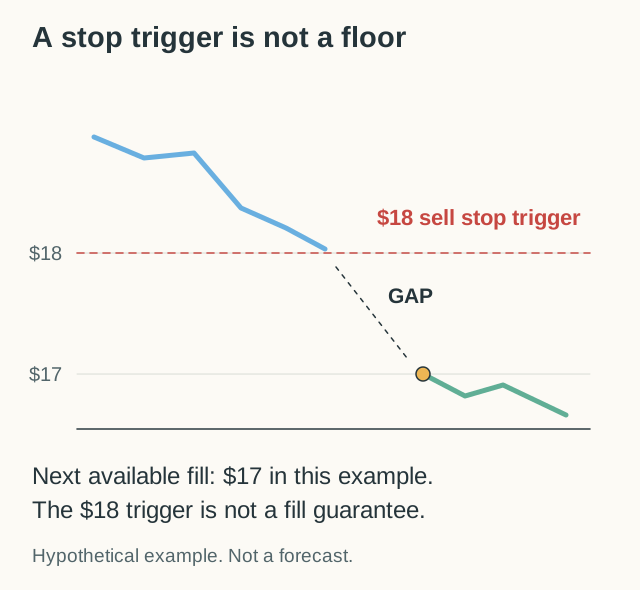
With a stop-limit at $18 and a $17.90 limit, the order would not sell at $17. That protects your price, but you still own the share while it keeps falling. Neither order can promise both a minimum price and a sure exit.
Try it yourself
Pick Market, Limit or Stop, set a price if needed, and press Place order. Try at least two order types, and watch what happens when the price gaps.
A share at $20 has a sell stop at $18. Bad news makes it open at $17. The stop triggers and sells at about $17, not $18. A stop-limit with a $17.90 limit would not sell at all.
What would you expect?
What this shows: Market orders give speed, not a fixed price. Limit orders give a price, not a sure fill. A stop is a trigger, not a promise.
No order gives you both a fixed price and a sure fill. When the price gaps past a stop, the order fills at the next price available, which can be well below your stop.
Before every order, ask yourself one question: what matters more right now, the price or the fill?
Also check how long your order lasts. Some orders end when the market closes that day, while others stay open until you cancel them. Check whether your order can fill before or after normal market hours too.
An order type changes your instruction. It does not turn a bad trade into a good one.
Sometimes only part of an order fills. This is a . Imagine you want 50 shares. Sellers offer 20 shares at $20.05 and another 30 at $20.10. Assume those offers stay in place and there are no fees.
| Your order | What happens in this example | What is still uncertain |
|---|---|---|
| Market buy for 50 | 20 × $20.05 + 30 × $20.10 = $1,004, about $20.08 a share | Offers can change before your order arrives |
| Limit buy for 50 at $20.05 | 20 shares fill. 30 stay open | Whether the other 30 ever fill |
| Limit buy for 50 at $20.00 | Nothing fills | Whether a seller comes down to $20 before the order ends |
The first ask was $20.05, but the market order paid $20.08 on average, because only 20 shares were on offer at $20.05.
Now say your screen shows "20 filled, 30 open". Before you send another order, check what you already own and whether the first order is still active. A new order for 50 shares is a brand new instruction, not the missing 30. If both fill, you could end up with 100 shares by mistake.
When you practise, write down the order number, how many shares filled and how many are still open.
Practise these steps in a simulator, and keep notes in a paper trading journal, especially when something surprises you. The SEC also has a short glossary of order types.
Next lesson: how to read a stock chart. After that, paper trading lets you try each order with virtual money. Our stock market simulators guide compares free places to do that. To plan where a stop and a target go, see the risk-reward lesson.
Both wait for a trigger price. A stop then becomes a market order, so it fills at the next price available, which can be worse. A stop-limit becomes a limit order, so it will not fill worse than your limit, but it may not fill at all.
Neither is always better. Use a market order when getting filled matters most, and a limit order when the price matters most and you accept it may not fill. In busy shares with small spreads, market orders usually fill close to the quote.
No. A stop order is a trigger. If the price jumps past it, for example after overnight news, it sells at the next price available, which can be lower. Plan for that when you decide how big a position to take.
10 free investing tools for beginners: calculators, fee checkers, company filings, charts, screeners, trackers and a practice app, with each tool's limits.
10 well-known dividend stocks, from Coca-Cola to Main Street Capital: their dividend records, risks and how to check them. A research list, not buy tips.