
Paper Trading Journal: A Free Template to Review Practice Trades
A trading journal shows what you planned, what happened and what you learned. Keep those three apart, and a lucky profit can't hide a mistake.
In this article
- What should a paper trading journal include?
- What does a filled-in entry look like?
- Why judge the process separately from the result?
- Try it: Sort the journal: good process or mistake?
- How do you review your journal?
- What can a practice journal prove?
- How do you make your next session comparable?
- Questions beginners ask

What should a paper trading journal include?
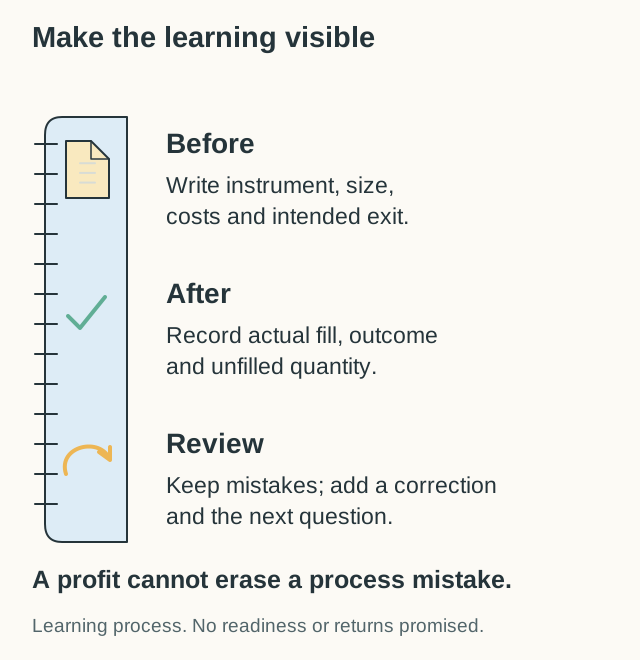
A useful has two halves: what you planned before the order, and what happened after it. Copy this template into a notebook or a spreadsheet.
| Before the order | After the order |
|---|---|
| Date, time, time zone and any data delay | Fill time and |
| The share or other investment, and where it trades | Quantity filled, and any part not filled |
| Your reason, and what would prove it wrong | Why you exited, and whether that followed the plan |
| Quantity, order type and planned exits | Result before costs, the costs, and the |
| Your guesses about costs and fills | Anything the app did that surprised you, and your next question |
Fill in the left side before you place the order. Fill in the right side afterwards. Never go back and change the left side to match what happened.
Keep each box short: one line is enough. The aim is to compare entries later, not to write an essay. Add one more line at the bottom of each entry: what you would do differently next time.
What does a filled-in entry look like?
Here is a made-up example. You plan to buy 20 virtual shares at $50. Your , the price where you will sell if the idea fails, is $48. Your target is $54.
- Planned risk: 20 × ($50 − $48) = $40.
- Planned target gain: 20 × ($54 − $50) = $80.
Write those numbers down before the order. Later, the simulator fills your exit at $47.80, not $48. Record the real loss: 20 × ($50 − $47.80) = $44 before costs. With a made-up $2 total cost for buying and selling, the net result is a $46 loss.
Don't rewrite the plan to say $47.80. The gap between the plan and the fill price is exactly what the journal is for. A stop is an instruction, not a promise of an exact price. Our lesson on market, limit and stop orders explains why.
This example is invented to show record-keeping. It is not a suggested trade or a real fill.
Why judge the process separately from the result?
Try this made-up comparison. Both sessions start with the same plan: buy 10 virtual shares at $30, with a stop at $28 and $1 of charges each way. If the exit fills exactly at $28, the planned loss is $20, or $22 with charges.
| Record | Session A | Session B |
|---|---|---|
| Quantity entered | 10 shares | 20 shares, by mistake |
| Sale price | $28 | $31 |
| Result before charges | 10 × ($28 − $30) = −$20 | 20 × ($31 − $30) = +$20 |
| Result after $2 of charges | −$22 | +$18 |
| Process | Followed the plan | Doubled the quantity with no reason |
Session B made money and has the bigger mistake. Calling it a good trade would hide the one thing you can fix. Session A followed the rule and still lost. That does not prove the rule is good, but it shows why process and result need separate columns.
Add a third column called 'next test'. For B, write a fix such as reading the quantity aloud before you confirm. For A, check whether the stop was set the way you planned. Then run a fresh session under the same written conditions.
Try it yourself
Sort the journal: good process or mistake?
Sort each practice trade by how it was done, not by the money it made. Drag it to a bin, or tap it and then tap a bin.
Good process: following the plan and losing $22, skipping a trade that broke the rule, and recording a $47.80 fill honestly. Process mistakes: typing 20 shares instead of 10 (+$18), moving the stop (+$5), trading with no plan (+$30) and resetting after losses.
What would you expect?
What this shows: A profit can hide a mistake, and a loss can follow a good plan. Judge the process first, then look at the money.
The result of one trade is partly luck. Your process is the part you control and can improve, so it gets its own column.
How do you review your journal?
When you finish a set of practice trades, review them all at once:
- Count the entries with a written plan, and the ones without.
- List mistakes, such as the wrong quantity or the wrong order type.
- Work out every result again after all costs.
- Keep trades made under different versions of your rules apart.
- Write one question for the next session, instead of changing every rule at once.
Two entries can show a missing column or a typing mistake. They cannot show a reliable win rate. Note whether prices were delayed, how fills were assumed and which costs were left out.
If an order type confused you, look it up in the SEC's guide to types of orders before your next session.
What can a practice journal prove?
A journal shows whether you followed your own instructions in one simulation. It cannot prove that an idea will make money with real trades. Brokers that offer practice simulators warn that results there can differ from live trading.
If your simulator lets you reset the account, save the journal first. Losing entries are the ones you most need to review, so don't let them disappear.
What a journal can show is still useful. It shows how often you followed your plan, which mistakes repeat and how your fills compare with your plan. Those habits carry over to a real account.
For setup tips, read what is paper trading. For the maths behind stops and targets, see the risk-reward ratio lesson.
How do you make your next session comparable?
Use the same journal columns in every app you try, so you can compare sessions fairly. If you still need an app, our stock market simulators guide compares free options. The four-stage simulator plan gives each session a clear job. Record the order, the simulated fill, the costs and one correction each time. Two complete entries teach you more than a screenshot of one winning trade.
Write down why the fill was worse, for example a sudden drop or a gap overnight. That note is more useful than the loss itself.
Open your practice journal
Write a paper-trading scenario report
What did your assumed trade teach you? Use invented prices for one unleveraged purchase followed by one sale. Choose your own numbers or inspect the example. This exercise uses USD throughout. It does not model currency conversion, taxes, dividends, short selling or borrowing.
All entries stay in this page’s memory. Nothing is sent or saved by this tool. Reloading the page loses your entries. Export a text copy if you want to keep your work. Keep names, account details, passwords and wallet recovery phrases out of your notes.
A worked example you can use without JavaScript
Start with $10,000. Buy 20 invented units at $50 each, plan a stop at $47.50 and assume a sale at $54. Purchase and sale charges are $2 each.
- Cash used on purchase
- 20 × $50 + $2 = $1,002
- Planned loss at an exact stop fill, including assumed charges
- 20 × ($50 − $47.50) + $4 = $54
- Gross result, then net result
- 20 × ($54 − $50) = $80; $80 − $4 = $76
- Result as a share of starting cash
- $76 ÷ $10,000 × 100 = 0.76%
- Net result divided by the planned loss
- $76 ÷ $54 ≈ 1.41. This is an outcome-to-plan comparison, not an expected return.
Now assume the sale occurs at $46 instead. The net loss is $84, larger than the planned $54. A stop is an instruction, not an assurance of an exact fill.
On paper, write your entry rationale, what would invalidate it, your assumed costs and fills, and one question to investigate next.
Method, limits and source
Cash used = purchase price × units + purchase charges. Gross result = (sale price − purchase price) × units. Net result = gross result − purchase charges − sale charges. Planned loss = (purchase price − planned stop) × units + both assumed charges. The same fixed charges are used in the plan and outcome. The result percentage uses all starting practice cash, including cash not invested. No annualization is applied.
The purchase must fit within the starting cash. The sale price may be zero and charges can make the net loss greater than the purchase value. Sale proceeds after charges can be negative in this simplified example. Spreads and slippage should be reflected in the assumed actual fill prices; do not charge them twice. A real stop can fill at a worse price, and this tool does not predict executions or returns.
Order concepts: SEC Investor.gov: Types of orders (United States; order availability and handling vary by venue). Read the paper-trading journal lesson.
Questions beginners ask
What should I write in a trading journal?
Before the trade: your reason, what would prove it wrong, the quantity, the order type and your planned exits. After the trade: the fill price, the costs, the net result, whether you followed the plan and one thing to try next.
Should I keep a journal for paper trades?
Yes. Practice is where mistakes are cheap, and a journal is how you spot them. Without one, you tend to remember the wins, and you can't tell a good process from a lucky result.
Should I use a spreadsheet or a notebook?
Either works. A spreadsheet adds up results for you. A notebook is quicker during a session. What matters is using the same columns every time and never rewriting the plan after the result.
How many practice trades do I need?
There is no set number. A few entries can reveal a typing mistake or a missing column, but they can't show whether a strategy works. Review in batches, fix one thing at a time and keep every entry.