
Calls and puts: what are you actually buying?
A $2 option quote can mean a $200 purchase. Start with the contract behind the small number, then decide what a rise or fall would change.
In this article
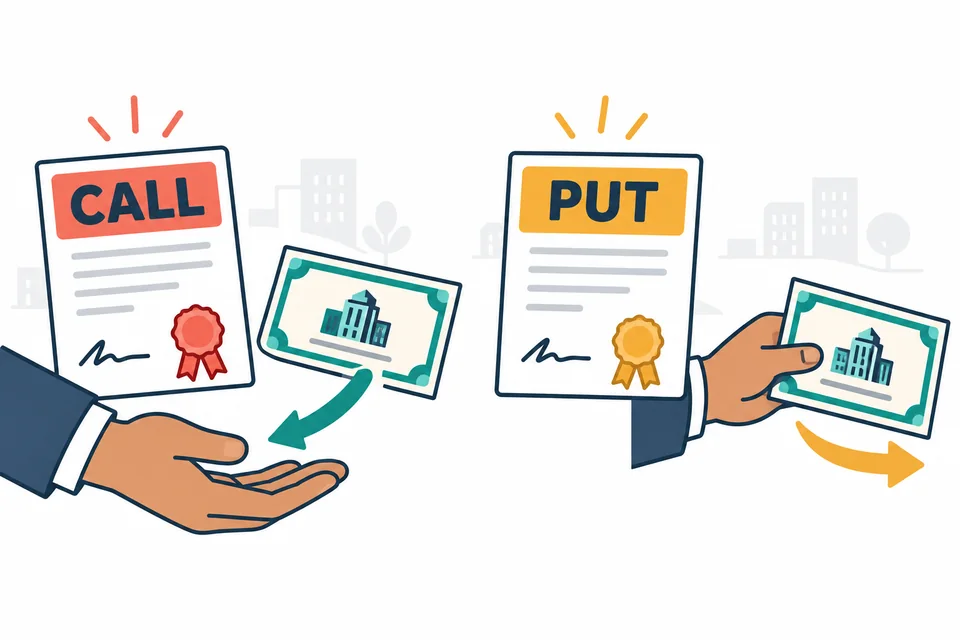
A call gives its buyer a right to buy; a put gives a right to sell.
Read the contract before the price
A share can stay in your account for years. An option has a deadline. It is a contract linked to an underlying security, such as a stock or an exchange-traded fund (ETF). This lesson covers standard exchange-listed options, starting with the buyer’s side.
Four details belong together: the underlying, whether it is a call or put, the , and expiration. The strike is the price at which the contract lets its holder buy or sell the security. The is the separate price paid for that right.
The Options Industry Council’s introduction explains the contract terms. A standard US stock-option contract usually covers 100 shares, but adjusted contracts and other products can differ. Check the multiplier and what must be delivered instead of assuming every option means 100 shares.
In an options chain, many contracts share one company name. Match the strike, call or put, expiration and multiplier every time. A cheap-looking price for a different deadline is a different contract, not a discount on the one you meant.
A call buys one right; a put buys another
Imagine a made-up stock called Maple at $50. All examples below use US dollars, one unadjusted 100-share US stock-option contract, and no fees.
- Buy a $50 call: you obtain the right to buy 100 Maple shares for $50 each under the contract’s exercise rules.
- Buy a $50 put: you obtain the right to sell 100 Maple shares for $50 each under those rules.
If Maple rises to $60, buying at $50 becomes useful. If it falls to $40, selling at $50 becomes useful. Those are two different rights, rather than two buttons for predicting the next candle.
A bought put can also accompany shares you already own. It can limit part of a holding’s downside over a specified period, at the cost of its premium. The shareholding and the option still need to be assessed together.
Try it yourself
Which right or obligation is it?
Choose an item, then choose its category. Each choice explains the contract.
Call buyer: right to buy. Put buyer: right to sell. Assigned call writer: obligation to deliver. Assigned put writer: obligation to buy.
What would you expect?
What this shows: A buyer owns a right. A writer accepts an obligation. The call or put determines which way the shares move.
Assignment requires the writer to buy or deliver shares at the strike, depending on the contract.
Who has the obligation?
The option’s writer receives premium in exchange for an obligation. If assigned on a call, the writer must deliver the shares at the strike. If assigned on a put, the writer must buy the shares at the strike. Owning a right and promising to fulfil someone else’s right have different risks.
For a purchased call or put considered alone, the option loss is limited to the premium plus costs. That does not describe an uncovered call writer, whose potential loss is unlimited. The SEC’s listed-options bulletin sets out this distinction. Learn the full comparison in options risk.
Can I buy listed options where I live?
US brokers require specific options approval, as FINRA explains. In Canada, the Montréal Exchange lists equity options; ask your dealer about approval, account restrictions and the particular market you can access.
UK and Australian access also depends on the firm, account and product. These lessons are educational, including for readers too young to open a trading account.
Next, see how a premium changes profit and loss, then what happens at expiration. Return to the options learning path, or build the foundation in stocks and investing.
Questions beginners ask
Does a $2 option cost $2?
Not in our 100-share example. A $2 per-share premium costs $200 for one contract before fees. Check the actual multiplier.
Is owning a call the same as owning shares?
No. The call is a time-limited right. Exercising it to buy shares requires payment at the strike; ownership of the option alone does not give shareholder rights.
Can everybody trade listed options?
No. Eligibility depends on jurisdiction, age, account, product access and broker approval. Reading a lesson does not establish eligibility.