
What happens when an option expires?
Your $200 call may become a $5,000 share purchase. Find out what happens before the deadline, rather than discovering it from the next account balance.
In this article
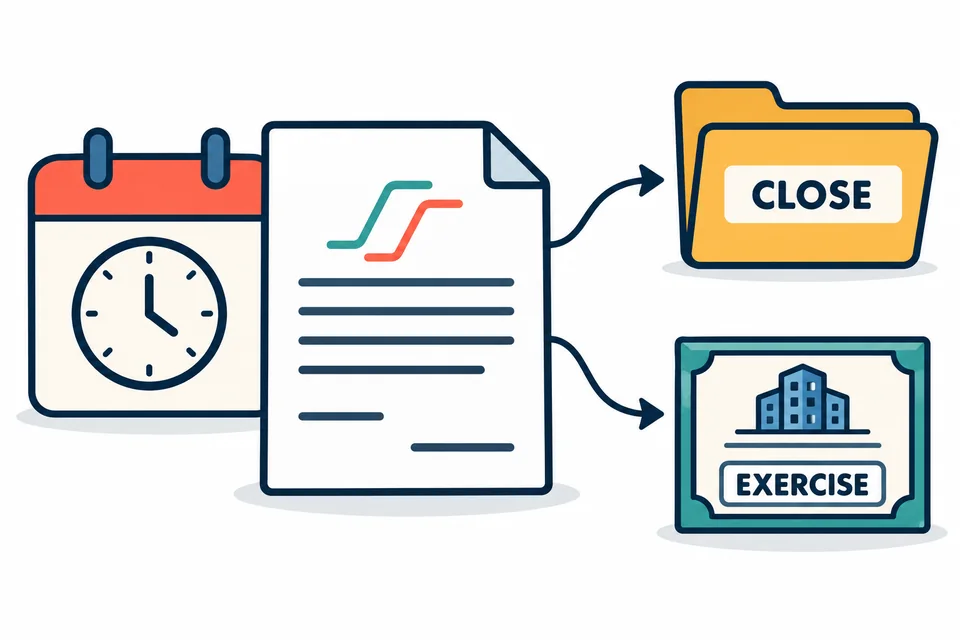
Selling an option to close and exercising it are different actions.
Three actions that are easy to mix up
Imagine you own one unadjusted US 100-share stock call with a $50 strike. It cost $2 per share, or $200. The numbers below are hypothetical US dollars; fees are omitted.
- : sell the option you own. If the trade fills for the full position, you no longer hold that option.
- : use the contract’s right to buy the shares at the strike.
- Expire: the contract reaches its end. Depending on its value, contract terms and instructions, it may be exercised or finish without value.
You cannot treat these as different names for taking a cash payout. With a physically settled call, exercising means buying the underlying shares.
Follow the money through exercise
Your call is in the money with the stock at $55. Exercising buys 100 shares at $50, requiring $5,000 of cash or permitted buying power. The $200 premium was a separate earlier payment. You now own shares worth $5,500 at that example price, rather than receiving an automatic $500 cash prize.
The shares can then change value. If they fall to $47 before you sell, they are worth $4,700. Including the $200 premium, the combined sequence is down $500 before costs: $4,700 − $5,000 − $200.
Exercising a physically settled put means delivering shares at the strike. If you do not own them, your broker’s permissions and procedures become critical; you should not assume the transaction will be allowed or simply settle as cash. The OIC exercise FAQ covers funding, share delivery and broker procedures.
Try it yourself
Close the option or buy the shares?
Sort each action. The example is one physically settled $50 call covering 100 shares.
Sell the call at $2.60: receive $260, a $60 gain before costs. Exercise the $50 call: pay $5,000 to buy 100 shares, separately from the original $200 premium.
What would you expect?
What this shows: The premium pays for a right. Exercise uses that right and can require much more cash.
A full closing sale removes the option without a new share purchase. Exercise changes the position you hold.
Exercise style describes timing
An American-style option allows its holder to exercise before expiration under the contract’s rules. A option allows exercise only at expiration. These terms describe timing, not your location.
US stock and ETF options generally use American-style exercise. Other products differ. Selling to close in the market is separate from exercising, so a European-style option can still be tradable before its expiration.
Early exercise can give up remaining time value. If a call has $1 intrinsic value but can be sold for $1.40, exercise uses the $1 right and gives up the extra $0.40. For 100 shares that is $40 before costs. Compare available prices and your objectives before choosing an action.
Do nothing is still a decision
Some in-the-money US options enter an exercise-by-exception process at expiration. It is unsafe to translate that into “my broker always handles it”. Account agreements, contrary instructions, trading halts and broker deadlines can change the outcome. The OIC assignment FAQ explains these exceptions.
Ask your broker when it needs exercise or do-not-exercise instructions, which time zone applies, and what it does if the account cannot support delivery. A broker may act before the market’s deadline. Its rules may include closing a position, and an attempted closing trade may not fill.
Option trading hours, the final exercise-instruction cutoff and the settlement valuation can be different. A price on your phone after the market closes does not answer all three questions.
Check the exact market and contract
Canada’s Montréal Exchange contract specifications identify the listed product and expiry cycle. Use the Canadian contract’s rules and your dealer’s instructions rather than importing a US schedule. Holiday changes and weekly expirations make a remembered monthly date inadequate.
In Australia, ASX specifications distinguish contract size, exercise style and settlement. Do not assume an ETF option follows every rule of an individual-share option. UK readers accessing overseas contracts need both the market’s specifications and their own broker’s account rules.
Before a practice position expires, write down your intended action, the deadline and the required cash or shares. Then compare the result with your plan. Review exercise and assignment risk, revisit premium and payoff maths, or return to calls and puts. Find the sequence on the options path and the foundations in stocks and investing.
Questions beginners ask
Do I have to exercise a profitable call?
No. You can generally sell it to close while it trades, if a buyer and acceptable price are available. Exercise and a closing sale have different consequences.
Does European style mean it trades only in Europe?
No. It means exercise is allowed only at expiration. The name does not determine the investor’s country or where the contract trades.
Can I ignore an option on expiration day?
That can leave an unintended outcome. Confirm your broker’s exercise procedures, cutoff and funding requirements before the deadline.