
When does a bought option actually make money?
A stock rises above your call’s strike. Good news, perhaps, but the premium still needs paying back. Separate the option’s value from your profit.
In this article
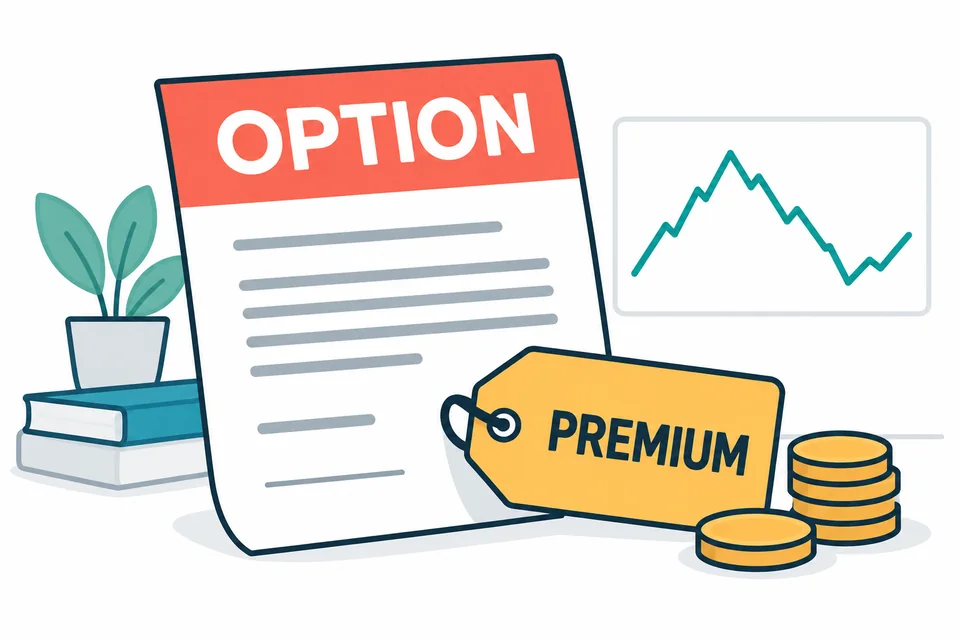
At expiration, a call has value above its strike and a put below it.
Start with one $50 call
Assume one unadjusted US stock-option contract for 100 shares, quoted in US dollars. You buy a $50 call at a $2 premium per share, paying $200. Every number in this lesson is hypothetical. The expiration examples ignore fees and any later share-price movement after exercise.
The call’s expiration value per share is the stock price minus $50, with a floor of zero. At a $55 stock price, that is $5 per share, or $500 per contract. Subtract the $200 premium: the option payoff implies a $300 profit before costs.
That calculation describes economic value. A physically settled stock option does not simply pay $500 into your account. Exercising the call buys shares at the strike. See the OIC long-call guide and our expiration lesson for the mechanics.
Above the strike can still mean a loss
| Stock price | Option value | Profit or loss |
|---|---|---|
| $48 | $0 | −$200 |
| $51 | $100 | −$100 |
| $52 | $200 | $0 |
| $55 | $500 | +$300 |
At $51 the call is : buying for $50 has value. Yet that $100 value does not recover your $200 purchase. Your loss is $100.
The expiration break-even is strike plus premium per share: $50 + $2 = $52, before costs. Add $10 total transaction costs and break-even becomes $52.10 for this 100-share example. Being correct about direction is only one part of the result.
Try it yourself
Value or profit? Sort the result
For the $50 call bought at $2 per share, classify each expiration result. Ignore fees.
At $51: −$100. At $52: $0. At $55: +$300. All are expiration values for the $200 contract before costs.
What would you expect?
What this shows: An option can have value without making its buyer a profit. Subtract what it cost.
At a $51 stock price, this call has $100 intrinsic value against a $200 purchase cost: a $100 loss before costs.
Turn the calculation around for a put
Now buy a $50 put for the same $2 per-share premium. If the stock finishes at $45, the right to sell for $50 has $5 per-share value. The calculation is $500 value minus $200 premium = $300 before costs.
At $49, value is only $100, leaving a $100 loss. At $50 or above, the put has no at expiration, so its buyer loses the $200 premium. Its expiration break-even is strike minus premium: $50 − $2 = $48. See the OIC long-put guide for the payoff relationship.
A put’s value cannot keep growing below a zero stock price. At zero, this $50 put has $5,000 intrinsic value and a $4,800 profit before costs. That ceiling differs from a call’s exposure to a theoretically unbounded rise.
Why the quote can change before the deadline
Before expiration, an option’s quoted premium can include intrinsic value and . A $50 call with a $51 stock price has $1 intrinsic value. If the call quote is $2.40, the remaining $1.40 is time value.
Time left and , the movement expectations reflected in prices, matter alongside the underlying price. As time passes, time value generally erodes, all else equal. Higher implied volatility generally raises call and put premiums, all else equal. These are pricing relationships, not guaranteed daily moves. OIC’s pricing guide also explains the roles of interest rates and dividends.
So a stock can rise while a call loses market value if other changes outweigh the benefit. You cannot use an expiration payoff table as a prediction of tomorrow’s sell price.
Use the price you could actually receive
Compare like with like: the same underlying, strike, expiration and call or put. If you change the contract while checking a quote, you change the question. Keep the original premium in your calculation even when the latest price looks exciting.
Suppose you paid $2 and later sell to close at $2.60. On 100 shares, the gain is ($2.60 − $2) × 100 = $60 before costs. You did not need to reach the expiration break-even first.
Check the bid, ask, trading volume and contract details. A displayed midpoint or last trade is not a promised sale price. A wide spread can consume a small apparent gain.
Return to calls and puts if the rights are unclear. Next, connect these values to position risk. The options path and stocks path keep the steps in order.
Questions beginners ask
Is an in-the-money option always profitable?
No. In the money describes intrinsic value. The buyer still needs to recover the premium and costs to make a profit.
What is this call’s expiration break-even?
For a $50 strike call bought at $2 per share, expiration break-even is $52 before costs.
Can I sell a bought option before expiration?
Generally yes while it trades, if a buyer and an acceptable price are available. Your actual result uses the closing sale price minus what you paid and costs.