
Trading skills
5 Famous Forex Traders: Their Stories and What They Can Teach You
Meet five famous currency and macro traders: Lipschutz, Soros, Kovner, Druckenmiller and Tudor Jones. Learn what their stories show, and what they hide.
An AI label proves nothing on its own. Learn the questions that show what a trading claim really measures, and how to check the business before you pay anything.

An AI label does not show that a trading tool is accurate, profitable or legal. A joint investor alert from the SEC, NASAA and FINRA warns about frauds that use AI as a selling point. It also warns that AI-generated information may be wrong. Its main lesson: check claims yourself, using sources you trust.
| The claim | The question to ask |
|---|---|
| 'The model predicted the market' | Was each prediction recorded with a date before the outcome? Were all of them kept, including the misses? |
| 'A profitable strategy' | Is it a live result, a or a simulation? Are costs and losses included? |
| '90% accuracy' | What counted as correct? How big were the losses? |
| 'Regulated company' | Which company exactly, in which country, and where is its entry in the official register? |
| 'A celebrity uses it' | Can you confirm that through the celebrity's own official channels? |
Write the claim down exactly as it was made, without making it sound better. Then work through the questions one by one. A polished video or a confident chatbot answer is not evidence.
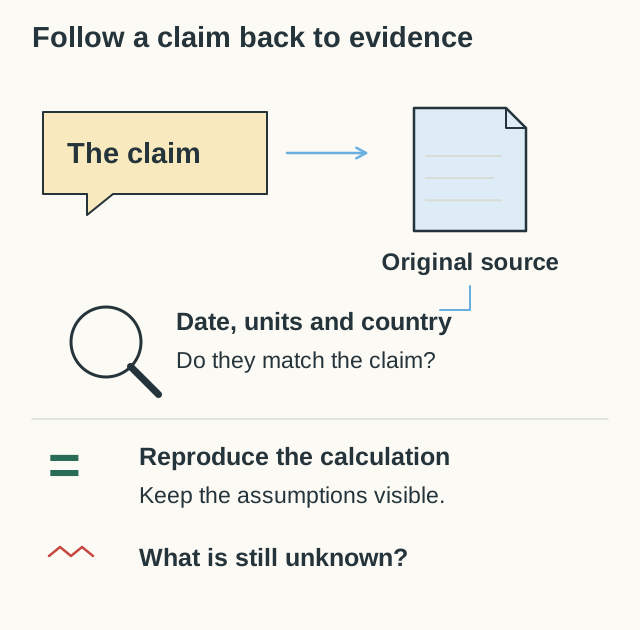
A backtest runs trading rules over past prices to see how they would have done. It is easy to test hundreds of rules and show only the best one. With enough tries, one will look brilliant by luck alone.
So ask when the record was made. Were the rules fixed first, then tested on prices that were not used to build them? Or were they adjusted until the past looked good? Our guide on how to backtest without fooling yourself explains the traps.
A , kept with dates while the trades happened, is much stronger evidence than any backtest. Even then, ask whether every account and every losing month is included.
Try it yourself
Press 'Generate 20 strategies' and find the best one. Then press 'Run it on new data' and see how it does next.
20 made-up strategies each win 50% of trades, like a coin flip, and risk 1% per trade over 100 trades. By chance, one ends ahead of the rest. On new data, every strategy still wins only 50% of the time, so the past winner has no edge.
What would you expect?
What this shows: All 20 strategies were coin flips. The best past record came from luck, so it says nothing about the next 100 trades.
Some sellers of AI bots show only the best of many tests. Ask for a live, dated record made before the rules were chosen, with every losing period included.
Yes. A ignores how big the wins and losses are. Compare two made-up demos. Each has 9 winning trades, 1 losing trade and a $0.20 cost on each of the 10 trades:
| Measure | Demo A | Demo B |
|---|---|---|
| 9 winning trades | 9 × $1 = $9 | 9 × $3 = $27 |
| 1 losing trade | −$20 | −$5 |
| Costs | 10 × $0.20 = $2 | 10 × $0.20 = $2 |
| Net result | $9 − $20 − $2 = −$13 | $27 − $5 − $2 = $20 |
Both demos are '90% accurate'. Demo A loses money. And even Demo B proves little: ten chosen trades say nothing about the losses that could come next.
Before you trust a headline number, ask for:
If you only get the winners, write 'not proven' instead of guessing that the rest were good.
A register entry is not an endorsement. It also may not cover everything the firm offers, so check what it is allowed to do. The maths, the evidence and the register are three separate checks. Passing one does not answer the others.
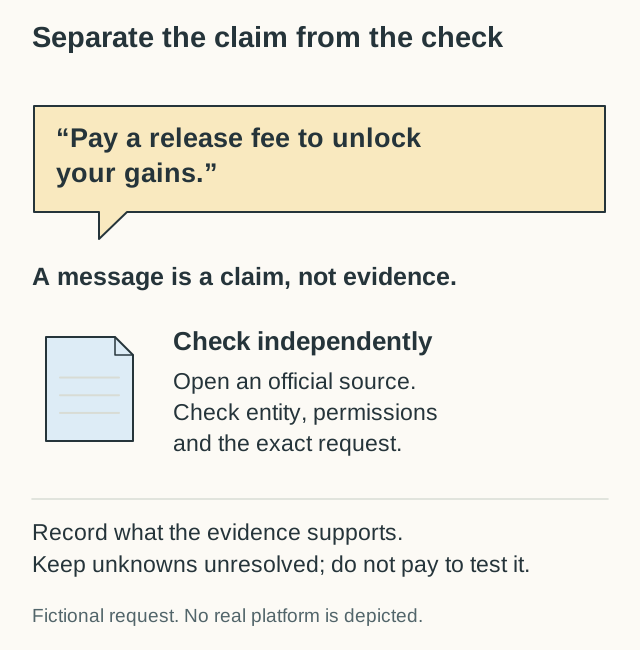
Never use contact details from an unexpected message to check that same message. Find the company's details yourself. If you have already sent money, stop sending more and report it to your country's regulator.
The same patterns appear in crypto scams and in trading guru offers.
AI can still help you learn. You can ask it to draft study questions, explain a term or organise your trading journal. Check every important fact against an original source, and ask what data the tool can see and how old it is.
That is very different from letting software place real orders, or trusting a predicted price. The same rule applies to AI chart analysis in practice apps, including our own Trading Game. Treat it as a second opinion to question, not a forecast.
To build skills without risking money, start with paper trading. A simulation can teach you the process, while leaving any profit claim unproven.
Some are real software, but the label proves nothing. Regulators warn that fraudsters use AI as a selling point. Check the company in the official register, ask for a full live record and never pay a fee to withdraw profits.
Usually that 9 in 10 trades or predictions were counted as correct. It says nothing about the size of the losses, the costs or how the trades were chosen. A bot can be right 90% of the time and still lose money.
No. A backtest shows how fixed rules would have done on past prices. If many rules were tried and only the best is shown, its result can be pure luck. A live, dated record is stronger evidence.
It can help you understand terms and draft questions. But it can be wrong or out of date, and it may sound sure when it is not. Check every fact in an original source before you rely on it.
Meet five famous currency and macro traders: Lipschutz, Soros, Kovner, Druckenmiller and Tudor Jones. Learn what their stories show, and what they hide.

Seven daily trading habits for beginners: plan before you trade, size from your stop, check the calendar, know your orders, count costs and review.