

Trading skills
AI Trading Claims: How to Check a Bot or Signal Before You Trust It
Learn to test AI trading bot claims: what '90% accurate' can hide, why a great backtest can be luck, and how to check the company behind the offer.
Anyone can post a big trading win. Learn to ask for the whole record, so you can judge a guru, a course or a copy trader on evidence.
A screenshot or a lifestyle photo is not proof of trading skill.
Before you pay any trading guru, ask for the profit claim in writing: the dates, the account size, the money added and taken out, and the risk taken. Then check it against a full record you can verify yourself. If they will not show it, walk away.
This page used to tell a personal story. A friend paid for a guru's course and lost money. The writer copied other traders instead and reported a gain of almost $2,000. We could not check any of it, so we don't repeat it as fact. It can't be used as proof.
A screenshot shows what a screen said at one moment. It does not show who owns the account, whether it was real money, or what was added and taken out. It doesn't show losses on trades that are still open, or the costs.
Even a true gain describes one period. It doesn't prove a skill that will repeat, or tell you what you would earn.
Three things often stand in for real results:
Add two more: urgency ("only 3 places left!") and promises of income. The US Federal Trade Commission (FTC) warns about coaching offers that promise income and then ask for more and more fees.
There is also a quieter trick. Someone can run many accounts or strategies, then show you only the best one. By luck alone, one of them will look brilliant. It is the same trap as a lucky test result: see how to backtest without fooling yourself.
Try it yourself
Press "Generate 20 strategies". Every one is pure coin flips. Look at the best one. Then press "Run them on new data" and watch what happens to it.
Twenty pretend traders each make 100 coin-flip trades, risking 1% each time. The typical account ends close to where it started. The luckiest one often shows a gain of around 20%, by chance alone. On new data, that star usually falls back into the pack, and it can even end near the bottom.
What would you expect?
What this shows: Among 20 accounts run on pure luck, one usually looks brilliant. Show only that one, and luck looks like skill.
That is why one great record isn't proof. Ask how many accounts, strategies or courses came before the one you are shown, and look at results after the person started selling.
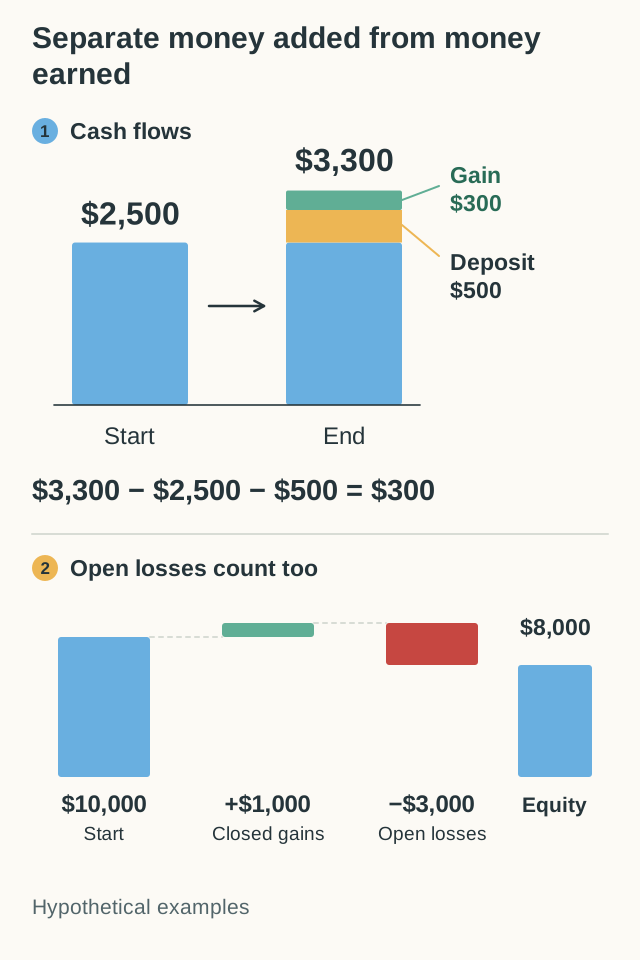
Start with the money that went in and out. The simple rule: profit = end balance − start balance − extra deposits + withdrawals.
Next, count everything else: trading fees, overnight charges, currency conversion, and trades that are still open. An account can show a profit on closed trades while its open trades are losing a lot.
Try it. A made-up account shows $900 profit on closed trades. Its open trades are down $700, and $100 of costs are not yet counted. The real result is $900 − $700 − $100 = $100. Quoting only the $900 would overstate it by $800.
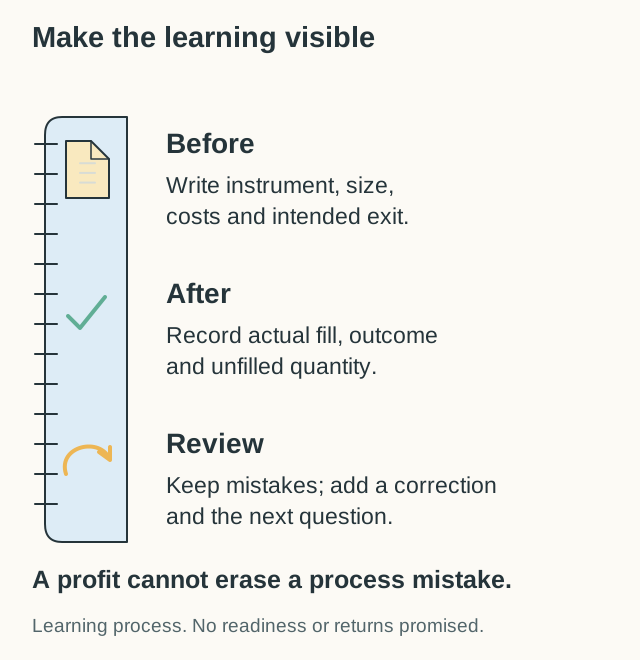
A course sells teaching, so judge it as teaching. Ask for:
A lesson on how orders work can be useful without any promise of profit. A "secret method" that will replace your salary is a warning sign. Don't borrow money to pay for a course. Free lessons from regulators and exchanges may cover what you need first.
Be fair, too. Don't call someone a fraud just because you dislike their photos. Check their actual claims and evidence.
Copying other traders can look like the better path. means your account copies another trader's trades automatically. It doesn't remove the need for checks.
Look at the assets, the , how concentrated the trades are, the costs, and how the trader is paid. Ask what happens if they change style, take more risk, or close trades while you are away. Copy trading platforms say on their own risk pages that past results and risk scores are no promise of future results. Followers who start on different dates can get different results.
You may also see research quoted to show that copying beats trading alone. A study of one platform in one period can't tell you what you will earn today. Find the original paper, its dates and its method before you trust a quote from it.
Read copy trading or a course: what you really pay for, and the 5 checks before copying a trader.
The SEC's February 2026 warning about social media scams makes the same point: check identities yourself, through sources you find on your own.
Ask for the full record: start balance, deposits, withdrawals, every trade, costs and the worst drop. Be wary of income promises, urgency, lifestyle photos and single screenshots. None of those prove skill.
Some teach useful skills. Check the lesson list, a free sample, the teacher's identity, the total price and the refund rules. Skip any course that promises income.
They are different things. A course sells teaching. Copy trading puts your money into someone else's trades. Both need evidence, and neither is a shortcut to income.
Learn to test AI trading bot claims: what '90% accurate' can hide, why a great backtest can be luck, and how to check the company behind the offer.
Meet five famous currency and macro traders: Lipschutz, Soros, Kovner, Druckenmiller and Tudor Jones. Learn what their stories show, and what they hide.