
Forex
The ABC of Forex Trading: Pairs, Pips, Lots and Leverage
Learn the forex basics in plain words: currency pairs, going long or short, pips, lots, the spread, and how leverage makes a small move cost a lot.
Learn why EUR/USD, USD/JPY and GBP/USD are worth watching in 2026, what moves each one, which dates matter into 2027, and what one bad move could cost.
No currency pair is the best one forever. Costs, news and your own timetable all change. So this page does not tell you what to buy. It shows three worth learning and watching in 2026 and into 2027, and why.
We looked for pairs with lots of trading, small costs and clear, scheduled news. In April 2025, EUR/USD made up 21.2% of all world currency trading. USD/JPY made up 14.3% and GBP/USD 7.6%, says the BIS survey. The BIS runs this survey every 3 years.
USD/CNY, the US dollar against the Chinese yuan, was a little bigger than GBP/USD, at 8.1%. We left it out. China's central bank sets a midpoint for the yuan each morning, and the yuan can only move up to 2% from it in a day. That is a different kind of market to learn.
| Pair | Share of world trading, April 2025 | Level, 16 Oct 2026 | Main 2026 story | Average spread at one UK provider |
|---|---|---|---|---|
| EUR/USD | 21.2% | 1.1253 | The ECB and the Fed both raised rates in September | About 0.8 |
| USD/JPY | 14.3% | About 158 | The Bank of Japan is raising rates, and Japan bought yen in April | About 0.9 pips |
| GBP/USD | 7.6% | About 1.33 | UK inflation of 3.1% and a split Bank of England | About 1.4 pips |
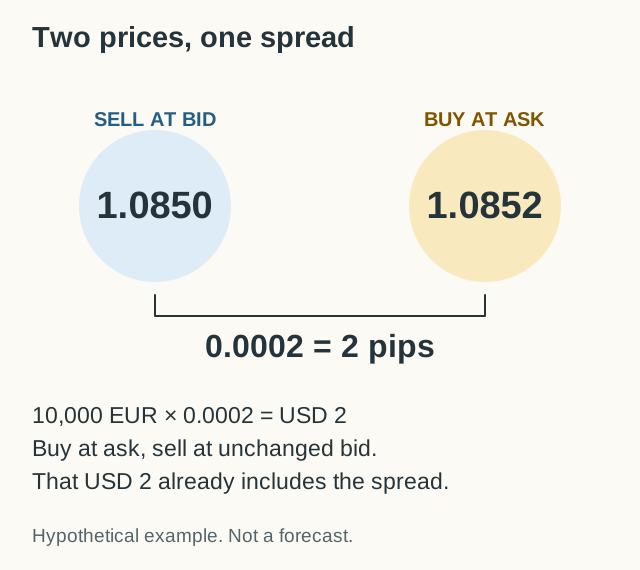
Levels come from ECB reference rates. The are one provider's published averages for the month before we checked, on 19 October 2026. Yours may differ, and spreads get wider around big news. See what a spread is.
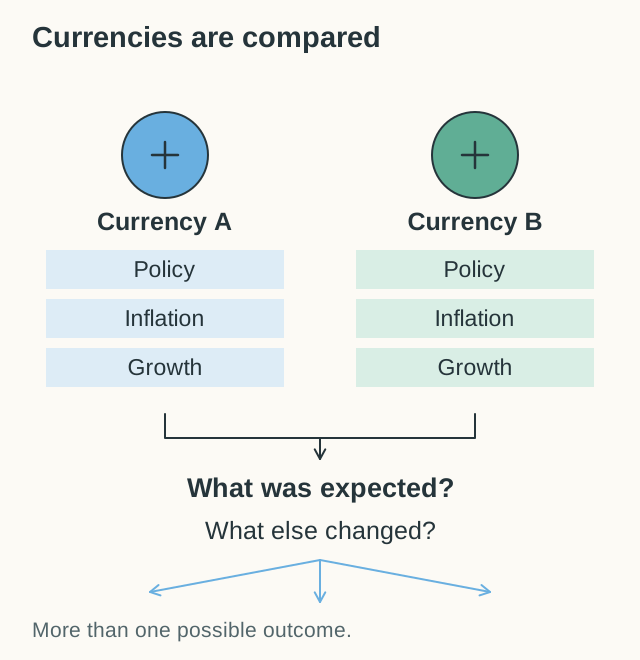
A big clue for each pair is the . That is the difference between the two central banks' rates. Money often moves toward the higher rate. But other news can beat that pull, so it is a clue, not a rule.
In 2026, a conflict in the Middle East pushed up energy prices and inflation. In September, both the Bank of England and the European Central Bank named it as a worry. Several central banks raised rates, or discussed it.
| Central bank | Rate | Latest change |
|---|---|---|
| US Federal Reserve (Fed) | 3.75% to 4.00% | Raised by 0.25 points on 16 September 2026, after a hold at 3.50% to 3.75% in July |
| European Central Bank (ECB) | 2.50% (deposit rate) | Raised in June and again on 10 September 2026 |
| Bank of Japan | About 1.25% | Raised to about 1.0% in June and about 1.25% on 18 September 2026 |
| Bank of England | 3.75% | Held on 17 September 2026, but 3 of 9 members wanted a rise |
The US dollar is in all three pairs. So one Fed decision, or one US jobs report, can move all of them at once. But the dollar sits on different sides. In EUR/USD and GBP/USD it is the second currency, the . In USD/JPY it is the first, the . A stronger dollar pushes the first two down and USD/JPY up. See how to read currency pairs.
The next Fed decisions are due on 28 October and 9 December 2026, then 27 January and 17 March 2027. The Fed calendar says each date is tentative until the meeting before it.
Try it yourself
Each card is real scheduled news or a real 2026 event. Sort it into the pair it hits most directly. Tap a card, then tap a box.
EUR/USD: the ECB decision on 29 October 2026 and euro-area inflation. USD/JPY: the Bank of Japan decision on 30 October 2026 and Japan buying yen. GBP/USD: the Bank of England decision on 5 November 2026 and UK inflation. All three: the Fed decision on 28 October 2026 and the US jobs report, because the US dollar is in every pair.
What would you expect?
What this shows: The US dollar is in all three pairs. One Fed decision can move them all, so three trades can really be one bet.
A stronger dollar pushes EUR/USD and GBP/USD down but USD/JPY up, because the dollar sits on a different side. Follow the central bank on both sides of each pair.
EUR/USD shows how many US dollars one euro buys. It is the most traded pair in the world. On 16 October 2026 the ECB reference rate was 1.1253.
In 2026, both sides raised rates. The ECB took its deposit rate to 2.50%. Its staff expect euro-area inflation of 3.0% in 2026 and 2.5% in 2027. The Fed went to 3.75% to 4.00%. So the gap favours the dollar by about 1.25 to 1.5 points. Watch whether each meeting makes that gap wider or smaller.
Dates to watch: ECB decisions on 29 October and 17 December 2026, then 4 February, 18 March, 29 April and 10 June 2027. Add the Fed dates above.
Busiest hours: usually when London and New York are both open. From 1 November 2026 that is about 13:00 to 17:00 UTC. See forex market hours.
Risk example: between 21 August and 7 October 2026, the ECB rate fell from 1.1699 to 1.1177, about 4.5%. A trade that bought 10,000 euros at 1.1699 would have lost $522 before costs.
USD/JPY shows how many Japanese yen one US dollar buys. It was about 158 in mid-October 2026, based on ECB reference rates for 16 October.
The Bank of Japan is slowly raising rates from very low levels. It moved to about 1.0% in June 2026 and about 1.25% in September. Two of its 9 board members voted against the September rise. With the Fed at 3.75% to 4.00%, the gap is still large, about 2.5 to 2.75 points. Japan also buys most of its energy from abroad, so high oil prices can weigh on the yen.
There is one more player: Japan's government. At the end of April 2026, with the yen near 160 per dollar, Japan bought yen to support it, RTHK reported. This is called . It can move the price fast and with no warning.
Dates to watch: Bank of Japan decisions on 30 October and 18 December 2026, then 22 January, 18 March, 28 April and 11 June 2027.
Busiest hours: the Tokyo session, about 00:00 to 09:00 UTC, and again when New York opens.
Risk example: you buy 10,000 dollars at 158 and the price drops to 154, about 2.5%. You lose 40,000 yen, about $260, before costs. A pip on this pair is 0.01, not 0.0001. See the pip value lesson.
GBP/USD shows how many US dollars one British pound buys. Traders often call it "cable". It was about 1.33 in mid-October 2026, based on ECB reference rates.
The UK's 2026 story is inflation. Prices rose 3.1% in the year to August, and the Bank of England expects more. On 17 September it held its rate at 3.75%, but 3 of its 9 members voted for a rise. A split vote tells you the next decision is less certain.
The UK and US rates are close, so the gap is small. That means inflation and jobs news on either side can matter more than the gap itself.
Dates to watch: Bank of England decisions on 5 November and 17 December 2026, then 4 February, 18 March, 29 April and 17 June 2027. The 5 November decision comes with a full Monetary Policy Report.
Busiest hours: the London session, about 08:00 to 17:00 UTC from 25 October 2026, when UK clocks go back. US clocks change a week later, on 1 November.
Risk example: on 10,000 pounds, each pip is worth $1. A spread of 1.4 pips costs $1.40 per trade. A fall from 1.3300 to 1.3150 is 150 pips: a $150 loss.
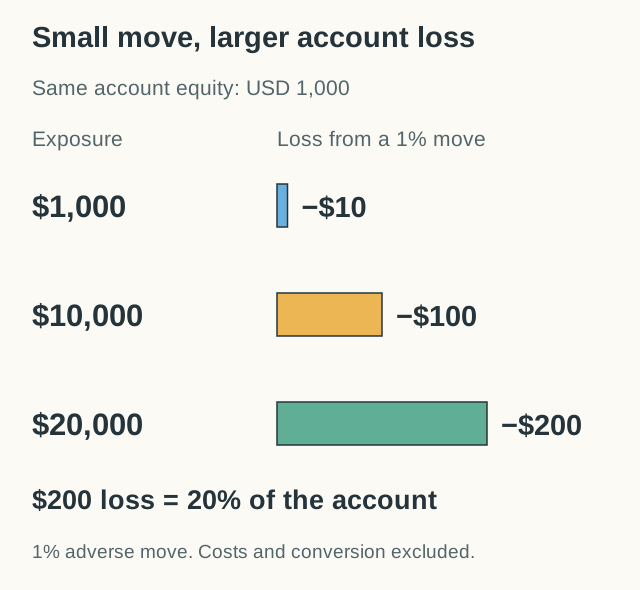
lets you open a big trade with a small deposit, called . It makes gains and losses bigger by the same amount.
Limits for everyday traders depend on where you live. In the US, the most is 50:1 on major pairs. In the UK, the EU and Australia, it is 30:1 for retail clients. Other countries have other rules, so check yours.
Go back to the EUR/USD example. Buying 10,000 euros at 1.1699 was a trade worth about $11,700. At 30:1, the deposit needed was about $390. With $1,000 in the account, the $522 loss took more than half of it in about 7 weeks. Your broker might have closed the trade even earlier.
No article, bank or app can tell you which way a pair will move. A rate gap can widen, then reverse at the next meeting. A government can step in overnight.
In 2017, we suggested three different pairs to watch. EUR/GBP was chosen for Brexit, USD/JPY as a gauge of market mood, and EUR/NOK for oil. Here is where they stood in October 2026, next to their 2017 averages.
| Pair | 2017 average | 16 Oct 2026 | What changed |
|---|---|---|---|
| EUR/GBP | About 0.877 | 0.844 | The pound gained about 4% against the euro |
| USD/JPY | About 112 | About 158 | One dollar bought about 41% more yen |
| EUR/NOK | About 9.34 | 10.62 | One euro bought about 14% more kroner |
The 2017 averages are worked out from Federal Reserve data, and the 2026 levels are ECB reference rates. The 2017 suggestions did not predict these long moves. Smaller pairs also cost more: one UK provider's average EUR/NOK spread was about 38 pips. As a share of the price, that is about 5 times the EUR/USD spread.
Next, read what influences exchange rates, or follow the forex learning path.
There is no permanent best pair. In 2026, EUR/USD, USD/JPY and GBP/USD are worth learning. They trade a lot, usually have small spreads and follow scheduled central bank news. Pick one, learn its dates, and practise with virtual money first.
The US dollar and the Japanese yen are two of the biggest currencies. In the BIS April 2025 survey, USD/JPY made up 14.3% of all currency trading, second only to EUR/USD. Heavy trading helps keep spreads small. It does not make the pair easy: in 2026 it also faced Bank of Japan rate rises and Japanese intervention.
No. They were based on 2017 news, and those forecasts have expired. The pairs still trade, but EUR/GBP and EUR/NOK usually cost more per trade than the three majors here.
Learn the forex basics in plain words: currency pairs, going long or short, pips, lots, the spread, and how leverage makes a small move cost a lot.

Learn the risk-reward ratio formula with a simple EUR/USD example, the win rate you need to break even, and why a bigger target is not always better.