
Forex
15 Forex Strategies and Patterns for Beginners (and How They Fail)
15 forex strategy ideas and chart patterns, from head and shoulders to carry trades: what each one bets on, how it fails and how to test one honestly.
Margin is the money a broker locks for a trade. Leverage is how big the trade is compared with your money. See why the trade size, not the margin, decides what a move costs you.
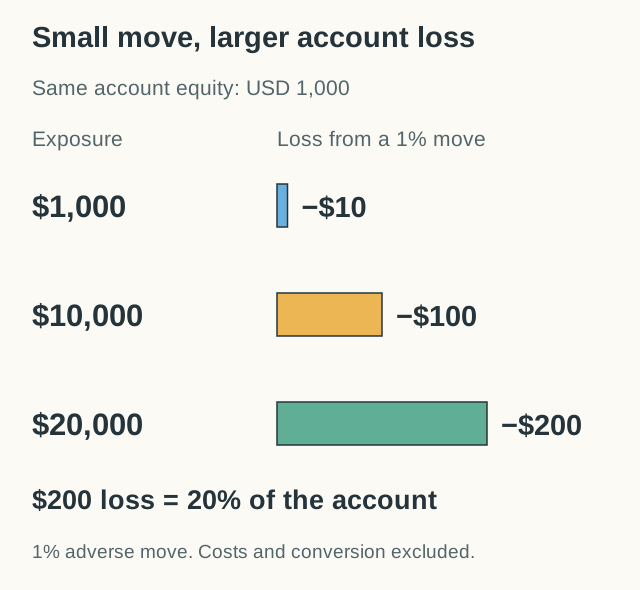
Say you put $1,000 into a trading account. Then you open a EUR/USD trade worth $10,000. You do not need $10,000 for this. The broker only locks a small part of your money while the trade is open.
That locked part is the . If the broker asks for 2% margin, it locks 2% of $10,000. That is $200. Margin is a deposit for the trade, not a fee. It comes back when the trade closes, plus any gain or minus any loss.
compares the size of the trade with your money. A $10,000 trade on $1,000 is 10 times your money, so the leverage is 10:1. Brokers often write this as 1:10. Both mean the same thing.
The whole trade is also called your . Its size is what counts when the price moves.
Your gain or loss is worked out on the whole trade, not on the margin. If EUR/USD falls 1% while you hold your $10,000 trade, you lose $100. That is 10% of your $1,000.
Now open a $20,000 trade with the same $1,000. That is 20:1 leverage. The same 1% move now costs $200, or 20% of your money. Double the leverage, double the loss.
| Leverage | Trade size | Loss from a 1% move | Share of your $1,000 |
|---|---|---|---|
| 1:1 | $1,000 | $10 | 1% |
| 10:1 | $10,000 | $100 | 10% |
| 20:1 | $20,000 | $200 | 20% |
| 30:1 | $30,000 | $300 | 30% |
| 50:1 | $50,000 | $500 | 50% |
| 100:1 | $100,000 | $1,000 | 100% |
It works both ways. A 1% move in your favour adds the same amount. Real trades also have costs, such as the spread, so every result is a little worse than this table.
Try it yourself
Keep the $1,000 deposit. Set leverage to 1:10 and press "Move the price". Then try 1:30, 1:50 and 1:100.
With $1,000 and a 1% move against you: at 1:1 you lose $10, at 1:10 you lose $100, at 1:30 $300, at 1:50 $500 and at 1:100 the whole $1,000. Costs are not included.
What would you expect?
What this shows: Leverage multiplies the move. A 1% move against you costs 1% of your $1,000 at 1:1, 30% at 1:30 and all of it at 1:100.
Your gain or loss is worked out on the full trade size, not on your deposit. The same price move simply counts more when the trade is bigger.
No. Margin is not a limit on your loss. To see why, keep the trade the same and change only the margin rule.
| What you see | 2% margin | 5% margin |
|---|---|---|
| Money in your account | $1,000 | $1,000 |
| Margin locked | $200 | $500 |
| Loss if EUR/USD falls 1% | $100 | $100 |
The broker locks a different amount, but the trade is the same size. So the 1% move costs $100 in both cases. A lower margin rule does not make a trade safer. It only lets you open a bigger trade with the same money.
Be careful with adverts that say you can trade with "only $200". That is the margin. Your loss depends on the trade size and how far the price moves. It can be much more than $200.
As a trade loses, the money left above your margin gets smaller. When too little is left, the broker can ask you to add money. This is a . The broker can also close your trades, and it may not wait for you.
A tells the broker to close your trade at a set price. It helps, but it is not a promise. If the price jumps past your level, called a , the trade can close at a worse price.
Can you lose more than you put in? That depends on where you live:
Rules change and accounts differ. Read your broker's agreement to see when it can close your trades.
Many countries limit the leverage a broker can offer everyday traders. The limits below are for major pairs such as EUR/USD. They are a ceiling, not a target.
| Where you live | Major pairs | Other pairs | Rule |
|---|---|---|---|
| United States | 50:1 (2% margin) | 20:1 (5% margin) | CFTC rule for retail forex |
| United Kingdom | 30:1 | 20:1 | FCA rules for retail CFDs, since 2019 |
| European Union | 30:1 | 20:1 | EU rules for retail CFDs, since 2018 |
| Australia | 30:1 | 20:1 | ASIC order for retail CFDs, since March 2021 |
| Canada | Ask your dealer | Ask your dealer | Check the dealer's agreement and Canadian rules |
Look back at the first table. At 50:1, a 1% move costs half your money. At 30:1, it costs 30%. So even the legal maximum can hurt fast.
Some brokers based in other countries advertise 100:1 or more. A broker offering more than your country allows may not have permission to serve you. Check it first with the broker verification checklist.
Start from the loss you can accept, not from the most your broker allows. Before any trade, answer 3 questions:
Next, plan where you would exit with the risk-reward lesson. To turn price moves into money for any pair, go back to the pip value lesson. Try your numbers with virtual money before you use real money. Our forex broker comparison lists the leverage limits and protections by country.
Your trade can be up to 30 times the money you put down. With $1,000, you could open a trade worth up to $30,000. A 1% move on that trade is $300, gained or lost.
No. Higher leverage only lets a small amount of money open a bigger trade, so the same price move makes a bigger gain or loss. You can always use less than your broker's maximum.
It depends on where you live. In the US, the CFTC warns that forex losses can be bigger than your deposit. In the UK, EU and Australia, retail CFD accounts have negative balance protection, so losses stop at the money in that account.
No. Margin is money the broker locks while your trade is open. It is released when the trade closes. Your costs are things like the spread, commission and overnight financing.
15 forex strategy ideas and chart patterns, from head and shoulders to carry trades: what each one bets on, how it fails and how to test one honestly.
Find better eToro traders to copy in 5 steps: check the record, the deepest fall, big bets, the risk score and who gets paid, before you risk money.