
Forex
15 Forex Strategies and Patterns for Beginners (and How They Fail)
15 forex strategy ideas and chart patterns, from head and shoulders to carry trades: what each one bets on, how it fails and how to test one honestly.
Saying a trade moved 20 pips tells you nothing about money. Learn the two things that turn pips into dollars: your trade size and the quote currency.
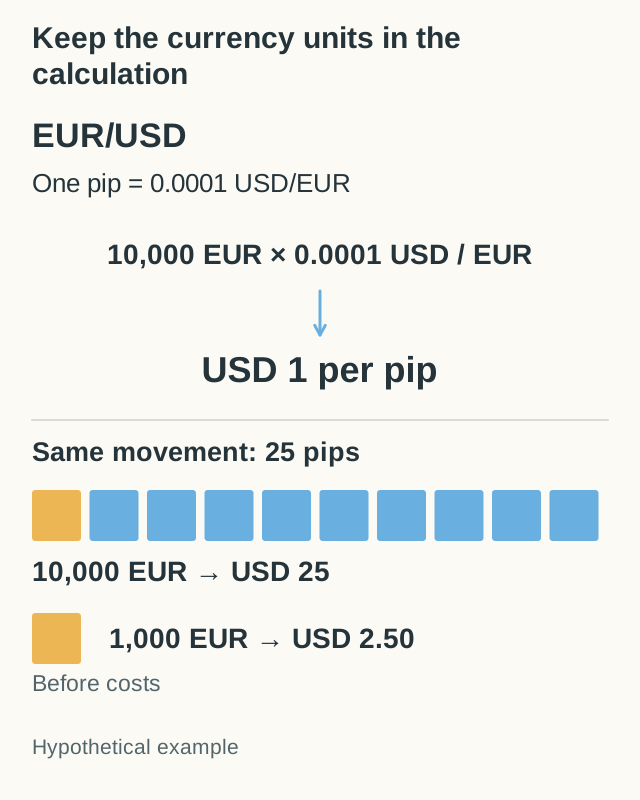
A is the usual small step in a currency price. For EUR/USD, USD/CAD and most other pairs, one pip is 0.0001. For pairs with the Japanese yen, such as USD/JPY, one pip is 0.01.
Many platforms show one more digit. A move from 1.10000 to 1.10001 is a tenth of a pip, often called a . So a pip is not always the smallest change you see on screen.
Traders count price moves in pips. "EUR/USD rose 25 pips" means it went up by 0.0025, for example from 1.1000 to 1.1025.
Metals and other products can follow different rules, so check the contract details for anything you trade. If pairs are new to you, read how to read currency pairs first.
EUR/USD tells you how many US dollars one euro costs. So a change in the price is a number of dollars per euro. Multiply it by the number of euros you hold, and you get dollars.
Say you buy 10,000 euros at 1.1000 and sell them at 1.1025.
| Step | Sum | Answer |
|---|---|---|
| Price change | 1.1025 − 1.1000 | 0.0025 |
| Pips | 0.0025 ÷ 0.0001 | 25 pips up |
| One pip | 10,000 × 0.0001 | $1 |
| Result | 10,000 × 0.0025 | $25 gain |
If the price falls 25 pips to 1.0975 instead, the change is minus 0.0025, and you lose $25. Keep the minus sign all the way through the sum. And if you had sold (gone short) instead of buying, the same rise would have cost you $25.
Here is a handy rule for any pair that ends in USD, such as EUR/USD, GBP/USD or AUD/USD. Every 10,000 units you hold makes each pip worth $1.
Try it yourself
Keep the move at 20 pips. Change the trade size from 1,000 to 10,000 to 100,000 and watch the money. Then switch to USD/JPY.
On EUR/USD, 20 pips is worth $2 on 1,000 euros (a micro lot), $20 on 10,000 (a mini lot) and $200 on 100,000 (a standard lot). On USD/JPY at 150, 20 pips on 10,000 dollars is 2,000 yen, about $13.33.
What would you expect?
What this shows: On EUR/USD, the same 20-pip move is worth $2, $20 or $200. Your trade size, not the pip count, decides the money.
Each step up in size multiplies the money by 10. On USD/JPY the answer starts in yen: 20 pips on 10,000 dollars is 2,000 yen, about $13.33 at 150 yen per dollar.
Platforms count trade size in units or in . A standard lot is 100,000 units of the first currency. A mini lot is 10,000, and a micro lot is 1,000. Most forex brokers use the same sizes.
| Size | Euros | One pip | 20 pips |
|---|---|---|---|
| Micro lot | 1,000 | $0.10 | $2 |
| Mini lot | 10,000 | $1 | $20 |
| Standard lot | 100,000 | $10 | $200 |
Check how your platform counts. On one app, typing 1 can mean one unit. On another, 1 can mean a whole standard lot, which is 100,000 times bigger.
Small sizes are useful while you learn. With a micro lot of 1,000 euros, a 20-pip move against you costs $2, not $200.
When you do the maths, write the size in full units. Round only the final money answer.
The money always comes out first in the pair's second currency, the . For EUR/USD that is US dollars, so with a US dollar account you are done. For USD/CAD it is Canadian dollars. For USD/JPY it is yen.
Say you buy 10,000 US dollars of USD/CAD. One pip is 0.0001 Canadian dollars per US dollar, so each pip is worth CAD 1. A 27-pip gain is CAD 27.
If your account is in US dollars, convert it. At USD/CAD 1.3500, divide: CAD 27 ÷ 1.35 = $20. A different rate gives a different answer, and your provider may charge for the conversion.
USD/JPY works the same way. One pip on 10,000 dollars is 100 yen. At 150 yen per dollar, that is about $0.67.
No. The sums above give the gross result, before costs. The spread, commission, overnight fees and currency conversion can all change what you keep.
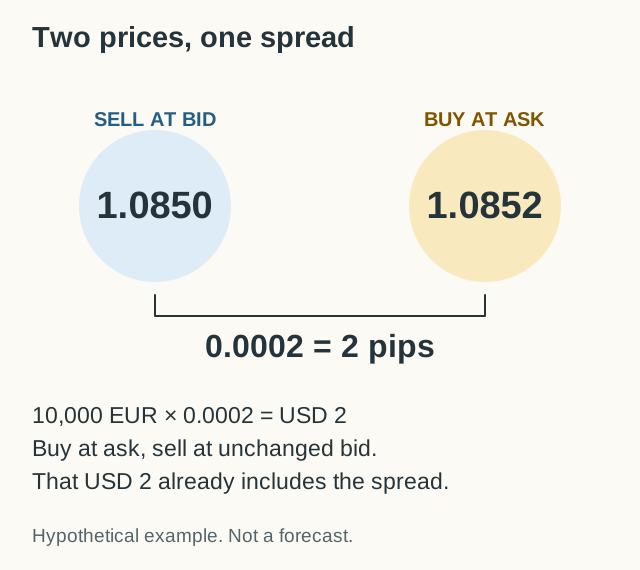
Use the real prices you traded at: the ask when you bought and the bid when you sold. Then the is already inside your answer, so don't subtract it a second time.
In a fast market, your exit can also fill at a worse price than you planned. This is called . A pip sum shows what a move is worth. It does not promise what you will get.
Try each one before you read the answer. All the numbers are made up, and costs are left out.
Next lesson: what the spread costs you. After that, see how margin and leverage change the size of a trade, and how to plan risk and reward. Remember that a stop order cannot promise your loss limit, because prices can jump past it. When you compare providers, our forex broker guide uses this same 10,000-euro example to compare costs.
It depends on the pair and your trade size. On EUR/USD, one pip is worth $0.10 on 1,000 euros, $1 on 10,000 and $10 on 100,000. For other pairs, work it out in the second currency first, then convert.
Multiply your trade size by the pip size. The answer is in the second currency of the pair. For example, 10,000 euros × 0.0001 = $1 per pip on EUR/USD. If your account uses another currency, convert at the current rate.
One yen is worth much less than one dollar or euro, so yen pairs are quoted with fewer decimals, such as USD/JPY 150.00. The usual small step is therefore 0.01 instead of 0.0001.
15 forex strategy ideas and chart patterns, from head and shoulders to carry trades: what each one bets on, how it fails and how to test one honestly.
Find better eToro traders to copy in 5 steps: check the record, the deepest fall, big bets, the risk score and who gets paid, before you risk money.