
Forex
How Much Is a Forex Pip Worth?
Learn what a pip is and how to turn a pip move into money on EUR/USD, USD/CAD and USD/JPY, and why your trade size matters more than the pip count.
Six short tasks turn forex lessons into practice. Do them with a calculator or a simulator, then check your answers. The goal is correct sums, not a big pretend profit.

These 6 tasks turn forex lessons into practice. You can do them with a calculator, or with virtual money in a simulator. All prices and balances here are made up for practice. They are not live quotes or trade ideas.
First, pick one practice balance and keep it. We use $2,000. If your simulator hands you $100,000, keep your own $2,000 record next to it. Huge pretend balances make huge trades feel normal.
For every practice trade, write down the date, the pair, the time zone of your chart and the fees you assume. Pick one major pair, such as EUR/USD, and keep each trade small. Set a every time.
Task 1. Say USD/CAD 1.3500 in words. Which currency gets stronger if the price falls to 1.3300? Does a long USD/CAD trade gain or lose?
Answer: 1 US dollar costs 1.35 Canadian dollars. After the fall, each US dollar buys fewer Canadian dollars, so the Canadian dollar got stronger. The long USD/CAD trade loses, before costs. If this felt hard, go back to how to read currency pairs.
Task 2. EUR/USD is 1.1000 to sell (the ) and 1.1002 to buy (the ). You buy 5,000 euros, then sell at once. There is no commission. How much do you lose, in dollars and in ?
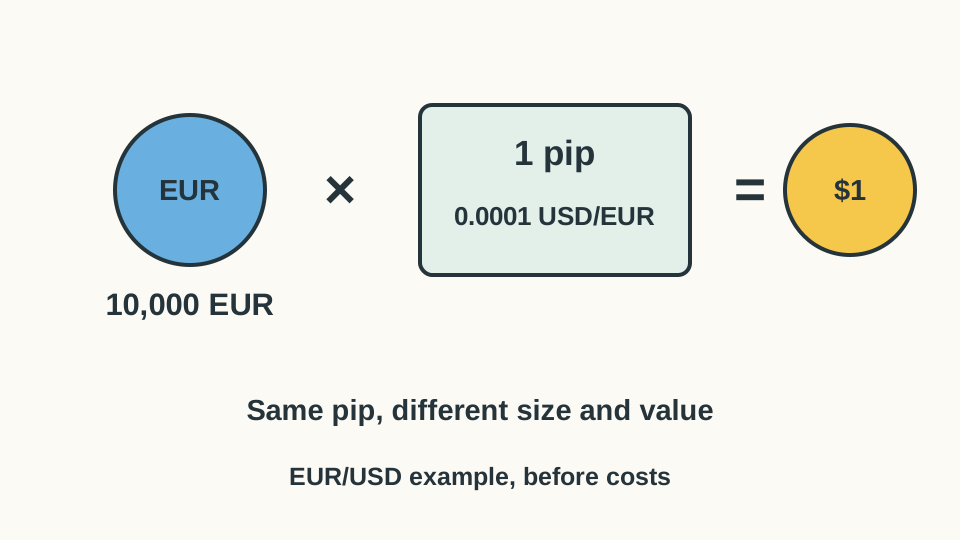
Answer: 5,000 × 0.0002 = $1. That is 2 pips, and each pip is worth $0.50 on this trade. If the broker also charged $0.50 each way, the total would be $2. Compare with the spread lesson.
Task 3. Your $2,000 account holds a $10,000 trade. The price moves 1% against you. Ignore costs. What do you lose? Does a small requirement change the answer?
Answer: 1% of $10,000 is $100, which is 5% of your $2,000. Margin does not change it. Margin is money the broker locks, not a limit on your loss. Depending on your country and account, you can even lose more than the margin. See margin vs leverage.
Task 4. You decide this trade may lose at most $10. Your stop is 25 pips away on EUR/USD. How many euros can you trade? What if the broker's smallest trade is 10,000 euros?
Answer: $10 ÷ 25 pips = $0.40 per pip. On EUR/USD, 10,000 euros make $1 per pip, so $0.40 per pip means 4,000 euros. At 10,000 euros, the same 25 pips would cost $25. That does not fit your plan, so skip the trade. Do not move the stop closer just to make a bigger trade fit.
The $10 is a practice number, not advice. A price jump can still make the loss bigger than planned.
Try it yourself
Start with a $2,000 account, 0.5% risk and a 25-pip stop. Read the trade size. Then slide the risk up to 5% and watch the losing-streak bar.
With $2,000, a 0.5% loss limit is $10. A 25-pip stop on EUR/USD then allows $0.40 per pip, which is 4,000 euros. At 5% risk the limit is $100 and the size is 40,000 euros, so a losing streak does far more damage.
What would you expect?
What this shows: Size the trade from your loss limit: $10 and a 25-pip stop mean 4,000 euros. Risk more, and it takes fewer losses to halve the account.
The biggest trade your broker allows is not a plan. Your stop distance and the money you accept to lose decide the size. Costs and price jumps can still make a loss bigger.
A one-hour opens at 1.1000. It reaches a high of 1.1040 and a low of 1.0980, then closes at 1.1020. You were long with a target at 1.1030 and a stop at 1.0990. Which order filled first?
Answer: you cannot tell from this candle. Both prices sit inside its range. The candle shows only 4 prices: open, high, low and close. It does not show the order in which they happened.
To score this trade, you need more detailed price data. Or you can use a careful rule, such as "if both were touched, count it as a loss". Never count it as a win just because the candle closed higher.
This matters a lot when you test a strategy on past prices. See the chart lesson and how to backtest.
Imagine the prices freeze just after you press "Buy". The screen does not say if your order went through. What do you check before you try again? Do this task on paper, not in a real account.
Answer: check 3 places first:
Then check your internet connection. If you still cannot tell, use the broker's support line or emergency contact.
Do not just press "Buy" again. If the first order did go through, you would now have 2 trades and twice the risk. Closing the app or the browser does not cancel an order the broker has already accepted.
A practice journal turns trades into lessons. Write the plan before the trade, and the review after it.
| Part | What to write |
|---|---|
| Plan | Pair, direction, rule and a reason to skip the trade |
| Sums | Size, pip value, costs and planned loss |
| What happened | Sent, filled, rejected or unclear |
| Result | Result after costs, and any rule you broke |
| Review | What went wrong and how to stop it happening again |
Keep your mistakes in the journal. If you reset the account after every loss, your record will look far better than reality.
Judge your process apart from the result. A winning trade that broke your rules is still a mistake. A losing trade that followed the plan may be fine. If any answer above is still unclear, return to the 7-step forex course. This workbook sets no deadline for using real money.
Both help. Paper is best for the sums. A simulator helps you learn the buttons and order screens. Neither shows how you will feel when real money is at risk.
It can be. Big pretend balances make big trades feel normal. Keep your own record with a balance you could really afford, such as $2,000, and size every practice trade from that.
No number proves you are ready. Keep practising until every task here feels easy, and your journal shows you follow your own rules. Using real money is never required.
Learn what a pip is and how to turn a pip move into money on EUR/USD, USD/CAD and USD/JPY, and why your trade size matters more than the pip count.
Learn the forex basics in plain words: currency pairs, going long or short, pips, lots, the spread, and how leverage makes a small move cost a lot.