

Stocks & investing
What Is Market Capitalization?
Market cap is share price × number of shares. See why a $5 share can belong to a bigger company than a $100 share, and how size groups and splits work.
Buy and hold sounds easy: buy, then wait. The hard part is holding on when prices fall. Learn to build a plan you can actually stick with.

means choosing investments you plan to keep for many years. You don't try to profit from short-term ups and downs. It can make investing simpler and cheaper, because you trade less.
| Buy and hold | Frequent trading | |
|---|---|---|
| How long you hold | Years | Minutes to weeks |
| How often you trade | Rarely | Often |
| Trading costs | Low | Higher, because every trade costs something |
| What you watch | Your plan and what you own | Short-term price moves |
But buy and hold does not make returns smooth. A weak company can stay weak for years, and even a well-spread portfolio can fall a lot. You still need to check what you own from time to time.
The hard part is rarely the buying. It is holding on when prices fall and every headline says "sell".
Try it yourself
You put $1,000 into a made-up broad stock fund. Watch the price play out. At each stop, choose Hold or Sell, then compare your result at the end.
In this illustration, $1,000 in a broad stock fund fell about 28%, to about $716, early on. Selling during that fall locked in a loss. Holding to the end left about $1,476.
What would you expect?
What this shows: Selling in a fall turns a loss on screen into a real one. In this illustration, holding through the drop ended well above the start.
Real markets make no promise to recover, and a single company may never come back. Buy and hold only works if you can afford to wait. That is why the plan comes before the purchase.
First decide when you will need the money and how big a fall you could live with. Savings for retirement in 30 years can wait out a bad year. A home deposit needed in two years cannot.
To hold through a fall, you need two things. You need the nerve to watch your balance drop. And you need enough cash elsewhere, so you are never forced to sell. The SEC, the US markets regulator, has a guide to asset allocation that links these choices to your time and your comfort with risk.
Time alone cannot fix a weak investment. For a company, examine the business, debt, cash and competition. For a fund, check its goal, holdings, fees and concentration.
A broad fund spreads your money, but it can still lean on one country, one industry or a few giant companies. Owning several funds that hold the same companies adds work without much extra safety. See how to diversify.
So when should a buy-and-hold investor sell? Good reasons include:
A falling price alone is a reason to look closer. It does not prove you should sell, or buy more.
means you earn returns on your earlier returns, not just on the money you put in. Suppose $1,000 grows by a steady 5% a year, with no fees or taxes. It becomes $1,050, then $1,102.50, then $1,157.63.
Real share returns are never steady. A 20% gain followed by a 20% loss does not bring you back to the start. $1,000 rises to $1,200 and then falls to $960.
| Path | After year 1 | After year 2 | Total change |
|---|---|---|---|
| +5%, then +5% | $1,050 | $1,102.50 | +10.25% |
| +20%, then −20% | $1,200 | $960 | −4% |
| −20%, then +20% | $800 | $960 | −4% |
The average of +20% and −20% is zero, but you lost 4%. So don't judge results by averaging percentages. The order of good and bad years also matters when you add or take out money.
A common habit is to add a fixed amount on a schedule. With $50 each time, you get 2 shares when a made-up share costs $25, and 1 share when it costs $50. You automatically buy more when prices are low. This makes the habit easier, but it does not promise a profit.
You may already have a , a large amount to invest at once. Spreading it out means some money waits in cash for longer. That can feel calmer, but it is a choice with its own costs.
Fees keep running while you hold. A 0.2% yearly fee on $10,000 is about $20 a year, and a 1% fee is about $100. Over 20 years the gap grows much bigger.
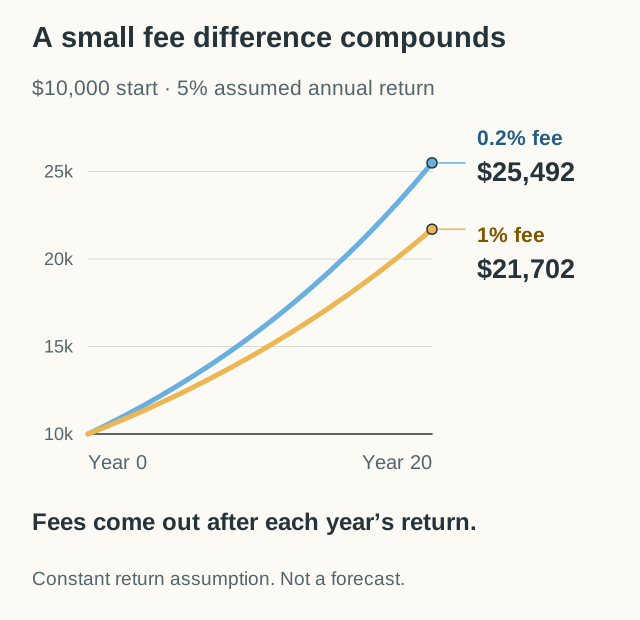
Read the fund's documents and the SEC's guide to fund fees. The ETF vs mutual fund cost guide shows how to compare them.
Set a review date, such as every six months. Decide in advance what would make you act: one of the selling reasons above, or a big drift in your mix. A busy news day is not on the list.
brings your mix back to plan. Say you aim for 60% shares and 40% bonds on $10,000, but you now hold $7,000 in shares and $3,000 in bonds. That is 70/30. Moving $1,000 from shares to bonds restores 60/40, before costs and tax. New money can do the same job.
Next, learn how companies share profits in dividend investing, or write your review rules into your first investment plan.
No. It means not trading short-term moves. You still review what you own, and you may sell when you reach your goal, your plans change or the reason you bought no longer holds.
No. It depends on what you hold and how long you can wait. A single company can fail and never recover, and even broad markets have had falls that took years to recover. Nobody can promise the future.
A crash is a reason to check your plan, not an automatic signal. Selling after a big drop locks in the loss. But if you need the money soon, or the reason you bought has changed, selling may still be right.
They are different activities. Buy and hold trades rarely, so costs stay low. Frequent trading costs more and needs constant attention, and many small costs and losses can add up. Choose based on your goal, time and skills.
Market cap is share price × number of shares. See why a $5 share can belong to a bigger company than a $100 share, and how size groups and splits work.
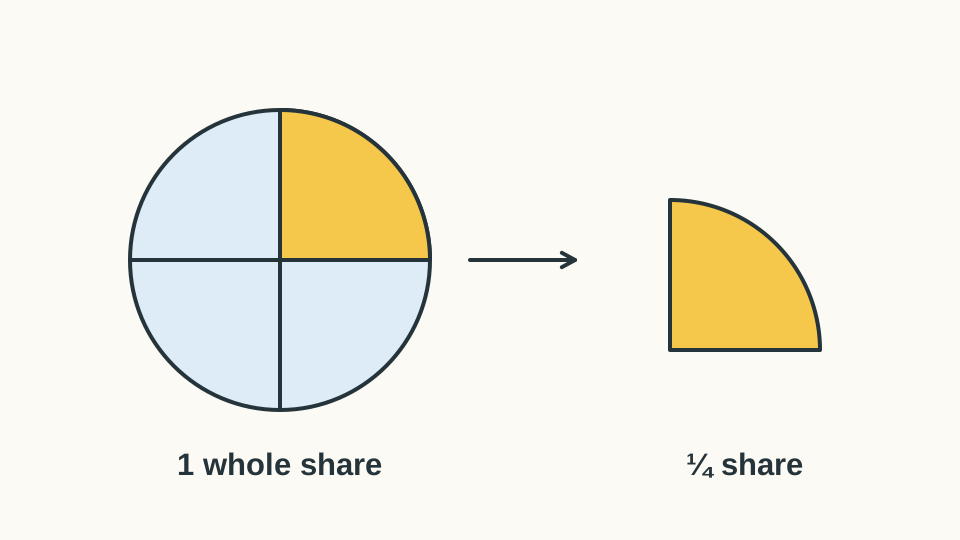
A fractional share lets $50 buy part of a $200 share. Learn how fractions move with the price, how dividends work and what to ask your broker first.