
Stocks & investing
10 Best Free Investing Tools for Beginners (2026)
10 free investing tools for beginners: calculators, fee checkers, company filings, charts, screeners, trackers and a practice app, with each tool's limits.
A $5 share can belong to a bigger company than a $100 share. Here’s how to compare their size without being misled by the price of one share.

, or market cap, is the value the stock market puts on all of a company's shares. To find it, multiply two numbers:
The number of shares means all the shares that investors own, called . Don't use the number of shares traded today. That is trading volume, and it is a different thing.
| Company | Share price | Shares | Market cap |
|---|---|---|---|
| Maple Tools | $25 | 80 million | $2 billion |
| Harbor Software | $5 | 600 million | $3 billion |
| North Works | $100 | 10 million | $1 billion |
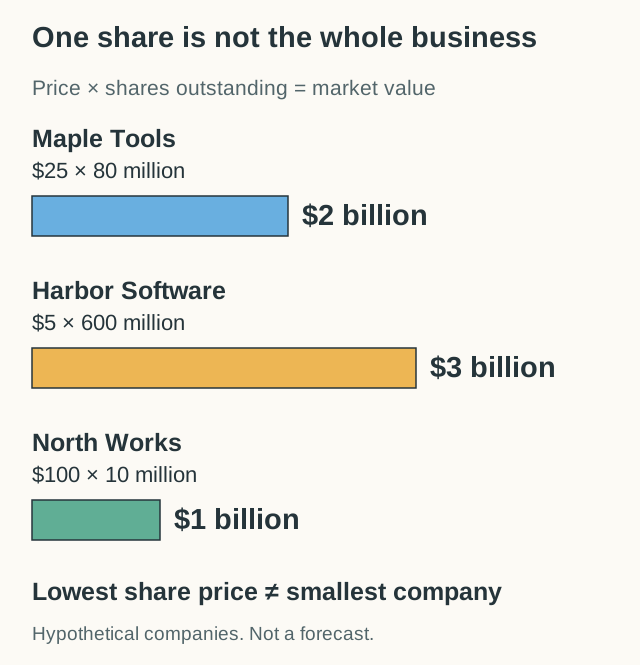
Harbor has the cheapest share but the biggest market cap. North has the most expensive share but is the smallest company. Calling Harbor a bargain because its share costs $5 mixes up the price of one piece with the value of the whole.
Try it yourself
Harbor's share costs $5 and North's costs $100. Guess which company is bigger, then move the price and share sliders and watch the scale tip.
Harbor Software: $5 × 600 million shares = $3 billion. North Works: $100 × 10 million shares = $1 billion. The cheaper share belongs to the company that is 3 times bigger.
What would you expect?
What this shows: A cheap share is not a small company. Harbor's $5 share belongs to a $3 billion company, 3 times bigger than North at $100 a share.
Market cap multiplies the price by the number of shares. Harbor has 600 million shares and North only 10 million, so the share price alone can't tell you which company is bigger.
Keep Maple's 80 million shares the same. If the price rises from $25 to $30, the market cap grows from $2 billion to $2.4 billion. That is a 20% rise. If the price falls to $20, the market cap drops to $1.6 billion.
No cash moves in or out of the company's bank account when this happens. The market is simply paying a different price for the same shares.
The number of shares can change too. Say the price stays at $25 but Maple goes from 80 million to 88 million shares. The market cap becomes $2.2 billion. The company may have sold new shares to raise money, bought another business with shares or paid staff in shares.
Ask what the company got in return. A bigger market cap does not prove that each existing owner is better off. Each old share is now a smaller slice of the company.
In a , a company cuts each share into more pieces. Suppose Maple does a two-for-one split. Its 80 million shares at $25 become 160 million shares at $12.50. The market cap is still $2 billion.
If you owned 20 shares worth $500, you now own 40 shares, still worth $500. The share count doubled; the factories, sales and cash did not.
Real prices can still move around a split, because buyers react to many things. But the split itself only changes the number and size of the pieces.
This is also why price charts must be adjusted for splits. Without the adjustment, a chart would show a 50% "crash" that never happened. See how to read stock charts.

Investors sort companies into size groups by market cap. FINRA, a US regulator, gives these example ranges in US dollars:
| Group | Market cap |
|---|---|
| Mega-cap | $200 billion or more |
| $10 billion to $200 billion | |
| Mid-cap | $2 billion to $10 billion |
| $250 million to $2 billion | |
| Micro-cap | Less than $250 million |
By these ranges, Harbor ($3 billion) is a mid-cap and North ($1 billion) is a small-cap. Maple sits right on the $2 billion line between the two. FINRA notes that the lines between groups vary. Fund and index providers set their own limits, and a range in US dollars won't match one in Canadian dollars. Check the method behind any label. Read FINRA on market cap.
Many stock market indexes, which track a group of shares, are weighted by market cap. That gives bigger companies more influence on the result. But size is a description, not a safety label. A large company can still be overpriced or in trouble.
Not quite. Market cap only values the shares. A buyer of the whole company would also take on its debt and get its cash.
A simple version of starts with market cap, adds debt and subtracts cash. Say Maple has a $2 billion market cap, $600 million of debt and $200 million of cash. Its simple enterprise value is $2 billion + $600 million − $200 million = $2.4 billion. Real calculations include more items.
So two companies with the same market cap can carry very different debts. Next, see how to buy part of an expensive share in fractional shares. To learn how funds hold many companies at once, read ETF vs mutual fund, or go back to stock market basics.
No. It only measures size, at today's price. A big company can be overpriced or in trouble, and a small one can do well. Use market cap as a starting point for research, not as a verdict.
Yes. It moves with the share price while the market is open. It also changes when the number of shares changes, for example when a company sells new shares or buys back old ones.
Not exactly. A buyer would also take on the company's debt and get its cash. Enterprise value tries to include those, so it can be higher or lower than market cap.
No. You get more shares at a lower price each, so the total value stays the same at the moment of the split. Later price moves are a separate matter.
10 free investing tools for beginners: calculators, fee checkers, company filings, charts, screeners, trackers and a practice app, with each tool's limits.
10 well-known dividend stocks, from Coca-Cola to Main Street Capital: their dividend records, risks and how to check them. A research list, not buy tips.