
Stocks & investing
10 Best Free Investing Tools for Beginners (2026)
10 free investing tools for beginners: calculators, fee checkers, company filings, charts, screeners, trackers and a practice app, with each tool's limits.
Fractional shares let you invest an amount of money instead of buying whole shares. The maths is simple. The broker's rules deserve just as much attention.
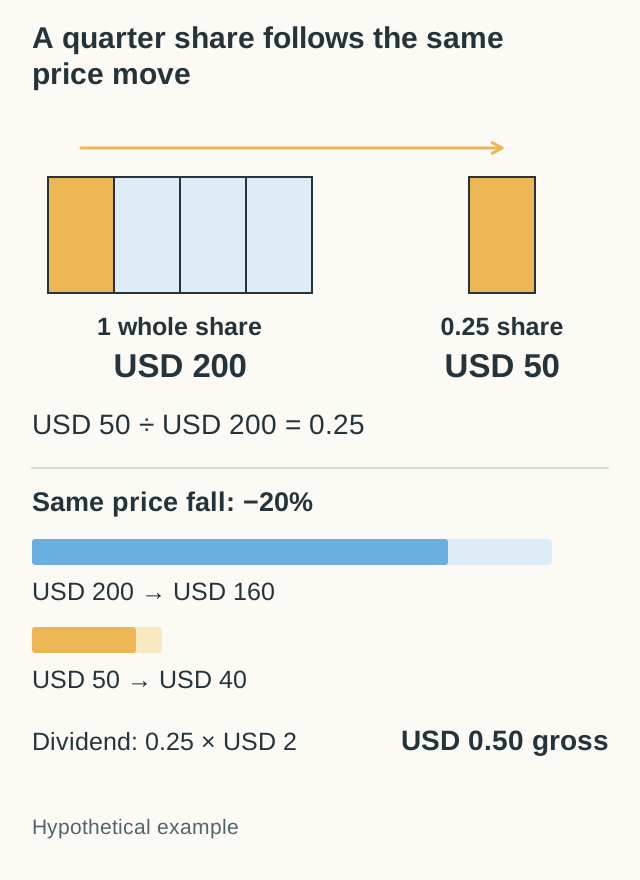
A is less than one whole share. It lets you invest an amount of money, like $50, instead of buying a whole number of shares.
Fractions are handy when one share costs a lot, or when you want to invest the same amount every month. With whole shares only, $50 a month could not buy a $200 share until you had saved for four months. With fractions, every $50 goes to work at once.
Not every broker offers fractions, and those that do may not offer them for every share. In the US, the SEC (the markets regulator) explains in its guide to fractional shares that the details depend on each broker's program. Canada's Ontario Securities Commission says the same in its guide for investors. Some brokers in the UK and Australia offer fractions too, again on their own terms.
The maths works in any currency, as long as the budget and the price are in the same one. Don't divide a Canadian-dollar budget by a US-dollar share price. Convert first, and count the cost of converting. See currency risk for Canadian investors.
Try it yourself
Pick a made-up share, then slide how much you invest. Buy less than one share, then move the price up or down 10% and watch your slice.
$50 ÷ $200 = 0.2500 of a share. If the share rises 10% to $220, your slice is worth $55. If it falls 10% to $180, it is worth $45. With a $500 share, $50 buys 0.1000 of a share.
What would you expect?
What this shows: $50 buys a quarter of a $200 share. Your slice rises and falls by the same percentage as a whole share: a 10% fall makes it $45.
A fraction changes how much money you put in, not how risky the company is. Smaller amounts mean smaller dollar swings, but the percentage moves are exactly the same.
Your quarter share moves exactly like a whole share, just with smaller amounts of money. A 10% rise adds $20 to a whole $200 share and $5 to your quarter. In percentage terms, it is the same 10%.
| What happens | Working | Your slice |
|---|---|---|
| You invest $50 at $200 | 50 ÷ 200 | 0.25 shares |
| The share rises 10% to $220 | 0.25 × 220 | $55 (+$5) |
| The share falls 10% to $180 | 0.25 × 180 | $45 (−$5) |
| A of $2 per share | 0.25 × 2 | $0.50 |
The $0.50 dividend makes three assumptions. The company pays a dividend, you own the slice on the right date, and your broker pays fractions in full. A dividend is never promised, and taxes or fees can reduce it.
Ask your broker how it handles tiny payments, tax taken at source and automatic reinvestment. Don't assume the amount on screen reaches you unchanged.
Only if the order fills at exactly $200. "Invest $50" fixes the money, not the number of shares. The number depends on the price when your order is filled, called the .
If the price moves to $205 before your order fills, $50 buys about 0.2439 of a share, not 0.25. Fees would make it a little less.
Brokers fill fraction orders in different ways. The SEC says some send them to the market straight away. Others group many customers' orders and fill them together at set times. There may also be limits on which shares, order types, minimum amounts and trading hours you can use.
The OSC gives a Canadian example where a broker bundles orders before filling them. That is a reason to read your own broker's terms, not proof that every broker works the same way. Ask when the price is set, and what happens to an order that is cancelled or not filled.
Fractions come with rules that a whole share might not have. Ask your broker these questions, and keep the written answers with the date:
| Topic | Ask before you buy |
|---|---|
| Filling orders | Is my order sent at once or grouped? Which price and time decide my fill? |
| Order types | Can I use limit orders for fractions? In which sessions? |
| Voting | Can I vote with my fraction, and how? |
| Corporate actions | What happens in a split, a merger or another company event? What about small leftover amounts? |
| Moving brokers | Can my fraction move to another broker, or must I sell it? |
The last question matters. The SEC says fractions generally cannot be moved to another broker. They may have to be sold in an , when you move your account. The OSC also warns about transfer limits. Selling can mean costs, time out of the market and possibly tax.
Also ask whether fraction orders cost more than whole-share orders, and whether there is a minimum amount. If an answer is unclear, treat that feature as missing, not as a benefit.
No. In our example, the whole share fell 10% and your quarter share also fell 10%. Investing less means fewer dollars at risk in that company. It does not make the price move more gently. The business can still disappoint, and you can still lose money.
An expensive share price also does not mean an expensive company. A $200 share can belong to a smaller company than a $20 share. See what is market capitalization.
Fractions can help you spread a small amount across several holdings. But slices of several similar companies are still one bet. See how to diversify. And a fixed fee per order can eat a big part of a small purchase, so check the brokerage fees first. Our stock trading apps comparison notes which apps sell fractions, and their limits.
Usually, in proportion to what you own: 0.25 of a share gets a quarter of the dividend per share. Check how your broker handles very small payments, tax taken at source and rounding.
It depends on the broker. Some pass voting rights on to you and others do not. Ask before you buy if voting matters to you.
Often not. In the US, the SEC says fractions generally cannot be transferred and may have to be sold, which can have tax effects. Canada's OSC also warns about transfer limits.
You get the economic value of part of a share, but how you hold it depends on the broker's program. Read the terms on ownership, voting and transfers.
10 free investing tools for beginners: calculators, fee checkers, company filings, charts, screeners, trackers and a practice app, with each tool's limits.
10 well-known dividend stocks, from Coca-Cola to Main Street Capital: their dividend records, risks and how to check them. A research list, not buy tips.