

Stocks & investing
How to Start Investing in Stocks: A Simple First Plan
Start investing in stocks step by step: give your money a job, choose what to own, check the broker, count every cost and place a first order.
Plenty of good stock trading courses are free. Others are a free first step into an expensive sales funnel. Here is where to look, and what to check before you sign up.

Start with organisations that have nothing to sell you. Then add courses that are open about their costs. Everything below is free to start, but offers change, so check the current terms.
| Course | Who runs it | Cost | Good for |
|---|---|---|---|
| Introduction to investing | US Securities and Exchange Commission (Investor.gov) | Free | US basics, fees and fraud warnings |
| Stocks learning path | Ontario Securities Commission (GetSmarterAboutMoney) | Free | Canadian basics |
| Shares | ASIC's Moneysmart (Australia) | Free | Australian basics |
| Financial Markets | Yale University on Coursera, taught by Robert Shiller | Free to join; graded work and the certificate may cost extra | General theory of markets in 7 modules, about 30 hours |
| Finance and capital markets | Khan Academy | Free | Short videos, including a unit on stocks and bonds |
| Free 6-module stock course | Finance Illustrated | Free | A step-by-step plan with a task after each module |
| Stock market PDF for beginners | Finance Illustrated | Free download | Reading offline |
| Trading Academy in the Trading Game app | Trading Game (made by our team) | Free to start; optional Pro plan | 150+ lessons, plus practice with virtual money |
Regulator pages are short and plain, and they teach the basics rather than trading. University courses go deeper into theory. Apps and practice tools let you try things out. A mix of the three works well.
Each one covers its own country's rules. A US guide on tax or accounts does not apply in Canada, the UK or Australia.
If you are completely new, start with your own country's regulator page. Then take one short course with exercises. Add a longer university course only if you want more depth. Finishing one course beats starting five.
Some free courses are a : free lessons designed to lead you to something bigger and paid. That is not always wrong, but you should know what is for sale. Watch for these signs:
Any one of these is a reason to slow down. Two or more are a strong sign that the course is mainly marketing.
Try it yourself
Read each course ad or message. Tap 'Red flag' or 'Seems fine', then see which words gave it away.
3 of these 6 messages are red flags: profit claims with a countdown ('made $4,000 last week', 'only 5 seats left'), 'deposit $250 to unlock lesson 2', and 'win 95% of the time, guaranteed'. The other 3 show what is taught and what it costs, and ask for no money.
What would you expect?
What this shows: A free course can be a sales funnel. Profit claims, countdowns and 'deposit to unlock' are signs it is selling, not teaching.
Good courses show what you will learn, who teaches it, what costs extra and how you can lose money. They never need your deposit or a promised win rate.
Use these six checks on any course, free or paid:
A course that passes all six is a good place to learn, even if it also sells a paid plan. Being open about that is part of passing.
Free courses cover the basics well. A paid course may add structure, more depth or feedback from a real teacher. Before you pay, ask for the full syllabus, how it tests you, who teaches it and what the refund rules are.
A certificate or a leaderboard rank does not prove that someone can invest. If the seller also gives personal advice or manages money, check them in your country's official register. Use FINRA BrokerCheck in the US, the CSA's registration guidance in Canada, or the FCA's firm checks in the UK.
Compare the price with your plans too. If you are starting with $1,000, a $500 course costs half of it. Free lessons and virtual practice can teach you a lot first. To weigh a course against other ways of learning, see copy trading or a trading course.
Whichever course you choose, learn the topics in a sensible order. Strategies come last, not first.
A course that jumps straight to chart patterns or 'my strategy' skips the parts that protect your money. If a lesson uses a word you don't know, stop and look it up before you move on.
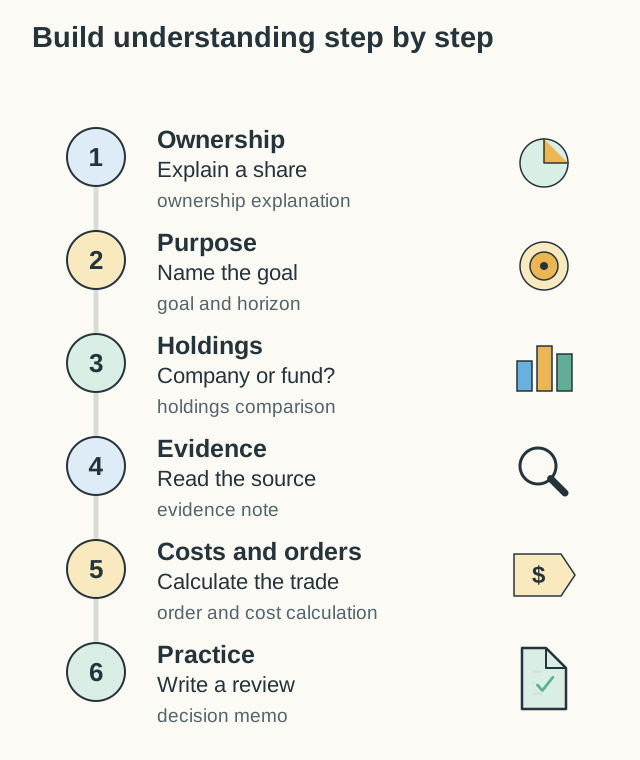
A free course only helps if you finish it. A simple routine makes that easier:
If you want a ready-made plan, follow our free 6-module stock course. For more reading, see the stock market resources list. To compare practice apps, read our stock market simulators guide.
Many are. Courses from regulators and universities are written to teach, not to sell. Weak ones use free lessons to push paid signals, mentoring or a broker account. Check the syllabus and how the course makes money.
It varies a lot. A regulator guide takes an hour or two. A university course can take 30 hours or more. Many people find short, regular sessions over a few weeks easier to keep up than one long weekend.
Some do, often for a fee. A certificate shows you finished the course. It does not show that you can invest well, and it is not a licence to give advice.
No course can promise that. A good course teaches how markets, costs and risks work, so you avoid expensive mistakes. Be wary of any course that sells a 'system' with promised returns.
Start investing in stocks step by step: give your money a job, choose what to own, check the broker, count every cost and place a first order.

Market cap is share price × number of shares. See why a $5 share can belong to a bigger company than a $100 share, and how size groups and splits work.