
Forex
How Much Is a Forex Pip Worth?
Learn what a pip is and how to turn a pip move into money on EUR/USD, USD/CAD and USD/JPY, and why your trade size matters more than the pip count.
Forex means swapping one currency for another. Learn how a trade works, what it costs and how much you could lose, before you risk any money.

(short for foreign exchange) is the market where people swap one currency for another. If you have changed US dollars into euros for a trip, you have used it.
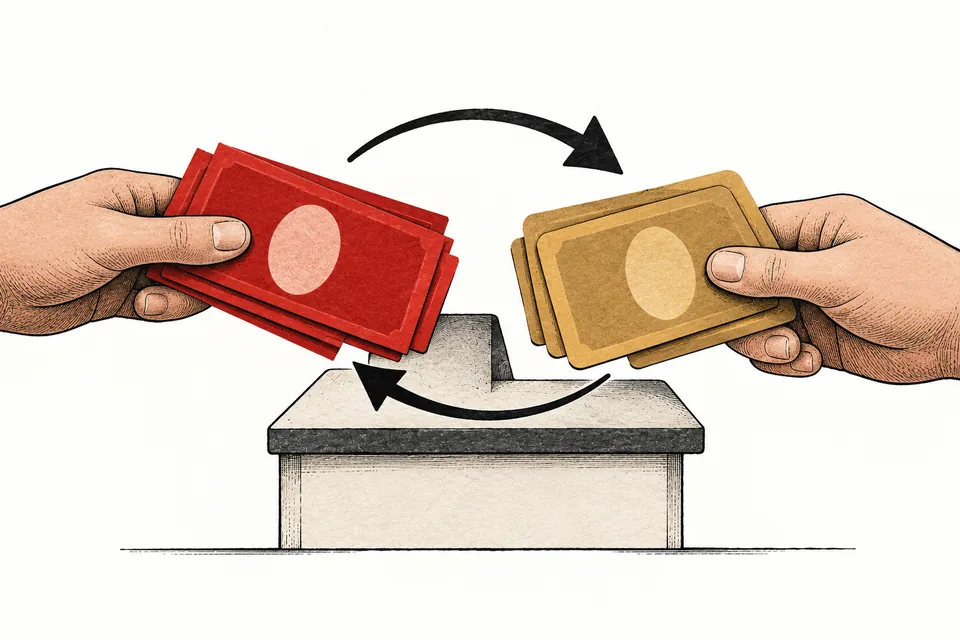
Imagine you swap $1,100 for 1,000 euros before a trip to Europe. While you are away, the euro gets stronger. Your 1,000 euros are now worth more dollars than you paid. Forex traders try to profit from moves like this, in either direction.
There is one big difference. Travel money gives you euros to spend. Retail forex trading often uses a contract that only pays the change in price. You may never own a single euro. Banks, companies and central banks also trade currencies, for their own reasons. See who trades forex.
The rules depend on where you live. In the US, retail forex is traded with a dealer, and the CFTC explains the risks. In Australia, ASIC Moneysmart explains margin forex. In Canada and the UK, check what product you are buying and who provides it.
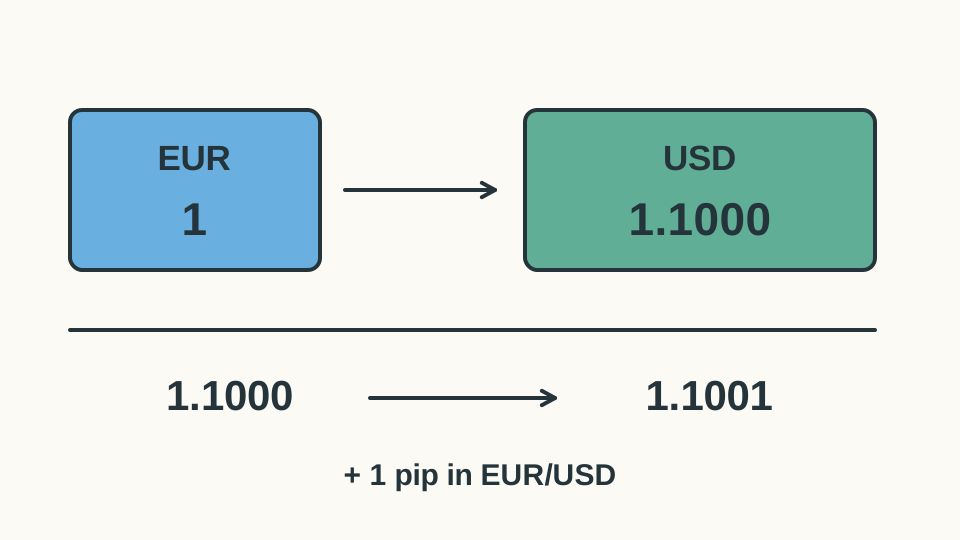
Every forex price compares two currencies. EUR/USD 1.1000 means 1 euro costs 1.10 US dollars. When you buy EUR/USD, you buy euros and pay with dollars. You gain if the euro gets stronger.
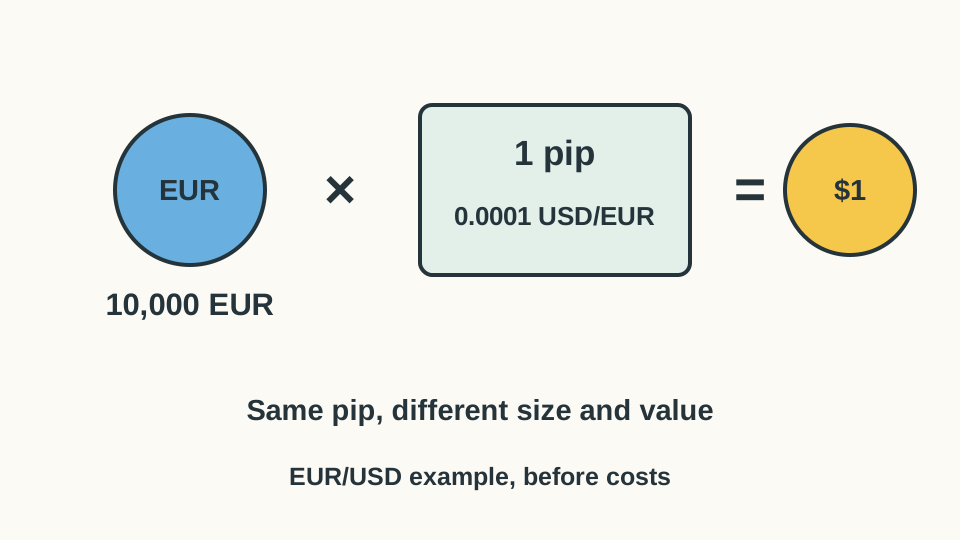
Prices move in small steps called . For most pairs, 1 pip is 0.0001. For pairs with the Japanese yen, it is 0.01. If you hold 10,000 euros of EUR/USD, each pip is worth $1.
Trade size is often shown in . A standard lot is usually 100,000 units of the first currency. Many brokers offer smaller sizes too. Always check the size on your screen. One "unit" in an app does not always mean one euro.
Your next lesson shows how to read any pair out loud: how to read currency pairs.
Every pair has two prices. The is the price you can sell at. The is the price you can buy at. The gap between them is the , and you pay it on every trade.
So every trade starts a little behind. The price must move in your favour by the spread before you break even.
Other costs can add up. Some accounts charge a commission per trade. Holding a trade overnight can add a financing charge. A "zero spread" account may charge commission instead. Compare the full cost for the same pair and trade size. The spread lesson shows how.
Try it yourself
Buy 10,000 euros at the ask price, then press "Sell now" at the bid. Then slide the number of trades per month.
EUR/USD is 1.1000 to sell and 1.1003 to buy. Buying 10,000 euros and selling at once loses 3 pips, or $3. At 20 trades a month, that is $60 in spreads.
What would you expect?
What this shows: You are $3 down the moment you buy. Make 20 trades a month and the spread alone costs $60, even if prices never move.
You buy at the higher price and sell at the lower one. The spread is a cost you pay up front on every trade, so trading more often costs more.
lets you open a trade much bigger than the money in your account. Say you have $1,000 and open a $20,000 trade. That is 20:1 leverage.
Now the price moves 1% against you. You lose 1% of $20,000, which is $200. That is 20% of your money from one small move. The same works for gains, but losses can come just as fast.
The is the part of your money the broker locks while the trade is open. It is not the most you can lose. Limits also depend on where you live. For major pairs, US dealers can offer up to 50:1. In the UK, EU and Australia, retail CFD accounts are capped at 30:1. Learn more in margin vs leverage.
Watch for hidden doubling, too. If you buy EUR/USD and also buy GBP/USD, both trades are bets against the US dollar. One dollar move can hit both trades.
An order is your instruction to the broker. Here are the 3 basic types:
| Order | What it does | Watch out |
|---|---|---|
| Market | Buys or sells now at the best price available | The final price can differ from the one on screen |
| Limit | Buys or sells only at your price or better | It may never fill |
| Stop | Sends an order once the price reaches your level | The fill price is not fixed |
A closes your trade if the price moves against you to a set level. It is a useful tool, but not a promise. If the price jumps past your level, for example after a weekend, the trade can close at a worse price.
Check which price triggers your stop. Some platforms use the bid, others the ask. Your broker's terms decide what really happens.
Plan the loss before you think about the profit. A common guideline is to risk no more than 1% of your account on one trade. With $2,000, that is $20. This is a habit some traders use, not a rule that makes trading safe.
Costs and price jumps can make the real loss bigger. And if your broker's smallest trade is too big for your plan, the trade does not fit. Do not stretch the plan to make it fit.
Only ever trade with money you can afford to lose. Never use money you need for rent, food or bills.
Learn in this order. Each step builds on the one before:
Practise with virtual money first. Write down the pair, size, costs, stop and reason before each practice trade. Practice results do not prove you would make money with real trades.
Many brokers offer the same trading app, made by another company, such as MetaTrader. The app is not the broker. Before you send any money, use the broker checklist and compare licensed providers in our forex broker guide. And remember: learning forex does not mean you have to trade it.
Every trade can lose, because nobody knows the next price. Trading without a plan is close to gambling. A written plan, small trades and a loss limit make the risk smaller and clearer, but they do not make profit certain.
You can learn with virtual money for free. If you later use real money, only use money you can afford to lose. Also check the broker's smallest trade size. If it risks more than your plan allows, the trade does not fit.
Many beginners study one major pair, such as EUR/USD, because it is widely traded and its spread is often small. A popular pair is not a safer bet. It can still move against you.
Currency trading runs around the clock on weekdays, but your broker sets its own hours, holidays and overnight charges. Prices can also jump when markets reopen after a weekend.
Learn what a pip is and how to turn a pip move into money on EUR/USD, USD/CAD and USD/JPY, and why your trade size matters more than the pip count.
Learn the forex basics in plain words: currency pairs, going long or short, pips, lots, the spread, and how leverage makes a small move cost a lot.