
Forex
15 Forex Strategies and Patterns for Beginners (and How They Fail)
15 forex strategy ideas and chart patterns, from head and shoulders to carry trades: what each one bets on, how it fails and how to test one honestly.
Every forex price compares two currencies. Once you can read one quote out loud, you can read them all.
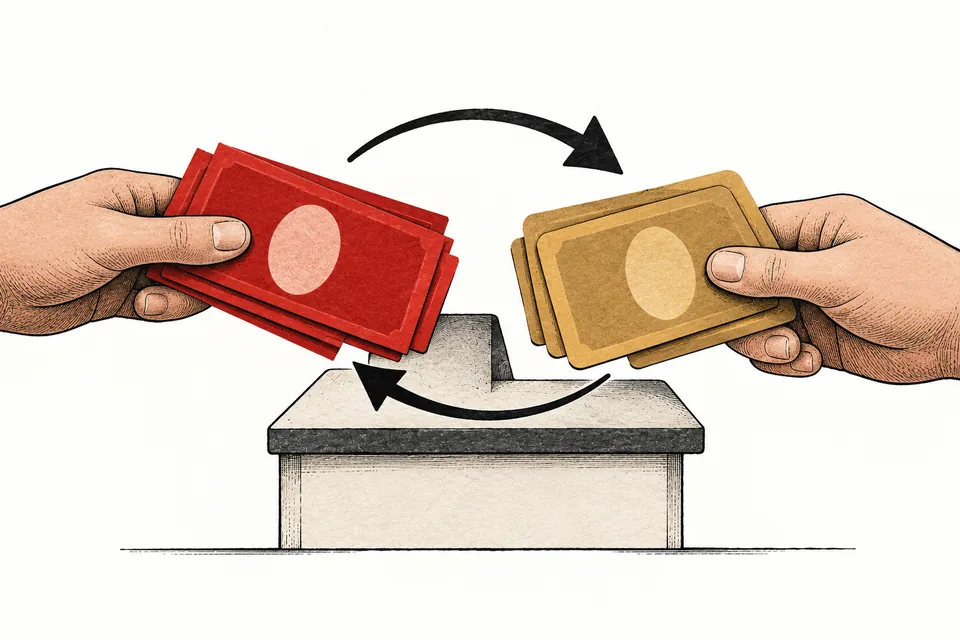
A is a price written with two currencies. Take EUR/USD 1.1000. It means one euro costs 1.10 US dollars.
The first currency (EUR) is called the . There is always exactly one of it. The second currency (USD) is the . The number tells you how much of the quote currency you need to buy one unit of the base.
Traders use three-letter codes so nobody mixes up the many kinds of dollar. USD is the US dollar, CAD the Canadian dollar, AUD the Australian dollar and NZD the New Zealand dollar. EUR is the euro, GBP the British pound, JPY the Japanese yen and CHF the Swiss franc.
| Pair and price | In plain words | If the number goes up |
|---|---|---|
| EUR/USD 1.1000 | 1 euro costs 1.10 US dollars | The euro got stronger |
| USD/CAD 1.3500 | 1 US dollar costs 1.35 Canadian dollars | The US dollar got stronger |
| AUD/USD 0.6500 | 1 Australian dollar costs 0.65 US dollars | The Australian dollar got stronger |
These are example prices, not live quotes.
Think of the pair as a seesaw: it compares two currencies, without giving either one a good-or-bad score.
If EUR/USD rises from 1.1000 to 1.1200, one euro now buys more dollars. The euro got stronger against the dollar. You could also say the dollar got weaker against the euro. Both sentences describe the same move.
Watch the order when you read the news. USD/CAD puts the US dollar first. So when the Canadian dollar gets stronger, USD/CAD usually goes down.
Try it yourself
Push the euro up, then push the dollar up. Watch the price and the seesaw. Then flip the quote.
If the euro gets stronger, EUR/USD rises, for example from 1.1000 to 1.1200. If the US dollar gets stronger, EUR/USD falls. Flipped, 1.1000 becomes USD/EUR 0.9091.
What would you expect?
What this shows: The price only tells you how two currencies compare. A stronger euro and a weaker dollar move EUR/USD the same way: up.
That is why traders always say both currencies. When the first currency gains, the pair rises. When the second gains, the pair falls.
Buying a pair means you buy the first currency and pay with the second. Selling a pair means the opposite.
If you sell EUR/USD instead, it works the other way round. You make money if the price falls and lose money if it rises.
"I am buying dollars" is not a complete trade idea. You always need to say which currency you are selling to pay for them.
You can write the same price the other way round. To flip it, divide 1 by the price.
If USD/CAD is 1.3500, then CAD/USD is 1 ÷ 1.3500 = about 0.7407. One Canadian dollar costs about 74 US cents. It is the same information seen from the other side of the seesaw.
A flipped quote is not the negative of the original, and the percentage moves are not exactly the same size. If USD/CAD rises 10%, CAD/USD falls about 9.1%. A broker's real prices also include a buying price and a selling price, so a flipped reference rate is only an estimate.
Traders sort pairs into three loose groups:
These labels are habits, not official ratings. A popular pair is not automatically safe. And two trades can secretly be one bet: buying EUR/USD and GBP/USD both bet against the US dollar.
A is the usual small step in a currency price. For most pairs it is 0.0001. For pairs with the Japanese yen it is 0.01.
If you hold 10,000 euros of EUR/USD, each 0.0001 move is worth $1. Many platforms also show a smaller fifth digit, sometimes called a pipette or point, so check how your platform counts.
Want to turn pips into money for any trade size? Try the pip value lesson.
The rate you see in the news, at a travel money desk and in a trading app can all be different. A bank may publish a daily reference rate. A trading app shows a live buying price and a live selling price. A chart might show either one, or the middle.
Before you compare two prices, check where each one came from and when. The gap between buying and selling prices is a real cost, explained in what is the spread in forex. To see which apps show live quotes and which only teach, read our forex apps comparison.
You buy euros (the first currency) and pay with US dollars (the second). You gain if the euro gets stronger against the dollar.
Market habit. Some currencies, like the euro and the pound, are usually written first. Always read the order on the screen before you trade.
No. A higher number only means the first currency got stronger against the second. Whether that is good for you depends on what you bought or sold.
15 forex strategy ideas and chart patterns, from head and shoulders to carry trades: what each one bets on, how it fails and how to test one honestly.

Find better eToro traders to copy in 5 steps: check the record, the deepest fall, big bets, the risk score and who gets paid, before you risk money.