Your Ultimate Beginner Forex Trading Course to Start Smart

ye

Think of a beginner forex trading course as your personal cheat code for the financial markets-it’s where you learn the rules of the game before you put any real money on the line. These courses are designed to build your skills and confidence, taking you from a curious spectator to a prepared trader.

Why A Forex Course Is Your Smartest First Move

Ever feel like the world of finance is some exclusive club you weren't invited to? Let's fix that.

Jumping into forex trading without any training is like trying to beat a video game on the hardest difficulty without ever playing the tutorial. It's a quick way to lose. A structured course is your map and your strategy guide, all rolled into one, giving you a solid footing from day one.
Forex trading charts displayed on multiple screens, showing financial data and trends.

Look at legendary investors like George Soros. He's known as "The Man Who Broke the Bank of England" after he famously made a billion dollars in a single day betting against the British pound in 1992. His incredible success wasn't built on luck; it came from a deep understanding of market rules and human psychology. He famously said, "The financial markets generally are unpredictable… The idea that you can actually predict what's going to happen contradicts my way of looking at the market."

This gets right to the heart of it: you need a strategy, not a crystal ball. That's the exact mindset a good course helps you build.

Building Skills, Not Just Knowledge

A quality beginner forex course does more than just dump a textbook's worth of facts on you. It’s all about building practical, real-world skills. You're not just memorizing terms; you're learning how to think like a trader.

Here's a quick look at the essential skills you'll gain from a foundational forex trading course.

What a Beginner Forex Course Actually Teaches You

Skill Category What You Learn Why It Matters for You
Market Fundamentals The "why" behind price movements-economic news, interest rates, global events. You'll stop seeing charts as random squiggles and start understanding the stories they tell.
Risk Management How to protect your starting capital with stop-losses and proper position sizing. This is your financial seatbelt. It's the #1 skill that separates successful traders from gamblers.
Trading Psychology How to control fear and greed, stick to your plan, and make disciplined decisions. Your own emotions can be your biggest enemy. This helps you stay in control when real money is on the line.
Technical Analysis How to read charts, identify trends, and use indicators to find potential entry/exit points. This is your toolkit for making informed predictions about where the market might go next.
Strategy Development How to build a personalized trading plan that fits your goals and risk tolerance. A trading plan is your personal rulebook. It keeps you from making impulsive, emotional mistakes.

This systematic approach is why so many traders invest in their education first. In fact, with over half of traders buying educational materials each year, it's clear that structured learning is seen as a vital part of building a sustainable trading career.

Modern courses have come a long way from dry PDFs. To see just how powerful new learning methods can be, it's worth understanding the benefits of interactive video for corporate training, which are now being used to make complex trading topics much easier to absorb.

Instead of making expensive mistakes with your own money, a course gives you a safe space to learn from the wins and losses of others. It helps you manage your expectations and sets you on a path to becoming a disciplined, informed trader.

Learning the Language of Forex Trading

Before you can even think about trading, you need to learn how to speak the language. The forex market is like a massive global conversation that runs 24/5, and a good beginner forex trading course acts as your personal translator, cutting through all the confusing terms.
A person studying forex charts and financial data on a laptop, with a notebook nearby.

This conversation is built on a handful of core concepts. Without them, you're essentially flying blind. Our mission is to demystify the jargon so you can glance at a trading platform and actually understand what’s happening.

"An investment in knowledge pays the best interest." – Benjamin Franklin

Nowhere is this truer than in trading. Getting a handle on the vocabulary is your first real investment, and it’s the one that safeguards every other dollar you’ll put on the line later.

Your First Forex Words

Let's start with the absolute essentials. Think of these as the foundational building blocks you can't trade without.

  • Currency Pairs: Currencies are always traded against each other, like EUR/USD. The easiest way to think about it is like a tug-of-war between two economies (in this case, the Eurozone and the United States). You’re essentially placing a bet on which side will pull harder. If you want to really nail this down, our guide on how to read currency pairs is the perfect next step.

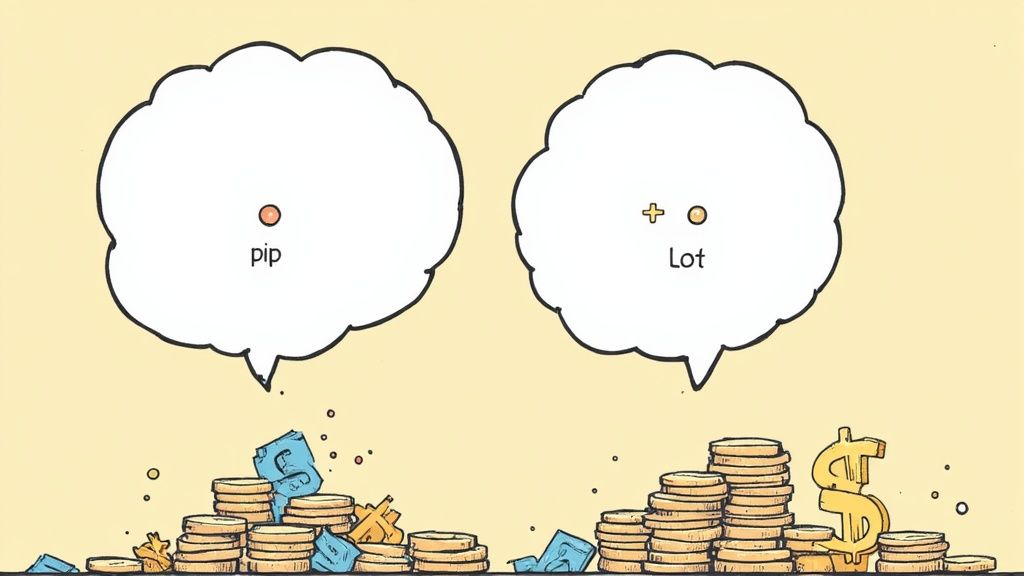
  • Pip: A 'Pip' is short for 'Percentage in Point.' It's the smallest possible price move a currency pair can make. Think of it as a single point in a basketball game-one point might not seem like much, but they add up fast and ultimately decide who wins or loses the trade.

  • Leverage: This is a powerful tool, kind of like using a car jack to lift a two-ton vehicle with minimal effort. In trading, leverage lets you control a large position with a relatively small amount of your own money. It’s fantastic for amplifying profits, but it's a double-edged sword that will just as easily amplify your losses if a trade goes against you.

  • Lot Size: This term simply refers to how big your trade is. A standard lot is 100,000 units of currency, but don’t let that number scare you. Brokers offer mini and micro lots, which are perfect for beginners who are starting out with a smaller account.

To really get the most out of your learning, it helps to understand your own personal strengths. Digging into the different learning styles in adults can make the whole process click much faster. By the time you wrap up a solid introductory course, you'll have the vocabulary you need to follow market news and place your first trades with confidence.

Choosing Your Tools of the Trade

Every craftsman needs their tools, and traders are no different. Before you even dream of placing that first trade, you've got to get your hands dirty with your main piece of kit: the trading platform. This is your command center, your digital cockpit where all the magic happens.

Think of it like the dashboard of a race car. It shows you the track ahead (the charts), lets you monitor your speed, and gives you the controls to accelerate, brake, and steer. For traders, this is where you’ll size up the market and put your money to work.

Any beginner forex trading course worth its salt will spend a good chunk of time making sure you master this. It’s the arena where you'll be competing, and knowing it like the back of your hand is simply non-negotiable.

Your First Trading Platform

For most folks just starting out, one name pops up over and over again: MetaTrader 4, or MT4. You can think of it as the Swiss Army knife for traders-it’s the industry standard, loaded with powerful features, yet it's surprisingly easy to get the hang of once you learn the ropes.

It’s so popular that a staggering 85% of forex traders rely on the MT4 platform. That massive user base is a huge plus, meaning there's a giant community and endless tutorials out there to help you find your footing. To get a better sense of how traders use these tools, it's worth checking out some current forex trading statistics.

Learning to Read the Story in the Charts

Once you’ve got your platform set up, the next big hurdle is learning to read charts. At first glance, they might just look like a chaotic scribble of lines from a heart monitor, but they’re actually telling a powerful story-a visual tug-of-war between buyers and sellers.

Your job is to become a storyteller, to learn how to interpret that narrative. Most successful traders, especially when they’re new, find that simplicity is their best friend. They stick to daily charts. Looking at the market one day at a time helps filter out all the distracting short-term “noise” and gives you a much clearer, big-picture view of where things are actually headed.

"The goal of a successful trader is to make the best trades. Money is secondary." – Alexander Elder

This quote nails the mindset you need. Focus on learning your tools and reading the charts properly first. The profits will follow. By getting comfortable with your platform and learning to read the market's story on a daily chart, you’re laying the solid foundation you need to trade smarter and with more confidence.

The Most Important Lesson: Protecting Your Capital

This is the chapter that separates traders from gamblers. If there's one single lesson in any beginner forex trading course that matters more than all the others, it's this one: learn how to protect your money. It’s not about hitting that one-in-a-million trade; it's about staying in the game long enough to build consistent wins.

Legendary investor Warren Buffett summed it up perfectly with his two famous rules.

"Rule No. 1: Never lose money. Rule No. 2: Never forget rule No. 1."

What he’s really saying is that your number one job is to play defense. One massive loss can completely erase a dozen smaller wins and kick you out of the market for good. To make sure that doesn't happen, you have to learn how to manage risk like a professional.

This infographic breaks down the essential tools you'll be using to control your trades and keep your capital safe.
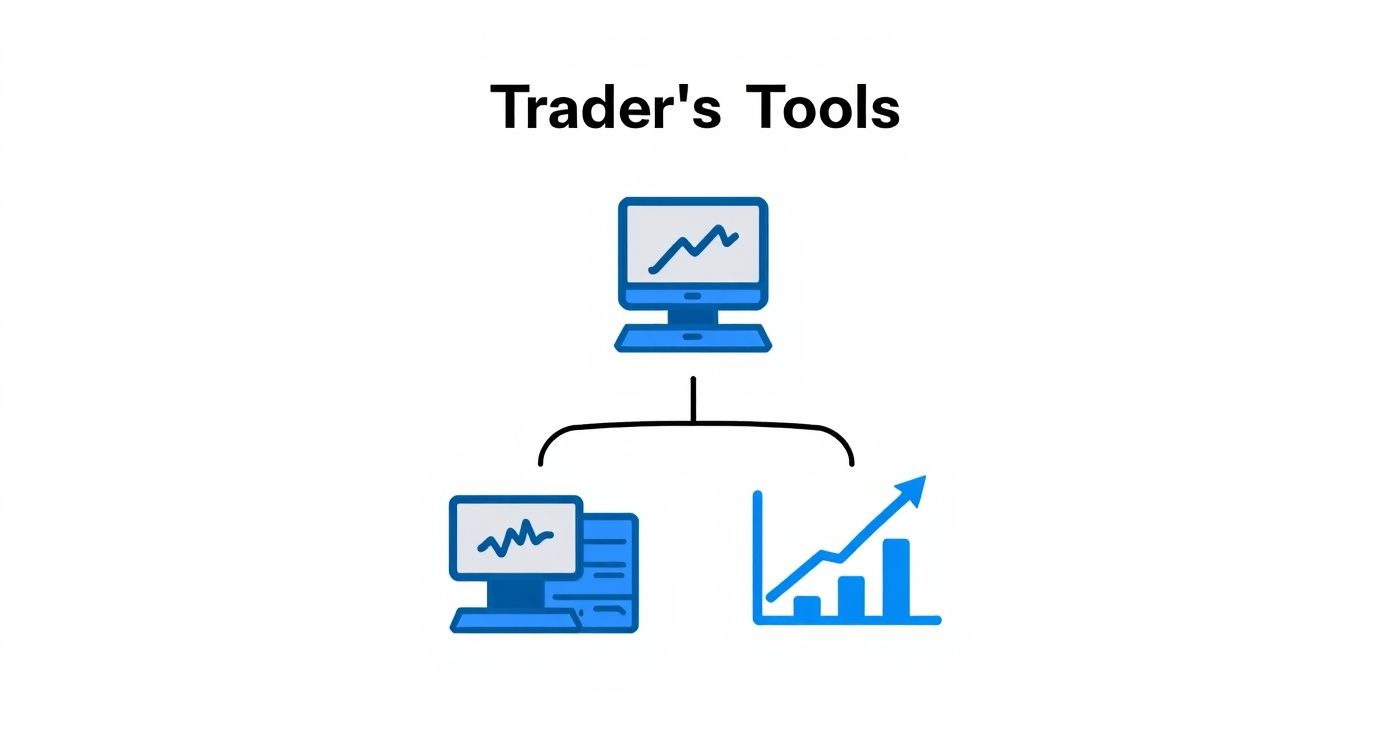
Infographic about beginner forex trading course

As you can see, everything starts with your trading platform. From there, you use your charts and analysis to make decisions, but it's the risk management tools that truly keep you in control.

Your Financial Escape Hatch

Your best defensive move in trading is the Stop-Loss. Think of it as a pre-set eject button for your trade. It's an order you place with your broker that basically says, "If this trade starts losing a certain amount of money, get me out immediately." No questions asked.

This is your safety net. It’s what prevents a small, acceptable loss from spiraling into a catastrophic one that blows up your account. For professional traders, setting a stop-loss on every single trade isn't optional-it's a non-negotiable rule that ensures they live to trade another day.

Another dead-simple but incredibly powerful defensive strategy is the 1% Rule. It’s a personal guideline where you promise yourself you will never risk more than 1% of your total trading capital on any single trade.

  • If you have a $1,000 account, your maximum risk per trade is $10.
  • If you have a $500 account, your maximum risk per trade is just $5.

Before placing any real trades, it's crucial to get comfortable with a few fundamental risk-control methods.

Simple Risk Management Techniques

Technique How It Works for You Simple Analogy
Stop-Loss Order Automatically closes a trade at a pre-set price to cap your losses. It's like setting a fire alarm. If things get too hot, it goes off and gets you out before the whole house burns down.
The 1% Rule Never risk more than 1% of your account on a single trade. Think of it as betting rules at a casino. You only bet a tiny fraction of your chips at once so one bad hand doesn't wipe you out.
Position Sizing Adjusting your trade size based on your stop-loss distance and the 1% rule. It’s like pouring a drink. You pour less into a small glass and more into a big one to avoid spilling over.

Sticking to these rules makes it almost mathematically impossible to lose your entire account quickly. It forces you to be disciplined, make smarter decisions, and survive the losing streaks that every single trader-even the best in the world-goes through.

Winning in trading is a marathon, not a sprint. These defensive rules are how you build the endurance to cross the finish line.

Putting Your Knowledge into Practice

Theory is great, but the real learning happens when you roll up your sleeves and get your hands dirty. It’s time to gain some practical experience without putting a single dollar of your own money on the line. This is where the beginner forex trading course introduces its most powerful tool: the "demo account."

Think of a demo account as a trading simulator. It's the flight simulator for a pilot, the driving range for a golfer. It’s your own personal sandbox where you can test-drive everything you've learned in a completely safe space. This is where you’ll click the button on your first trade, set a stop-loss, and watch how the market actually behaves.

Even celebrities who get into trading, like Michelle Williams, started right here at the beginning. She reportedly won a world championship trading competition-turning $10,000 into $100,000 in under a year-after taking a course and learning the fundamentals, proving that practice always comes before profit.

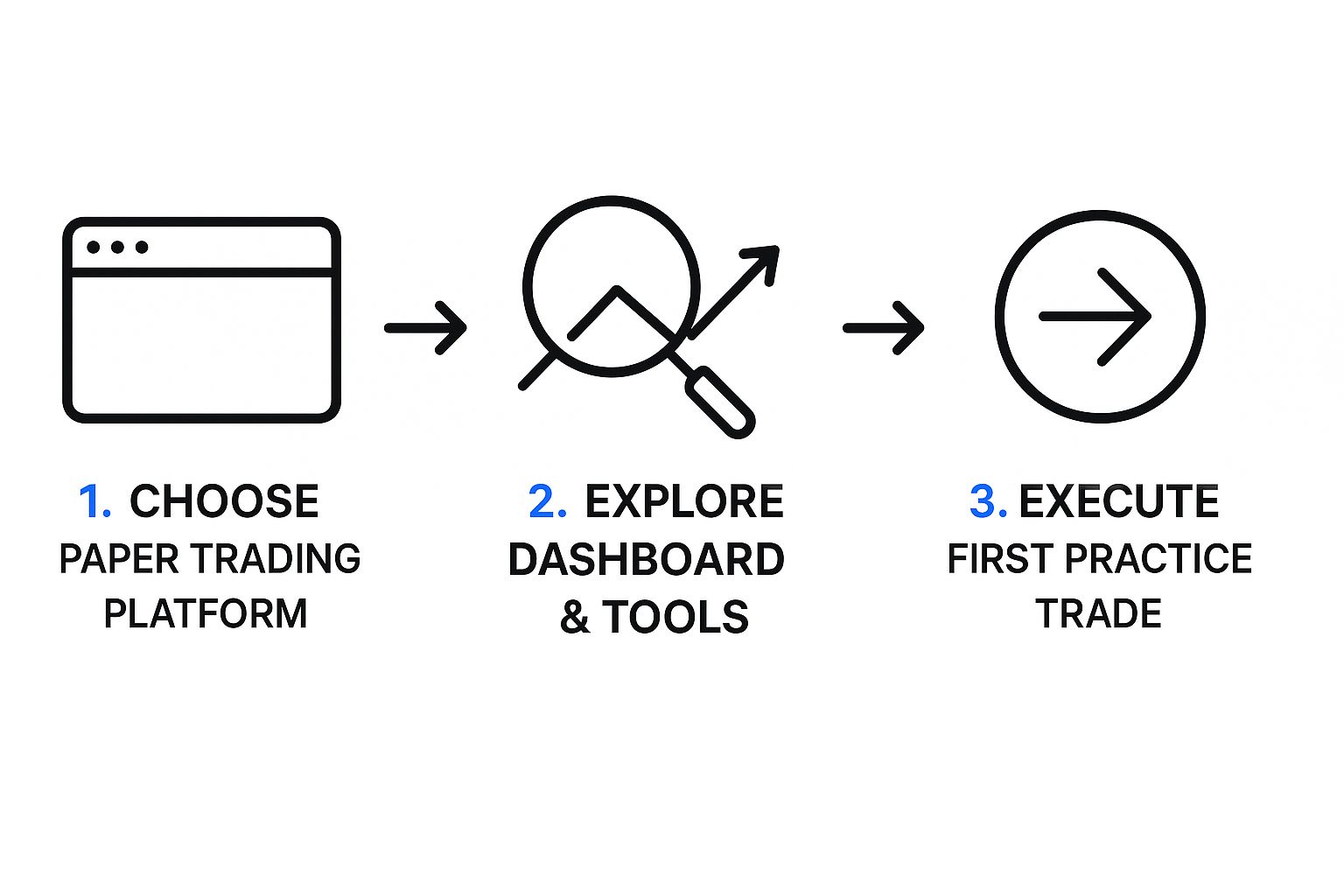
Your First Practice Trades

The goal here isn't to become a paper millionaire overnight. It's about building confidence and, more importantly, developing good habits from the very start. The experience you gain is far more valuable than any fake profit you rack up. Before diving in, you might also want to learn how to backtest trading strategies, which is an awesome way to test your ideas against historical market data.

Here’s a simple game plan for your first few sessions in the simulator:

  • Pick a Major Pair: Keep it simple. Start with a heavyweight pair like EUR/USD or USD/JPY. They tend to be more predictable and are easier to follow for beginners.
  • Place a Small Trade: Just get a feel for the mechanics of opening a position. Don't overthink it.
  • Set a Stop-Loss: This one is non-negotiable. Practice protecting your capital on every single trade, right from day one. Make it muscle memory.
  • Watch and Learn: Now, just observe. See how the price reacts to news events or economic data releases. Get a feel for the rhythm of the market.

This risk-free practice is the essential bridge between knowing the theory and actually trading. It’s fun, it’s educational, and it's an absolute must for any new trader.

Your Questions Answered

Got a few questions rattling around in your head? Good. That’s a sign you're taking this seriously. It's totally normal to be curious-or even a little skeptical-before jumping into something new like a beginner forex course.

Let's cut through the noise and tackle the big questions head-on. My goal is to give you straight answers so you can move forward with confidence.

Is It Too Late to Start Forex Trading?

Not a chance. It might feel like everyone else got a head start, but new traders are jumping into the market every single day. And it’s not just for the young, tech-savvy crowd, either.

You might be surprised to learn that a huge chunk of traders are more mature. In 2025, there are about 1.3 million forex traders in the US alone, and a massive 58% of them are over the age of 40. People from every walk of life are starting their trading journey right now. You can dive deeper into the US forex trading demographics here.

Do I Need a Lot of Money to Start?

This is one of the biggest myths holding people back. You absolutely do not need a massive bankroll to get your feet wet, thanks to things like leverage and micro accounts. Many brokers will let you open an account with $100 or even less.

What a good course really drills into you is how to manage that small account effectively. The focus isn't on the size of your starting capital, but on how smart you are with protecting and growing it.

"The secret to being successful from a trading perspective is to have an indefatigable and an undying and unquenchable thirst for information and knowledge." – Paul Tudor Jones

That quote from a trading legend says it all. Your most valuable asset isn't your money; it's your drive to learn how to do this the right way.

How Long Does It Take to Learn?

There’s no magic number here-everyone picks things up at their own speed. But a solid introductory course can get you comfortable with the absolute essentials in just a few weeks of focused effort.

A realistic timeline might look something like this:

  • Weeks 1-2: Getting a grip on the core lingo and basic concepts.
  • Months 1-2: Practicing what you've learned on a demo account without risking a dime.
  • Months 3-6: Feeling ready to trade with very small amounts of real money.

Becoming a consistently profitable trader is a marathon, not a sprint. The first step is just committing to learn the fundamentals, and a well-built course is your shortcut to getting there.


Ready to stop wondering and start doing? The free Trading School at financeillustrated.com will walk you through the basics of forex in about an hour. Jump in and start building real confidence today at https://financeillustrated.com.


Best Forex Trading Course for Beginners | Start Winning Today

ye

So, you're curious about forex. At its core, a forex trading course for beginners will teach you one simple idea: you're swapping one country's currency for another. Think of it like swapping your dollars for euros before a trip to Paris, but you're doing it on a massive digital stage to try and make money from the changing values between them.

What Is Forex Trading Anyway?

A person looking at financial charts on multiple screens, representing the world of forex trading.

Welcome to the foreign exchange market- or "forex" for short. This isn't just another financial market; it's the biggest one on the planet. Trillions of dollars change hands here every single day.

Unlike the stock market, which has opening and closing bells, the forex market is a 24/7 party that runs five days a week. This nonstop action creates a constant stream of opportunities for traders all over the globe, from London to Tokyo.

When you trade forex, you're not actually buying a physical thing. You're speculating. It's like making an educated guess on where a currency's value is headed. If you think the Euro is about to get stronger against the US Dollar, you'd "buy" the EUR/USD pair. If you're right, you pocket a profit.

The Sheer Scale of the Forex Market

It's hard to get your head around just how massive the forex market is. It makes all the world's stock markets combined look tiny. As of April 2025, the daily trading volume hit a mind-blowing $9.6 trillion. That's enough money to buy Apple Inc. three times over, every single day!

You might think it's all big banks and suits, but individual traders like us make up about 2.5% of that volume. That still adds up to roughly 9.6 million regular people trading worldwide, and get this- a surprising 27% are in the 18-34 age group.

This incredible scale is what allows for legendary moves. Think of George Soros, the investor who famously "broke the Bank of England." He bet against the British pound and reportedly made over $1 billion in a single day. While that's like winning the lottery, it shows the power of this market.

"I'm only rich because I know when I'm wrong…I basically have survived by recognizing my mistakes." – George Soros

Getting to Grips With the Lingo

At the heart of forex are currency pairs. You're never just buying one currency; you're always trading one against another. It's like a constant tug-of-war.

To get started, you need to speak the language. Here's a quick cheat sheet for the terms you'll see everywhere.

Your Quick Guide to Forex Terms

Term Simple Explanation
Pip The tiny little price move a currency pair can make. It's how you count your profits and losses.
Leverage Basically, borrowing money from your broker to trade bigger positions. It's like using a power-up, but it's risky!
Spread The small difference between the buy price and the sell price. This is how the broker makes a little money on each trade.
Lot A standard unit of currency. Think of it like buying a "box" of currency.
Long/Short "Going long" means you're buying, betting the price will go up. "Going short" means you're selling, betting it will fall.

These are the building blocks. Getting comfortable with them is your first real step toward understanding what you see on the screen.

The Main Players: Major, Minor, and Exotic Pairs

Not all currency pairs are created equal. They fall into three main groups:

  • Majors: These are the A-listers, the most traded pairs in the world. They always have the US Dollar (USD) in them. Think EUR/USD, USD/JPY, or GBP/USD. They're popular because they're busy and have lower fees.
  • Minors: Also called "cross-currency pairs," these guys feature other big currencies, just not the US Dollar. A classic example is EUR/GBP or EUR/JPY.
  • Exotics: This is where things get wild. An exotic pair matches a major currency with one from a smaller economy, like USD/TRY (US Dollar vs. Turkish Lira). They can be super unpredictable, so it's best to leave them alone until you know what you're doing.

The prices of these pairs are always moving, pushed around by everything from economic news and interest rates to political drama. Your job as a trader is to sort through this info and predict where the price is headed next.

If you want to dive deeper into trading basics, a great place to start is vtrader.io's Trading Academy. They break down these core ideas in a way that's easy to get.

Setting Up Your Trading Headquarters

Before you can even think about your first trade, you need to set up your mission control. This means getting a reliable broker and a solid platform. A broker is your ticket to the forex market; you literally can't get in without one.

Picking the right broker is a huge deal. This isn't like choosing a new phone- it's your hard-earned money on the line. The number one thing you need to look for is regulation. A regulated broker has a financial watchdog making sure they play fair, which gives you a crucial layer of protection.

Your Broker Checklist

Don't just sign up with the first broker you see with a flashy ad. You need to do your homework and compare the stuff that actually matters.

Here’s a quick rundown of what to look for:

  • Rock-Solid Regulation: Is the broker watched by a big financial authority like the FCA in the UK or ASIC in Australia? This is a must-have, no excuses.
  • Low Fees (Spreads): Brokers make their money from the 'spread'- a tiny fee in each trade. You want tight spreads so fees don't slowly eat your profits.
  • A Great Platform: Is their trading software easy to use? Most beginners start with MetaTrader 4 (MT4). It's the industry standard for a reason: it's reliable, powerful, and pretty simple to learn.
  • Helpful Support: When something goes wrong (and it will), you want to know you can reach a real person who can help. Check if they have good customer support before you sign up.

The Power of a Demo Account

Once you've picked a broker that ticks all the boxes, your next step is not to deposit real money. I can't say this enough. Instead, open a demo account.

Think of it as a flight simulator for traders. You get to play with a big stack of fake money, but you're trading in real, live market conditions. This is where you’ll learn the platform, test your first strategies, and make all your beginner mistakes without losing a single real dollar. It’s a critical step.

Shockingly, tons of new traders skip this. Data shows that around 72% of traders jump straight into live accounts without ever using a demo. This is a big reason why only about 15% of retail traders end up profitable. You can see more details about forex trading statistics and success rates on Moneyzine.com.

By starting with a demo, you're immediately putting yourself ahead of the game. You're building priceless confidence and learning how the market really moves.

As you get your setup ready, it's also smart to see how people in other markets pick their platforms. For a different perspective, check out some of the best cryptocurrency exchanges for beginners to see what features they prioritize. It gives you a bigger picture of what makes a great trading home base.

How to Actually Read the Market

So, how do traders decide when to hit "buy" or "sell"? It's definitely not a lucky guess. They're reading the market's mood using two main methods: technical analysis and fundamental analysis.

Imagine you're a detective. You could analyze fingerprints and clues at the crime scene- that's technical analysis. Or, you could interview witnesses and check alibis to understand the motive- that's fundamental analysis. The best detectives, and the best traders, learn how to do both.

The Chart Detective Approach

Technical analysis is all about studying price charts. The idea here is simple: everything you need to know, from a news event to a trader's emotions, is already shown in the price you see on the screen.

You're basically a chart detective, looking for patterns and trends that hint at where the price might go next. This isn't just for forex; it's a universal language for markets. You're looking for repeating patterns of human psychology played out on a chart.

One of the first things you'll learn is support and resistance.

  • Support: This is like an invisible floor where the price seems to stop falling and bounce back up.
  • Resistance: This is the invisible ceiling where the price struggles to push higher and often gets knocked back down.

Spotting these levels is a basic skill for any trader. If you want to really get the hang of it, our detailed article on how to read forex charts is the perfect next step.

The Economic Journalist Approach

On the other side, we have fundamental analysis. This is less about charts and more like being an economic journalist. You zoom out to look at the big picture- the real-world events and data that can make a currency's value swing like crazy.

This means you're glued to the economic calendar, watching for big news releases that can move the market. These are your heavy hitters:

  • Interest rate decisions from central banks
  • Monthly unemployment numbers
  • Gross Domestic Product (GDP) reports

A single comment from the head of the U.S. Federal Reserve can send the dollar soaring or crashing in minutes. Fundamental traders try to get ahead of these moves by digging into a country's economic health.

"The key to making money in stocks is not to get scared out of them." – Peter Lynch

This quote from legendary investor Peter Lynch is just as true for forex. When you understand the fundamental reasons why a currency is strong or weak, you have the confidence to stick with your trade, even when things get rocky.

Technical vs Fundamental Analysis At a Glance

Here’s a quick comparison to help you see the core differences between being a chart detective and an economic journalist.

Feature Technical Analysis Fundamental Analysis
Primary Tool Price Charts Economic Data & News
Core Focus "When" to trade (timing your moves) "What" to trade (finding value)
Time Horizon Short to medium-term Medium to long-term
Key Question "What is the price doing?" "Why is the price doing it?"
Example Buying when price bounces off a support level Buying a currency after a good GDP report

As you can see, your choice often comes down to your personality. Day traders who are in and out quickly often lean on technicals, while long-term investors might focus more on fundamentals.

Infographic about forex trading course for beginners

Ultimately, this isn't about which one is "better." The most successful traders I know don't pick a side; they blend both.

They might use fundamental analysis to get a big-picture idea- "Okay, the Eurozone economy looks strong, so I want to be buying EUR"- and then use technical analysis to find the exact moment to enter that trade. This powerful combo gives you a much better view of the market.

Protecting Your Money Is Your First Job

A chess board with a single king piece protected by a row of pawns, symbolizing defensive strategy in trading.

Let's get one thing straight. The most important lesson you'll learn isn't about hitting a massive home run on a trade. It’s about staying in the game long enough to even get a chance to win.

Your first job isn't to make money; it's to protect the money you already have. This is risk management, and it's the biggest difference between traders who last and those who blow up their accounts in a week.

The Golden Rule of Risk

So, how do you protect your cash? It all comes down to one simple rule you must follow on every single trade.

Never, ever risk more than 1-2% of your total account balance on one idea.

If you have a $1,000 account, the absolute most you should be willing to lose on any single trade is $10-$20. That's it. It feels small, maybe even boring, but it's the secret sauce. It means one bad trade won't wipe you out. It means you can be wrong five or six times in a row and still be in the game, ready for the next chance.

Your Automated Safety Nets

Luckily, your trading platform has tools to enforce this discipline for you. Think of them as your personal bodyguards, protecting you from taking big hits.

The two most important are the Stop-Loss and the Take-Profit order.

  • Stop-Loss Order: This is your eject button. You set a price where your trade will automatically close if the market moves against you. It’s your pre-set maximum loss, making sure a small mistake doesn't become a disaster.
  • Take-Profit Order: This is the other side. It’s an order to automatically close your trade once it hits a certain profit target. This locks in your wins before the market can change its mind and take them back.

Using these tools on every single trade isn't optional; it's essential. They take emotion out of the equation and force you to stick to your plan. You can practice setting them up with zero risk by learning what is paper trading in a demo account.

The Power of Risk-to-Reward

Now, let's tie this all together with the risk-to-reward ratio. This is just a way of making sure your potential wins are consistently bigger than your potential losses.

Imagine you're risking $10 on a trade (your stop-loss). A good goal is to aim for a profit of at least $20 or $30 (your take-profit). This gives you a 1:2 or 1:3 risk-to-reward ratio.

Why is this so powerful? Because it means you don't even have to be right half the time to make money. With a 1:2 ratio, you could win only 40% of your trades and still come out profitable. This is how pros think- not in single trades, but in probabilities over the long haul.

"The most important rule of trading is to play great defense, not great offense." – Paul Tudor Jones

This quote from legendary trader Paul Tudor Jones sums it up perfectly. Focus on protecting your money. The profits will follow.

Creating Your First Simple Trading Plan

A person writing in a-notebook with financial charts and graphs in the background, symbolizing the creation of a trading plan.

Alright, let's get serious. The single biggest thing that separates disciplined traders from gamblers is a trading plan.

Jumping into the market without a plan is like trying to explore a new city without a map. You'll make a lot of wrong turns, get frustrated, and probably end up lost. It's a recipe for disaster.

Your trading plan is your personal rulebook. It's the calm voice of reason you listen to when the market gets wild and your emotions are screaming at you to do something stupid. Even a basic plan is way better than just winging it. We're not trying to write a novel here- the goal is to build discipline from day one.

The Core Questions Your Plan Must Answer

A good trading plan doesn't have to be complicated. Simple is often better when you're starting out. It just needs to give clear answers to a few key questions that will guide every move you make.

Think of this as your starting template- a foundation you'll build on as you practice in your demo account.

  • What pairs will I trade? Don't try to watch every currency on the planet. Pick just one or two major pairs to start, like EUR/USD or GBP/USD. Get to know how they move.
  • What times will I trade? The market runs 24/5, but you can't. You need to sleep. Focus on a specific trading session when things are busy, like the London or New York open. Stick to that window.
  • What's my signal to enter? This has to be crystal clear. Define the exact conditions you need to see before you click "buy" or "sell." Is it the price bouncing off a support level? A specific pattern? Write it down.
  • When do I get out? Honestly, this is the most important part. You must know your exit points before you ever enter a trade. Where is your stop-loss (your "I was wrong" point) and where is your take-profit (your target)? No exceptions.

A plan removes the guesswork. When your predefined signal shows up, you trade. If it doesn't, you do nothing. It’s that simple, but it's the hardest part for most new traders to master.

This structured approach is what separates amateurs from the pros. In the United States alone, there are now about 1.3 million forex traders. The average age is 43, which tells you that this is a game where mature discipline really pays off. You can see more details on the demographics of US forex traders on bestbrokers.com.

From Plan to Practice

Now you’ve got a basic framework. The next step is to test it- in your demo account, of course. For every single trade you take, log it in a journal.

Jot down why you entered, what the plan was, and what happened. This simple act creates a powerful feedback loop. You'll quickly see what’s working and what isn't.

Maybe you'll find out your entry signal only works well during the London session, or that your profit targets are a bit too high for the current market. This is how you get better. You make a plan, test it with zero risk, look at the results, and tweak the plan. This cycle is the real "secret" to finding your edge.

Your Top Forex Trading Questions, Answered

Got more questions? Perfect. Curiosity is what separates good traders from great ones. Let's tackle some of the most common things beginners ask.

How Much Money Do I Need to Start Trading?

This is the big one, and the answer is probably less than you think. You don't need a huge pile of cash. Many brokers let you open an account with as little as $100, thanks to something called leverage.

But the better question is, how much should you start with? I'd suggest aiming for around $500. This gives you enough breathing room to actually practice good risk management without freaking out over every little market move. The golden rule is simple: never, ever trade with money you can't afford to lose.

Isn't Forex Trading Just Gambling?

It's only gambling if you treat it that way. If you're just clicking "buy" and "sell" based on a gut feeling and hoping for the best, then yeah, you might as well be at a casino.

Real trading is the opposite. It's about having a tested strategy, managing your risk on every single trade, and making decisions based on solid analysis- not blind hope. It's a game of skill and probability, not just rolling the dice. Fun fact: even poker pros like Daniel Negreanu use similar skills- they don't just hope for good cards, they manage their bankroll and read their opponents to tilt the odds in their favor.

"The stock market is a device for transferring money from the impatient to the patient." – Warren Buffett

That classic quote is just as true for forex. A solid plan and a healthy dose of patience are what separate a serious trader from a gambler.

Can I Actually Get Rich from Forex?

It's possible, sure, but it won't happen overnight. Forget the flashy Instagram posts with rented Lamborghinis. Building real, lasting wealth from trading is a marathon, not a sprint.

Think of it this way: the legendary George Soros, a guy famous for making a billion dollars on a single trade, built his fortune over decades of hard work. The real goal isn't one huge win; it's being consistently profitable. If you can focus on making smart, disciplined trades day after day, your account will grow steadily over time. That's the power of compounding at work.


Ready to build your trading skills the right way? At financeillustrated.com, our free Trading School is designed to get you up to speed fast. Dive into our bite-sized lessons, practice with risk-free simulators, and start your journey with confidence at https://financeillustrated.com.

12 Best Stock Trading Apps for Beginners in 2025

ye

Ever feel like investing is a game only for Wall Street pros in suits? It's not. Thanks to some amazing apps, you can start building your future right from your phone, maybe even between classes. Think of it like this: if you can master a video game, you have the skills to learn how to invest.

Even Mark Cuban, the famous billionaire from 'Shark Tank,' said, "The best investment you can make is in yourself." Learning to invest is an investment in yourself. But where do you start? With so many platforms flashing promises of ‘zero fees’ and ‘easy trading,’ picking the right one can feel like the first big test.

Don't sweat it. We’re going to break down the best stock trading apps for beginners, talking straight about what's good, what's not, and which one fits your vibe. Before you dive in and pick an app, it’s a good idea to understand your personal comfort with risk; consider taking an investment risk tolerance quiz to help figure out your strategy. This guide gives you actionable insights- no confusing jargon- to go from zero to investor. We've included screenshots and direct links for each option, making your decision-making process simple and fast. Let's get this money.

1. Robinhood

Robinhood is famous for its simple, mobile-first design, making it one of the best stock trading apps for beginners. It stripped away the complexity found on older platforms, letting you buy and sell stocks, ETFs, and even some cryptocurrencies with just a few taps. The goal here is speed and simplicity, perfect for anyone who feels overwhelmed by traditional brokerage sites.

What Makes It Great for Beginners?

The app's biggest draw is how easy it is to get started. There are no account minimums, and you can trade U.S. stocks and ETFs completely commission-free. This means you can start with a small amount of money without worrying about fees eating into your investment.

A standout feature is fractional shares. Instead of needing hundreds of dollars to buy one share of a company like Apple, you can buy a small piece of it for as little as $1. This allows you to build a diverse portfolio even with a modest budget. A lesser-known fact: many celebrities, including Ashton Kutcher and Snoop Dogg, were early investors in Robinhood, drawn to its mission of making investing accessible to everyone.

Things to Keep in Mind

While its simplicity is a major pro, it's also a con. The platform lacks the deep research tools and advanced charting that more experienced traders rely on. It's built for straightforward buying and selling, not complex analysis. For beginners just starting their journey, however, Robinhood’s streamlined approach is often exactly what they need to get comfortable with investing.

Website: https://robinhood.com

2. Fidelity

Fidelity is a powerhouse in the investment world, but it has made huge strides to become one of the best stock trading apps for beginners. It combines the resources of a full-service brokerage with a user-friendly app, offering a platform that you can start with and grow into. This makes it ideal for anyone who wants a long-term home for their investments, not just a simple trading tool.

What Makes It Great for Beginners?

Fidelity offers $0 commission trades on U.S. stocks and ETFs, so you can invest without worrying about fees. A key feature is Fidelity Go, a robo-advisor service that helps build a portfolio for you, which is great if you're feeling unsure. They also offer fractional shares, which they call "Slices," letting you buy portions of expensive stocks for as little as $1.

The platform truly shines with its educational content. Fidelity provides an enormous library of articles, videos, and webinars to help you learn about investing. This focus on education makes it a fantastic starting point for anyone serious about building financial knowledge. Many beginners take a free online stock trading course to complement the resources Fidelity offers.

Things to Keep in Mind

Because Fidelity offers so much, the platform can feel a bit overwhelming at first compared to hyper-simplified apps. The sheer volume of tools and research might be more than a new investor needs. Also, it doesn't offer direct cryptocurrency trading, so you'll need another platform for that. However, for a reliable, all-in-one brokerage that supports your growth, Fidelity is tough to beat.

Website: https://www.fidelity.com

3. Charles Schwab (including thinkorswim)

Charles Schwab is a long-standing giant in the brokerage world, but its modern platform is surprisingly accessible, making it one of the best stock trading apps for beginners who want a service they can grow with. It combines robust features with excellent educational resources, offering a clear path from novice to confident investor. The platform provides commission-free stock and ETF trades, giving you a professional-grade experience without the professional-grade costs.

What Makes It Great for Beginners?

Schwab’s standout feature for newcomers is the thinkorswim platform and its paper trading simulator, paperMoney. This lets you practice trading with virtual money in a real-market environment, so you can learn the ropes and test strategies without risking a single dollar. It's like having a free, high-tech trading playground to build your skills.

The platform also offers 24/5 trading on many popular stocks and ETFs, giving you flexibility beyond standard market hours. With no account minimums and strong customer support, Schwab ensures you have the help you need, whenever you need it. The combination of powerful tools and risk-free practice is perfect for anyone serious about learning to invest properly.

Things to Keep in Mind

The sheer number of features on the thinkorswim platform can feel overwhelming at first. Unlike simpler apps, Schwab is packed with advanced charting tools, screeners, and data, which can present a steep learning curve. However, for a beginner willing to put in a little time, mastering this platform means you'll have a powerful toolset that you won't outgrow as your skills advance.

Website: https://www.schwab.com

4. E*TRADE from Morgan Stanley

E*TRADE offers a powerful platform that grows with you, making it one of the best stock trading apps for beginners who plan to become more advanced traders. It strikes a great balance between user-friendly design for newcomers and sophisticated tools for those who want to dig deeper. Backed by Morgan Stanley, it provides a sense of security and access to high-quality research from the start.

What Makes It Great for Beginners?

The platform uniquely offers two mobile apps: the standard ETRADE Mobile app, which is perfect for everyday investing, and the Power ETRADE app, which is loaded with advanced charting and analysis tools. This two-app system lets you start simple and then "graduate" to the more complex app without ever having to switch brokerages.

Like its competitors, E*TRADE offers $0 commission trades on U.S. stocks and ETFs. It also provides access to a huge range of investment products, including mutual funds, bonds, and futures, which is great for expanding your portfolio down the line. The integration of Morgan Stanley research gives you professional insights you might not find on other beginner-focused apps.

Things to Keep in Mind

While E*TRADE is a fantastic all-around platform, its options trading fees aren't the absolute lowest unless you're a very active trader. The sheer amount of features and data available, even on the basic app, might feel slightly more complex than a hyper-streamlined app like Robinhood. However, for a beginner who is serious about learning and growing, this comprehensive environment is a major advantage.

Website: https://us.etrade.com

5. Webull

Webull is often seen as the next step up from simpler apps, offering a powerful suite of tools that appeal to beginners who want to grow into more advanced trading. It combines a sleek, modern interface with features typically found on professional platforms, making it one of the best stock trading apps for beginners who are serious about learning the ropes. You can trade stocks, ETFs, and options commission-free.

What Makes It Great for Beginners?

Webull’s standout feature for newcomers is its free paper trading simulator. This lets you practice trading with virtual money in a real-market environment, so you can build confidence and test strategies without risking a single dollar. It’s like a video game for investing where you can learn from mistakes for free.

Additionally, Webull offers fractional shares, so you can invest in pricey stocks with as little as $5. It also provides extended-hours trading, advanced charts, and a comprehensive education center right in the app. For those interested in options, Webull charges no per-contract fees, a significant cost-saving benefit.

Things to Keep in Mind

The abundance of tools can feel a bit overwhelming at first compared to ultra-simple apps. There's a slight learning curve to navigate all the charts and technical indicators available. However, for a beginner who is eager to learn and wants access to powerful analytical tools from day one, Webull provides an incredible platform to grow with.

Website: https://www.webull.com

6. SoFi Invest

SoFi Invest positions itself as an all-in-one financial hub, making it one of the best stock trading apps for beginners who want to manage their money and investments in a single place. The platform offers a clean, approachable way to start trading U.S. stocks and ETFs without getting bogged down by complicated tools. Its design encourages you to build good financial habits from the start.

What Makes It Great for Beginners?

SoFi Invest excels by integrating investing with your other financial accounts, like banking and loans. You can trade stocks and ETFs with $0 commissions and no account minimums. A key feature is Stock Bits, their version of fractional shares, letting you buy pieces of big-name stocks for as little as $5. This makes diversification accessible on any budget.

For those who want a hands-off approach, SoFi offers automated investing portfolios with a low advisory fee. It also provides a unique opportunity for beginners to participate in Initial Public Offerings (IPOs) when available, a feature typically reserved for wealthier investors. The platform is packed with educational content to help you learn as you go.

Things to Keep in Mind

The biggest strength of SoFi-its all-in-one nature-can also be a limitation. It lacks the advanced charting software, in-depth research reports, and complex order types that dedicated day traders would need. It’s built for long-term, straightforward investing rather than high-frequency trading. For newcomers, however, this simplified focus helps keep investing from feeling intimidating.

Website: https://www.sofi.com/invest/

7. Public

Public combines investing with a social community, making it a unique choice among the best stock trading apps for beginners. It allows you to follow other investors, see what they're buying and selling, and share your own trade ideas. This social layer helps demystify investing by showing you that you're not alone in your journey, creating a collaborative learning environment.

What Makes It Great for Beginners?

Public offers commission-free trading on U.S. stocks and ETFs with no account minimums, making it highly accessible. A key differentiator is its commitment to transparency. Unlike many competitors, Public does not participate in Payment for Order Flow (PFOF) for standard stock trades, meaning your orders are routed to find the best possible price, not to make the broker money.

For those just starting, fractional shares let you invest in big-name companies with as little as $1. Public also provides access to alternative investments like Treasury bills, which offer a stable, low-risk way to earn yield on your cash. The community feed and educational content are integrated directly into the app, helping you learn as you go.

Things to Keep in Mind

While the social aspect is great for learning, it can also encourage herd mentality, so it's important to do your own research. The platform's product selection is also more limited than that of a traditional, full-service brokerage. However, for a beginner focused on building foundational knowledge within a supportive community, Public offers a transparent and engaging entry point into the world of investing.

Website: https://public.com

8. M1

M1 offers a unique twist on investing, blending the control of a brokerage with the automation of a robo-advisor. Instead of focusing on day-to-day trades, it encourages you to build custom portfolios, or "Pies," and then automates the process of funding and balancing them. This "set it and forget it" approach makes it one of the best stock trading apps for beginners who want a structured, long-term strategy.

What Makes It Great for Beginners?

The platform's main appeal is its automated, rules-based system. You create a Pie by selecting stocks and ETFs and assigning a target percentage for each. When you deposit money, M1 automatically buys shares to match your targets, including fractional shares, to keep your portfolio perfectly balanced. This removes the guesswork and emotion from investing.

You can set up recurring deposits and let the platform handle the rest, making it incredibly low-effort. This hands-off method is perfect for anyone who wants to build a diversified portfolio without the stress of timing the market or manually rebalancing their holdings. It’s a powerful tool for developing disciplined investing habits from day one.

Things to Keep in Mind

M1 is not designed for active traders. It has one or two scheduled "trade windows" per day, meaning you can't buy or sell stocks instantly throughout the day. This reinforces its long-term focus but can be a drawback for those who want to react to market news immediately. Also, there is a $3 monthly platform fee unless you maintain an account balance over $10,000 or have an active M1 Personal Loan.

Website: https://www.m1.com

9. Merrill Edge Self-Directed (Bank of America)

For those who already bank with Bank of America, Merrill Edge Self-Directed is a natural and powerful choice. It seamlessly integrates your banking and investing into a single, cohesive experience. The platform offers a stable and reputable environment, perfect for beginners who value the security of a well-established financial institution while exploring the world of stock trading.

What Makes It Great for Beginners?

The biggest advantage is the integration. You can instantly transfer money between your Bank of America checking account and your Merrill Edge investment account, making funding your trades incredibly easy. Like other modern brokers, it offers $0 commission on online stock and ETF trades, which is essential for new investors.

The real magic happens with the Preferred Rewards program. Based on your combined BofA and Merrill balances, you can earn discounts, get credit card bonuses, and receive other banking perks. This synergy turns your investing activity into a benefit across all your finances, creating a rewarding all-in-one system. For more information, you can dive into comparing brokerage fees to see how it stacks up.

Things to Keep in Mind

While the platform provides access to high-quality Bank of America research, it’s not built for hyperactive day traders. The interface is more traditional and less gamified than some of the newer apps on this list. Additionally, its options trading fee of $0.65 per contract isn't the lowest available. However, for a beginner looking for a reliable, integrated, and feature-rich platform from a trusted name, Merrill Edge is an outstanding option.

Website: https://www.merrilledge.com

10. Vanguard Brokerage

Vanguard is a giant in the investing world, and it's built its reputation on a simple, powerful idea: long-term, low-cost investing. While it might not have the flashy interface of newer apps, it’s one of the best stock trading apps for beginners who want to build wealth slowly and steadily without distractions. It’s perfect for the "set it and forget it" type of investor.

What Makes It Great for Beginners?

Vanguard shines for its focus on low-cost index funds and ETFs. These funds let you own a small piece of the entire market, which is a fantastic strategy for diversification. The platform offers $0 commission on online stock and ETF trades, so you can invest without worrying about fees chipping away at your returns.

The app's design is straightforward, guiding you toward a buy-and-hold strategy rather than encouraging risky, frequent trading. Vanguard is famous for its extremely low expense ratios on its own funds, meaning more of your money stays invested and working for you over the long run. As the legendary investor Warren Buffett said, "Costs really matter in investments. If returns are going to be 7 or 8 percent and you're paying 1 percent for fees, that makes an enormous difference in how much money you're going to have in retirement."

Things to Keep in Mind

This platform is not designed for active, day-to-day traders. The research tools are basic compared to competitors, and the interface lacks the advanced charting features that short-term traders need. Additionally, its options trading fees are higher than many other brokerages, at around $1 per contract. Vanguard is built for one thing- long-term wealth creation- and it does that exceptionally well.

Website: https://investor.vanguard.com

11. Cash App Investing

If you already use Cash App to send and receive money, its investing feature is one of the easiest ways to start trading. Designed for absolute simplicity, it lets you buy and sell stocks and ETFs directly within the app you know. This integration makes it a top contender among the best stock trading apps for beginners who want to dip their toes into investing without signing up for a complex new service.

What Makes It Great for Beginners?

The platform's main appeal is its extreme accessibility. You can start investing with just $1, thanks to fractional shares, and there are no commissions on stock and ETF trades. This removes nearly all barriers for someone with a small budget.

Cash App Investing also offers unique features tied to its ecosystem. You can set up an Auto-Invest plan to buy stocks on a recurring schedule or use Round Ups to automatically invest spare change from your Cash Card purchases. It’s a seamless way to build a portfolio without even thinking about it.

Things to Keep in Mind

Cash App Investing is built for convenience, not for in-depth analysis. The platform has very limited research tools, charts, and educational resources compared to dedicated brokerage apps. It's perfect for straightforward buying and holding, but if you want to learn detailed market analysis or access a wider range of investment products, you’ll likely outgrow it quickly.

Website: https://cash.app/stocks

12. NerdWallet’s Best Stock/Investment Apps (Comparison Hub)

Instead of being a trading app itself, NerdWallet’s comparison hub is an essential research tool. It’s a continuously updated guide that evaluates and ranks many of the best stock trading apps for beginners. It simplifies the overwhelming process of choosing a platform by presenting key information, like fees and features, in one easy-to-scan place.

What Makes It Great for Beginners?

The biggest benefit is saving time and avoiding confusion. Instead of visiting a dozen different brokerage websites, you get a neutral, aggregated overview. The platform provides filters that let you sort apps based on your specific priorities, such as finding one with practice trading accounts, low fees, or strong educational resources.

A standout feature is the up-to-date ratings and fee summaries. Financial platforms change their fee structures often, and NerdWallet does the hard work of keeping track. This helps you quickly match with a broker that fits your budget and investment goals, providing direct links to open an account once you’ve made your choice.

Things to Keep in Mind

Since NerdWallet is an aggregator, it's a starting point, not the final word. You should always click through to the broker’s official site to verify the most current details before signing up. Also, be aware that the lists may include partner or affiliate links, which is how the site makes money, but they are clearly disclosed.

Website: https://www.nerdwallet.com/best/investing/stock-apps

Top 12 Stock Trading Apps: Feature & Fee Comparison

Platform Core Features & Tools User Experience & Quality ★★★★☆ Value Proposition 💰 Target Audience 👥 Unique Selling Points ✨ Price Points 💰
Robinhood Commission-free stocks/ETFs, fractional shares, equity options, IRA Match Simple onboarding, mobile & desktop UX Low cost, retirement IRA Match Beginner investors 👥 IRA Match 🏆, easy interface $0 commissions, $0 options fees
Fidelity $0 stock/ETF trades, fractional 'Slices', deep research Comprehensive tools, strong education Extensive research & support Beginners to advanced traders 👥 Broad account types, strong customer support $0 stock/ETF, some pro complexity
Charles Schwab (thinkorswim) $0 stocks/ETFs, options $0.65 per contract, paperMoney simulator Powerful but complex platforms Versatile platforms for all levels Beginners & advanced 👥 Paper trading simulator, 24/5 trading $0 stocks/ETFs, $0.65 options
E-TRADE (Morgan Stanley) Two apps, $0 stock/ETF trades, options with discounts, futures Smooth beginner→advanced transition Comprehensive product menu Beginner to active traders 👥 Integrated Morgan Stanley research $0 stocks/ETFs, $0.65–$0.50 options
Webull Paper trading, advanced charts, fractional shares, $0 options fees Feature-rich but learning curve Free practice tools for hands-on learning Beginners wanting practice 👥 No per-contract option fees, extended hrs $0 commissions, $0 option fees
SoFi Invest $0 commissions, fractional 'Stock Bits', automated portfolios Very approachable, simple app All-in-one banking & investing First-time investors 👥 IPO access, integrated education $0 stocks/ETFs, 0.25% advisory fee
Public $0 commissions, fractional shares, Treasury accounts, community feed Transparent execution, community-driven Execution transparency & fixed income choices Cautious beginners & community 👥 No PFOF on regular hours, unique community feed $0 commissions
M1 Automated investing, fractional shares, scheduled trades Low-effort, set-and-forget investing Automation & diversification Beginners wanting automation 👥 Customizable 'Pies', recurring deposits $3/month fee unless $10k+ assets
Merrill Edge (Bank of America) $0 stock/ETF trades, $0.65 options, BofA integration Stable platform, strong banking link Rewards for BofA customers BofA customers 👥 Preferred Rewards program, instant transfers $0 stocks/ETFs, $0.65 options
Vanguard Brokerage $0 stock/ETF trades, low-cost funds, simple platform Clear, minimal distractions Low fund expenses, buy-and-hold focus Long-term investors 👥 Emphasis on low-cost index funds $0 stocks/ETFs, ~$1 options
Cash App Investing $0 stock/ETF commissions, $1 fractional shares, auto-invest Extremely simple, integrated with Cash App Very low barrier to entry Absolute beginners 👥 $1 fractional shares, Cash App ecosystem $0 commissions
NerdWallet Comparison Hub Ratings, filters by user priorities, direct broker links Neutral, up-to-date overview Saves time matching needs All user levels 👥 Continuously updated, broad overview Free to use

Your Next Move: From Learning to Earning

Whew, that was a deep dive! But now you have a detailed roadmap to the world of investing. The perfect app for you is definitely on this list – it just depends on your personal goals and what kind of investor you want to become.

Think of it this way: choosing an app is like picking your first car. Do you want something super simple and straightforward to get you from A to B, like Cash App Investing? Or are you the type who wants to look under the hood, learn the mechanics, and maybe even race one day? If that’s you, then practicing with a "paper trading" account on a more powerful platform like Webull or Charles Schwab's thinkorswim is the perfect first step. It’s like a realistic driving simulator for the stock market.

How to Choose Your Perfect Match

To find the best stock trading apps for beginners that fit your life, ask yourself a few simple questions:

  • What's my main goal? Am I trying to build long-term wealth slowly and steadily (like with Vanguard or Fidelity)? Or am I more interested in learning the ropes of active trading (like with Webull)?
  • How much help do I need? Do I want an app with a huge library of educational articles and videos, like E*TRADE or Fidelity? Or do I prefer learning from other people in a social setting, like on Public or SoFi Invest?
  • Where do I already bank? If you’re already a Bank of America customer, using Merrill Edge can make moving money around super easy and might even get you extra perks.

The most important takeaway is that getting started is more important than being perfect. As the great hockey player Wayne Gretzky famously said, "You miss 100% of the shots you don't take." Your journey starts with picking one of these tools, diving into the educational resources they offer, and being patient as you learn. That’s where the real power is.

Your Action Plan for Getting Started

Don't just let this information sit here. Take action! Here’s a simple plan:

  1. Pick Two or Three Apps: Based on your answers above, narrow down the list to your top contenders.
  2. Explore Their Websites: Spend 10-15 minutes on each site. Check out their educational content and get a feel for the platform.
  3. Download and Try One: Choose your favorite and open an account. You don't have to fund it with a lot of money right away. Start small, maybe with just enough to buy a single share of a company you believe in.

As you gain experience and start looking for advanced features, you might want to explore top real-time stock alert apps that can help you stay on top of market movements. But for now, focus on mastering the basics. Your investing journey officially starts now. Pick your app, make a plan, and begin building your future, one smart decision at a time.


Feeling a little overwhelmed and want to build your confidence before you invest your first dollar? At financeillustrated.com, we turn complex financial topics into simple, beautiful visuals you can understand in minutes. Check out financeillustrated.com to learn the fundamentals of investing through engaging graphics and guides designed for beginners.

How to Start Investing in Stocks: A Guide for Young Investors

ye

Jumping into the stock market is a lot simpler than most people think. Seriously. To get started, you just need to open a special account, put some money in it, and pick your first investment – whether that’s a single stock or a bundle of them called an ETF.

Buying your first share is literally as easy as tapping a button on an app, and you can often get going with just $5 or $10.

Your Guide to Stock Market Investing

Young person reviewing stock charts on a tablet in a modern, sunlit room, looking confident and engaged

Ready to finally get your money working for you? When you buy a stock, you're owning a tiny piece of a company you probably already use, like Nike or Netflix. If the company does well, the value of your piece can grow with it.

First, let's bust a huge myth: you don't need a pile of cash to start. In fact, one little-known fact is that many of America's first millionaires were school teachers who started small and invested consistently over their careers. It's all about starting early and letting your money grow.

"Compound interest is the eighth wonder of the world. He who understands it, earns it; he who doesn't, pays it." – Often attributed to Albert Einstein

That quote is the secret sauce. Compounding is when your earnings start making their own earnings. It's like a small snowball rolling downhill, getting bigger and faster as it picks up more snow. Even a small start can turn into something huge over time.

Your Investing Quick Start Roadmap

Think of this guide as your roadmap. We'll walk through everything you need to know, making this feel less like a boring finance class and more like a smart, practical adventure.

Here’s a bird’s-eye view of the journey ahead.

Phase What You Do The Big Picture
Setup Open and fund a brokerage account. This is your home base for all your investments.
Selection Pick your first stocks or ETFs. You're choosing which companies you want to own a piece of.
Execution Place your first buy order. This is the exciting moment you officially become an investor.
Growth Develop long-term habits. You'll learn how to manage and grow your money over time.

By following these phases, you'll build the confidence to not just start investing, but to stick with it. This isn't about getting rich overnight; it's about making smart, steady decisions that build a strong foundation for your financial future.

Choosing the Right Brokerage Account

A diverse group of young adults looking at a brokerage app on a smartphone together, with a clean and modern user interface visible on the screen.

Before you can buy that first piece of a company, you need a place to do the buying and selling. That's a brokerage account. Think of it as a special bank account just for your investments.

Getting this first step right makes everything else so much smoother. Your choice of broker isn't a minor detail; it's your first real investing decision and the main tool you'll use to build wealth.

Find the Account That Fits You

For most beginners, the choice is between a standard brokerage account or a Roth IRA. A standard account offers the most flexibility, but a Roth IRA is a secret weapon for retirement, letting your money grow completely tax-free.

The potential here is huge. The entire global stock market is worth over $100 trillion. An interesting fact is that if you had invested just $100 in the S&P 500 (a mix of the 500 biggest US companies) back in 1980, it would be worth over $10,000 today. Modern brokerage apps have made it super easy for anyone to get a piece of that action.

Basketball legend Shaquille O'Neal said it best: "It is not about how much money you make. The question is are you educated enough to KEEP it." Choosing the right account is the first step to keeping – and growing – more of your hard-earned money.

What to Look For in a Broker

When you’re looking for a broker, it's easy to get overwhelmed. Just focus on a few key things that really matter for new investors. You'll want a platform that’s easy to use, offers good learning tools, and – most importantly – has low fees. Hidden costs are the silent killers of your future earnings.

Here’s a quick checklist of must-haves:

  • Low Fees: This is a big one. Many top brokers now offer $0 commission on stock trades. Don't settle for less.
  • A Great App: If the app is clunky or confusing, you're not going to use it. Find one that feels natural to you.
  • Learning Resources: The best brokers want you to succeed. They provide articles, videos, and tutorials to help you learn as you go.

Some platforms are for hyperactive day traders, while others are perfect for a more relaxed "set it and forget it" style. Don't be afraid to poke around and see which one feels right. For a much deeper dive into the costs, check out our guide on comparing brokerage fees to see how the top players stack up.

How to Pick Your First Investments

Alright, this is where the fun really begins – deciding where to put your money. With thousands of companies out there, it can feel paralyzing. So, let's cut through the noise and keep it simple.

A great starting point is to invest in what you know and use every day. Seriously, look around you. Are you reading this on an iPhone? Apple (AAPL) is a stock. Did you watch a movie last night? Netflix (NFLX) is a stock. Love your sneakers? Nike (NKE) is a stock.

This isn’t just a cute trick; it’s a strategy that legendary investors use. When you're a customer, you have a natural advantage. You understand the products and can often tell when a company is doing great or falling behind.

Individual Stocks vs. ETFs

As you start jotting down company ideas, you’ll hit a fork in the road: should you buy individual stocks or go for an Exchange-Traded Fund (ETF)?

An individual stock is exactly what it sounds like – a single slice of one company. An ETF is more like a curated playlist. It holds dozens or even hundreds of different stocks all at once. For example, an S&P 500 ETF lets you own a tiny piece of the 500 largest companies in the U.S. with a single click.

For new investors, ETFs are a fantastic way to instantly spread out your risk. If one company in the "playlist" has a bad month, it’s balanced out by all the others.

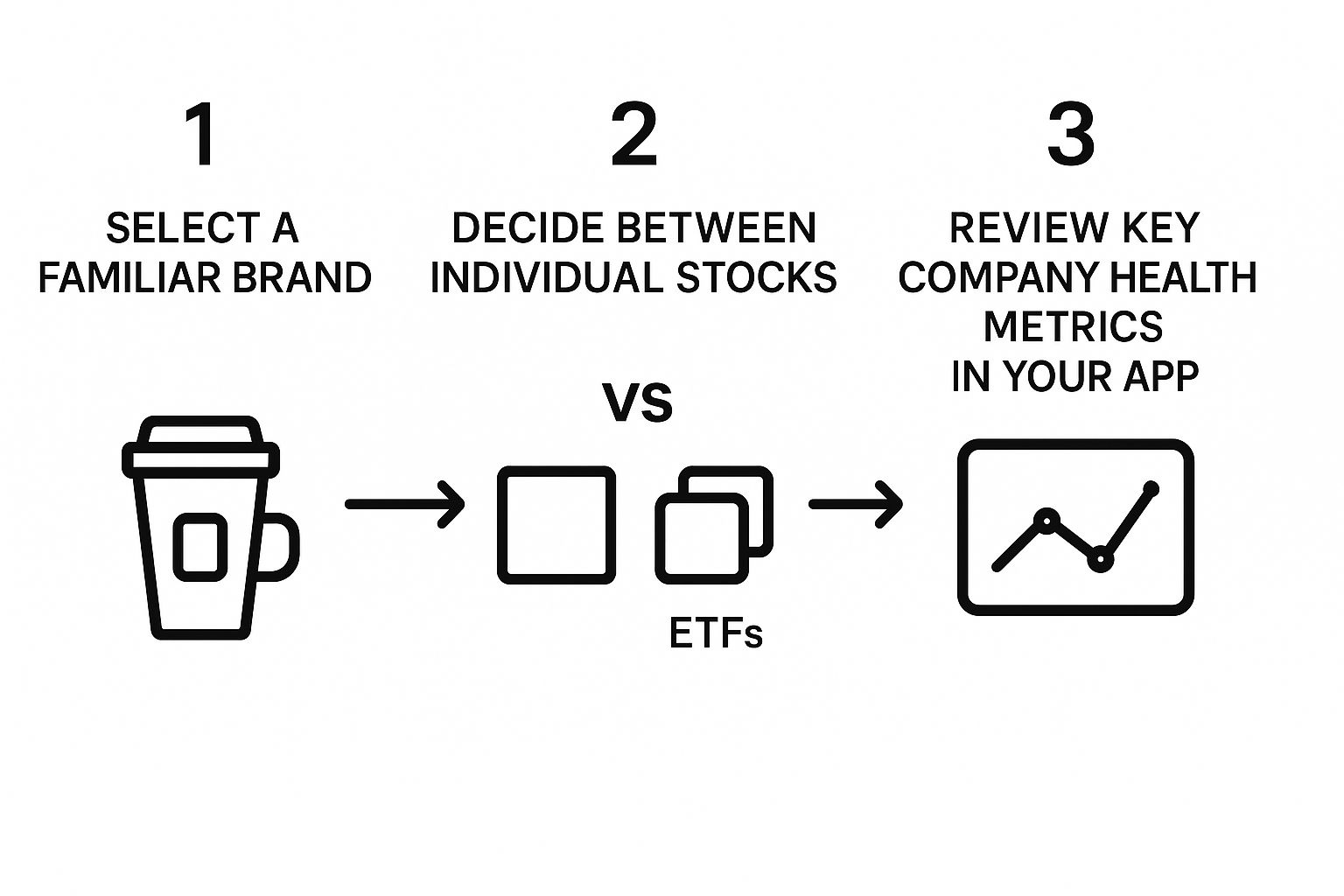
This simple infographic breaks down the selection process into a few clear steps.

Infographic showing a three-step process: selecting a familiar brand, choosing between stocks and ETFs, and reviewing metrics on a brokerage app.

As the visual shows, getting started can be as easy as picking a brand you trust and then deciding if you want just that one company or a more diversified basket. If you want to dive deeper into how these funds work, you can explore the key differences in our detailed guide on ETF vs mutual funds.

Whatever you pick, your brokerage app will have simple tools to do a quick "health check" on a company or fund before you commit your cash.

Making Your First Stock Purchase

A person's hand holding a smartphone, with the screen displaying a clean, user-friendly brokerage app interface showing the final 'Confirm Purchase' button for a stock.

You've done the work and picked your first stock. Now for the exciting part – actually buying it. Thankfully, this is way simpler than you might think.

Just open your brokerage app, search for the company's name or its ticker symbol (like NKE for Nike), and tap the "Trade" or "Buy" button. Easy.

From there, you just need to tell the app how you want to buy the stock. This is where you’ll see a couple of key terms called order types. Understanding these is the secret to placing your first trade with confidence.

Market Orders vs. Limit Orders

The two main choices you'll see are market orders and limit orders.

A market order is the most straightforward option. It tells your broker, "I want to buy this stock right now, at whatever the current price is." It's fast, simple, and your order will almost always go through instantly. For most beginners, a market order is the perfect choice.

A limit order gives you more control. It's like saying, "I only want to buy this stock if the price drops to a specific number or lower." For instance, if Nike is trading at $95 a share, you could place a limit order for $94.50. Your purchase will only happen if the stock price hits your target. It's a great tool if you have a very specific price in mind.

The Magic of Fractional Shares

So, what happens when you want to own a piece of a powerhouse like Amazon, but a single share costs thousands of dollars? This is where fractional shares completely change the game for new investors.

Instead of needing the cash for a full share, you can just buy a small slice of one.

You don't need a huge bank account to get started. With fractional shares, you can buy $5 worth of Tesla or $10 worth of Apple. This lets you build a portfolio filled with amazing companies, even if you're starting small.

This is what makes modern investing so accessible. It allows you to begin your journey with whatever amount you're comfortable with. So go on, place that first order – you're officially an investor now.

Building Good Habits for Long Term Growth

Buying your first stock is a huge milestone, but let's be real: the secret to building actual wealth isn't about one lucky pick. It’s about building simple, repeatable habits you can stick with for years.

The real game is won with patience, not timing. Legendary investor Warren Buffett couldn't have said it better:

"The stock market is a device for transferring money from the impatient to the patient."

This mindset is your secret weapon. The market will have days where it feels like a rollercoaster. But history has shown us that the market trends upward over the long haul. Keeping your cool and sticking to your plan is how you come out on top.

Put Your Investing on Autopilot

One of the most powerful habits you can form is Dollar-Cost Averaging (DCA). It sounds way more complicated than it is. All it means is investing a fixed amount of money on a regular schedule – say, $25 every Friday – no matter what the market is doing.

This simple strategy works like a charm:

  • When prices drop, your $25 automatically buys more shares.
  • When prices are up, that same $25 buys fewer shares.

This takes the emotion and guesswork out of investing. No more stressing about trying to "time the market." It’s a disciplined, set-it-and-forget-it method that builds wealth steadily. Even Ashton Kutcher, known for his acting, is a savvy tech investor who talks about the power of automating good financial habits.

Don't Put All Your Eggs in One Basket

Another key habit is diversification. Think of it this way: you wouldn't bet your entire life savings on a single roll of the dice, so why put all your money into just one company? Spreading your investments across different stocks and industries gives you a crucial safety net.

The numbers back this up. Over the past century, global stocks have delivered an average annual return of around 5-7% after inflation. An attention-grabbing fact is that this return is significantly higher than what you'd get from gold, bonds, or just holding cash. You capture this long-term growth by holding a mix of investments.

If you want to dive deeper into these historical trends, check out the UBS Global Investment Returns Yearbook.

When you combine patience with automation and diversification, you're not just investing – you're building a powerful system for long-term growth. These habits aren't flashy, but they are the bedrock of any successful investing journey.

Got Questions? We've Got Answers

Stepping into the world of investing can feel a bit like learning a new language. You're going to have questions, and that's not just normal – it's smart. Let's tackle some of the biggest ones right away.

Even the sharpest investors started at square one. They asked questions, learned the ropes, and made their moves. Your journey starts the same way.

How Much Money Do I Really Need to Start?

Honestly, you can probably start with the cash from your part-time job. Thanks to fractional shares, most modern brokerage apps let you get in the game with as little as $5.

The starting amount isn't nearly as important as the habit. It’s far more powerful to invest $25 every month than to wait until you have a "perfect" lump sum. Consistency is where the magic happens.

Is This Just a Nicer Word for Gambling?

Not if you’re doing it right. Gambling is pure chance, like betting on a coin flip. You have zero control.

Smart investing is about owning a piece of a real business. You're buying into a company that you believe has a solid plan to grow and succeed over time.

You can’t control a roll of the dice, but you can absolutely research a company, understand what it sells, and make an educated decision. While there's always risk, you minimize it by thinking like a business owner, not a high-roller in Vegas.

Stocks vs. ETFs: What’s the Difference?

Let’s use a food court analogy. Buying a single stock is like ordering just a slice of pizza. You’re betting everything on that one slice being delicious.

An ETF (Exchange-Traded Fund) is like getting the combo meal – the pizza, fries, and a drink all in one go.

The combo meal (the ETF) gives you instant variety. It holds dozens or even hundreds of different stocks. So, if the pizza company has a bad day, the fries and drink can help balance things out. For beginners, ETFs are an incredible tool for instant diversification.

How Often Should I Be Checking My Portfolio?

I know it's tempting. You put your money in, and you want to see what it's doing every five minutes. But this is usually a recipe for stress.

The market has daily mood swings – it zigs and zags constantly. For anyone investing for the long term, checking in once a month or even quarterly is plenty. Your goal is to let your money grow over years, not minutes.


Ready to put this knowledge into practice? At financeillustrated.com, we specialize in making the markets feel less intimidating and a lot more fun. Our free Trading School and interactive simulators are built to boost your confidence before you risk a single real dollar. Start your journey with us at https://financeillustrated.com.

How to Read Stock Market Charts: A Simple Guide for Beginners

ye

Learning how to read stock market charts is like learning the secret language of money. It’s a visual story of the constant tug-of-war between buyers and sellers, a skill legendary traders like Jesse Livermore mastered over a century ago. The core idea is simple: understand the price's past moves to guess what might happen next.

Your First Look at Stock Charts

Ever glance at a stock chart and feel like you're staring at an alien language? You're not alone. Think of a chart as the market's heartbeat, telling the story of a company's stock through its price changes. We'll skip the heavy jargon and focus on what these lines and colors really mean.

A person pointing at a stock chart on a computer screen.

Before modern digital charts, traders had to get creative. One of the earliest forms of analysis was reading ticker tape, popular all the way until the mid-1960s. This meant analyzing market data from paper strips printed by stock tickers. A crazy fact: Thomas Edison, the guy who invented the lightbulb, actually invented an early version of the stock ticker!

Traders like Jesse Livermore relied heavily on this method, using price and volume data to spot market trends without the fancy charts we have today. If you're curious, you can explore more about the history of technical analysis and its evolution.

The Four Key Pieces of Price Information

At its core, a chart is just a visual story of data. Every period on a chart – whether it's one minute or one day – tells you four essential things about the stock's price. Nailing these is the first step to reading any chart. They are the building blocks of every pattern and trend you’ll eventually learn to spot.

Every chart tells a story using four main data points for a specific period (like a day or an hour). Understanding these is step one.

Data Point What It Tells You Why It Matters
Open The very first price a stock traded at when the market opened for that period. It sets the initial mood and gives you a starting line for the day's action.
High The absolute highest price the stock hit during that specific period. Shows how excited buyers got; it's the peak of optimism.
Low The absolute lowest price the stock dropped to during that period. Shows how nervous sellers got; it's the peak of pessimism.
Close The final price the stock traded at when the market closed for that period. Many pros see this as the most important price, showing who won the day's battle.

This data might seem simple, but it’s the DNA of market analysis. These four points are what create the different shapes and colors you'll see on more advanced charts, which we'll dive into next. Think of them as the alphabet – once you know the letters, you can start reading words.

Choosing Your Chart Type

When you're trying to figure out a stock's story, not all charts tell it the same way. Think of them like different camera lenses – some give you a wide, sweeping view, while others zoom in on the gritty details. Picking the right one is key to seeing what’s really happening with the price.

Let's break down the three main types you'll run into everywhere.

A person pointing at a stock chart on a computer screen.

It helps to think of these charts as an evolution. For centuries, traders have been trying to visualize market data to get an edge. What we use today, like Japanese candlesticks, is the result of a long history of innovation. Pioneers like Charles Dow, the brain behind the Dow Jones Industrial Average, helped turn simple price tracking into a legit analytical tool.

The Simple Line Chart

First up is the line chart, the most basic view you can get. It’s literally a connect-the-dots picture of a stock's closing prices over a set period.

This chart is perfect for getting a quick, clean look at the overall trend. Is the stock generally heading up, down, or just drifting sideways over the past year? A line chart shows you this at a glance. The big drawback? It completely ignores all the drama that happened during the day – the highs, the lows, and the battle between buyers and sellers.

The More Detailed Bar Chart

Next, we have the bar chart, which adds a few more layers to the story. Instead of just a single dot for the close, you get a vertical line for each period (like a day or an hour). This line represents the entire trading range, from the highest high to the lowest low.

Sticking out from this bar are two small horizontal lines, or "ticks":

  • The left tick: This shows the opening price.
  • The right tick: This shows the closing price.

Bar charts give you a much better feel for volatility. A long vertical bar means the price swung wildly, while a short one signals a calm, quiet trading session.

The All-Powerful Candlestick Chart

For most traders, the real star of the show is the candlestick chart. It packs the exact same four pieces of data as a bar chart (open, high, low, and close) but presents them in a way that's far more visual and easy to read. Honestly, once you get the hang of these, you probably won't want to go back.

Each "candle" is made of two parts:

  • The Body: This is the thick, rectangular part. It shows you the range between the open and close price.
  • The Wicks (or Shadows): These are the thin lines poking out from the top and bottom, showing the day's absolute high and low.

What makes candlesticks so powerful is the color. A green (or white) candle means the stock closed higher than it opened – a good day for the bulls (the buyers). A red (or black) candle means it closed lower – a win for the bears (the sellers).

This instant color-coding tells you the market's mood in a split second. A long green candle screams strong buying pressure, while a long red one signals heavy selling. Learning to interpret these shapes and patterns is a foundational skill in understanding how to read candlesticks.

Spotting Trends and Key Price Levels

Alright, now that you know what the candlesticks and bars on a chart are telling you, it's time for the fun part: reading the market's mood. Think of it like looking at a mountain range from a distance. Is the general direction heading up, sloping down, or just moving sideways?

Learning to spot these big-picture movements is one of the first major hurdles in understanding how to read stock charts.

A chart showing an uptrend with support and resistance levels.

This isn't just a technical skill for making money; it’s about understanding market psychology. Even legendary investors who aren’t glued to charts, like Warren Buffett, get the power of market sentiment. He famously said, "Be fearful when others are greedy and greedy when others are fearful." Seeing trends on a chart is a direct, visual way to see that greed and fear playing out in real-time.

Identifying the Main Trend

You’ve probably heard the saying, "the trend is your friend." It gets repeated so often because it's true. The trend is simply the overall direction a stock's price is heading. It boils down to three types:

  • Uptrend: Picture a staircase going up. The chart is making a series of higher highs and higher lows. This tells you buyers are in control, consistently pushing the price higher.
  • Downtrend: This is the opposite – a staircase heading down. You'll see a distinct pattern of lower highs and lower lows. In this case, sellers have the upper hand.
  • Sideways Trend (Consolidation): The price seems stuck, bouncing around within a specific range without making any real progress. Buyers and sellers are basically in a standoff.

A quick way to make the trend pop off the page is to draw a simple trend line. For an uptrend, just connect the lows. For a downtrend, connect the highs. This simple line can instantly clarify the market's direction.

Understanding Support and Resistance

This is where chart reading really starts to get interesting. Support and resistance are two of the most fundamental concepts you'll ever learn, and they are incredibly powerful.

Think of them as a floor and a ceiling that the stock price is trapped in.

  • Support (the floor): This is a price level where a downtrend often hits the brakes or even reverses. Why? Because enough buyers see the stock as a good deal at that price and step in, stopping it from falling further. It’s a psychological floor.
  • Resistance (the ceiling): This is a price point where an uptrend tends to run out of steam. Selling pressure gets stronger than buying pressure, creating a ceiling that the price struggles to break through.

These levels aren't magic; they're created by group psychology. When a stock approaches a previous high, some investors who bought lower decide it's a good time to sell and take profits. That selling creates resistance. On the flip side, when a stock drops to a previous low, other investors see a bargain and jump in, creating support.

A quick heads-up: these levels aren't unbreakable laws. They are simply areas where the probability of a price reversal is higher. A stock can absolutely smash through support or resistance, especially with a lot of people trading (high volume) – and that breakout is a powerful signal in itself.

Spotting these levels gives you a map of the battlefield, showing you where the big fights between buyers and sellers are likely to happen. It's crucial because markets can be wild. Historical data shows that even in years the market ends with big gains, scary drops are just part of the game. Since 1928, the S&P 500 has had an average drop of about -16.4% within each year. Knowing where potential support is can make that ride a lot less stressful. You can discover more insights about historical market behavior here.

Using Indicators to Get a Deeper Read

Alright, once you've got a feel for spotting trends and key price levels on a chart, it's time to bring in the heavy hitters. These are your indicators, and they're like getting a second opinion from a smart friend before you make a move.

We're not going to overwhelm you with a dozen different tools. Instead, let's focus on a couple of the most trusted indicators out there, plus the one thing many beginners ignore: trading volume.

Think of it this way: the price chart tells you what is happening. Indicators and volume help you understand why it's happening and how much power is behind the move. They add that extra layer of context that separates a wild guess from an educated decision.

Infographic about how to read charts stock market

This simple flow is how experienced traders approach a chart. You start with a Moving Average to get the general direction, check an indicator like the RSI to gauge momentum, and then look at volume to see if the move has any real power behind it.

Smoothing Out the Noise with Moving Averages

First up is the Moving Average (MA). It’s one of the most popular indicators for a simple reason: it helps. Its main job is to cut through the day-to-day chaos of price swings and show you the underlying trend more clearly.

It does this by averaging the closing price over a set number of days, like 20 or 50, and plotting that as a single, smooth line on your chart. When the price stays consistently above this line, it’s a strong signal that you're in an uptrend. If it's trading below the line, that points to a downtrend. It's a fantastic, no-nonsense way to get your bearings.

Is the Stock Overheated or on Sale?

Next, let's look at the Relative Strength Index (RSI). This is a momentum indicator. It basically measures how fast and how big recent price changes are to tell you when a stock might be "overbought" or "oversold."

The RSI is shown as a line that moves between 0 and 100. Here’s the simple way to read it:

  • A reading above 70 suggests the stock is overbought. Buyers have been piling in, and it might be running out of gas and due for a price drop.
  • A reading below 30 suggests the stock is oversold. Sellers have been dumping it, and it could be getting cheap enough to attract buyers for a bounce.

Think of the RSI like a car's engine meter. If the engine is revving in the red zone (over 70) for too long, you probably need to ease off the gas. If it's sputtering and about to stall (below 30), it might be time for a tune-up. It’s a gauge of market excitement.

The Importance of Trading Volume

Finally, we have to talk about Volume. This might be the single most underrated piece of information on a chart, but it's critical. Shown as bars at the bottom of your chart, volume simply tells you how many shares were traded in a given period.

So, why is this so important? Because volume is the fuel behind any price move. It shows you how confident the market is.

Imagine a stock jumps 5%. On its own, that looks great. But if it happened on super low volume, it’s not very convincing – it's like one person managing to push a car a few inches. Now, if that same 5% jump happens on massive volume? That’s like a whole crowd getting behind the car and shoving it down the street. That's a move you need to pay attention to, as it shows lots of people believe in the new price.

These core ideas of price, momentum, and volume aren't just for stocks. They're universal principles that apply across different markets. In fact, you'll find similar concepts when it comes to reading cryptocurrency charts and indicators as well.

A Practical Chart Analysis Framework

Knowing all the individual pieces of a chart is great, but the real magic happens when you start putting them together to read the market's story. Think of it like learning the alphabet versus reading a book.

What you need is a repeatable process – a consistent framework you can use every single time you pull up a chart. This helps build confidence and turns a chaotic screen of data into a clear story.

As the legendary investor Warren Buffett says, "Risk comes from not knowing what you're doing." This framework is your first step toward knowing exactly what you're doing. It all boils down to asking the right questions in the right order.

Your 5-Step Chart Reading Checklist

I like to think of this as a pre-flight checklist before making any trading decision. It forces you to cover the essential bases and stops you from getting laser-focused on just one thing.

Let's walk through this simple but powerful framework that helps you analyze any stock chart you come across.

Step Action Item Key Question to Answer
1 Identify the Trend Is the stock in a clear uptrend, downtrend, or just moving sideways?
2 Spot Key Levels Where are the most obvious support (floor) and resistance (ceiling) levels?
3 Check the Volume Does the trading volume confirm what the price is doing, or is it telling a different story?
4 Look at Indicators What are the Moving Averages and RSI telling me about momentum and strength?
5 Form a Thesis Based on everything I see, what is the most likely direction for the price to go next?

This checklist turns a potentially confusing jumble of lines into a structured analysis. It gives you a story, not just a snapshot.

Let's apply this to a real-world example, say, a chart of Tesla (TSLA).

First, you’d zoom out to get the big picture. What’s the main trend over the last six months? Is it making higher highs (uptrend) or lower lows (downtrend)?

Next, you'd start drawing. Mark horizontal lines where the price has repeatedly bounced up from (support) or struggled to break through (resistance). These are the battlegrounds.

After that, glance down at the volume bars. Did that last big price jump happen on a huge spike in volume? That’s a powerful confirmation. A move on low volume is way less convincing.

Finally, pull up your indicators. Is the price trading above its 50-day moving average? Is the RSI screaming overbought (above 70) or oversold (below 30)?

By answering these questions one by one, you build a complete story about the stock's current situation. This systematic approach is the foundation of solid chart analysis. For anyone looking to go a step further, exploring the basics of technical analysis will add even more powerful tools to your toolkit.

Common Questions About Reading Stock Charts

Jumping into the world of stock charts can feel like learning a new video game – you get the goal, but the rules and special moves can be a bit of a blur. It's totally normal to have questions.

Let's clear up some of that initial fog and tackle the things most beginners wonder about.

How Much History Should I Look At On A Chart?

That’s a fantastic question, and honestly, it all depends on your goals. Are you a day trader trying to make a quick profit in a few minutes? If so, you might only care about what’s happened in the last few hours.

But if you’re a long-term investor playing the Warren Buffett game, looking at charts that span several years gives you a much better feel for the big-picture trend. A good rule of thumb for anyone starting out is to pull up a one-year daily chart. It gives you enough data to spot major trends, support, and resistance levels without getting lost in the daily noise.

Can Chart Reading Predict The Future?

Let's be crystal clear: no chart, indicator, or so-called "guru" can predict the future with 100% accuracy. The market gets thrown around by countless unpredictable events, from surprise economic news to global politics. Heck, even celebrities can move markets – remember when a single tweet from Elon Musk could send the Dogecoin chart on a wild ride?

Think of chart reading not as a crystal ball, but as a weather forecast. It uses past data to identify patterns and probabilities, helping you make a more educated guess about what might happen next. It's about stacking the odds in your favor, not getting rid of risk completely.

How Do I Know Which Indicators To Use?

Walking into the world of technical indicators feels like trying to pick one snack from a massive candy store – there are hundreds! A classic beginner mistake is to plaster their chart with a dozen different lines and tools until it's unreadable.

Keep it simple. Start with the basics we've covered:

  • Moving Averages (like the 50-day and 200-day): These are fantastic for quickly seeing which way the trend is heading.
  • Volume: This one is non-negotiable. Always, always check if volume is confirming what the price is doing.
  • Relative Strength Index (RSI): A simple but powerful tool to gauge if a stock is getting overbought or oversold.

These three give you a solid foundation for analyzing pretty much any chart. Once you've got them down, you can start exploring others. Just don't get "analysis paralysis." As the legendary trader Paul Tudor Jones said, "The secret to being successful from a trading perspective is to have an indefatigable and an undying and unquenchable thirst for information and knowledge." Start simple, stay curious, and never stop learning.


Ready to put your knowledge into practice? At financeillustrated.com, we make learning fun and accessible. Explore our free Trading School, practice with risk-free simulators, and build your confidence before you ever risk a dollar. Start your trading journey the smart way at https://financeillustrated.com.
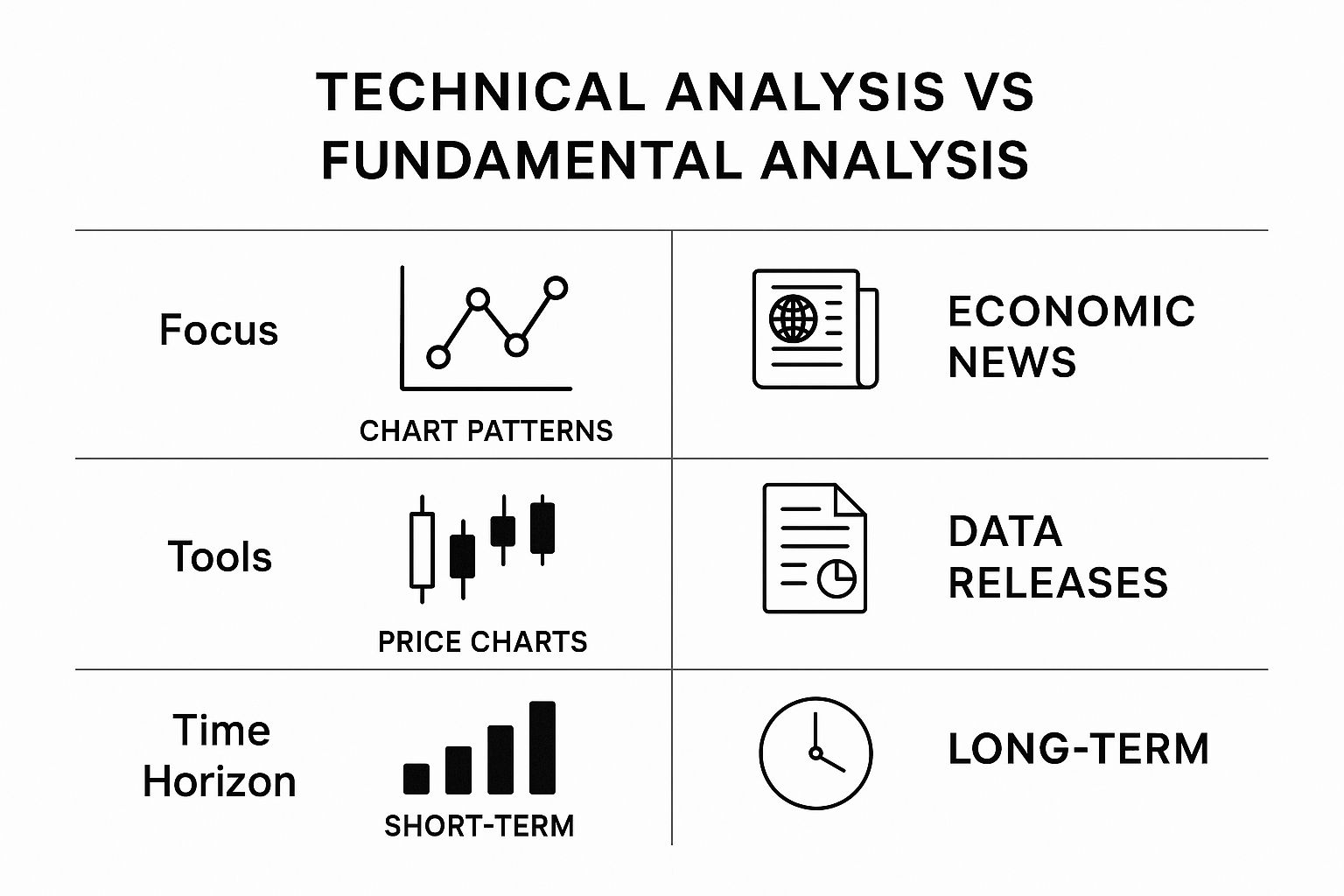
7 Actionable Daily Trading Tips for Young Investors in 2025

ye

Ever wondered how top traders seem to stay calm and consistently make smart moves? It’s not magic – it’s a system. They rely on a set of core rules they practice every single day, turning the crazy market into something they can manage. This isn't about complex math or needing a supercomputer. It’s about building smart habits, just like a pro athlete trains for a big game.

Forget the confusing jargon you see in movies. We're going to break down seven super practical, daily trading tips that anyone can understand and start using right away. Think of this as your personal trading playbook. We'll explore powerful ideas from legends like Paul Tudor Jones, who famously said, “The most important rule of trading is to play great defense, not great offense.” We'll even see how modern celebrities like Ashton Kutcher apply similar principles of smart risk-taking in their tech investments, focusing on solid strategies over wild gambles.

By the end of this guide, you’ll have a clear, actionable plan to approach the market with more confidence and control. You'll learn how to build a pre-market routine, manage risk like a pro, and review your moves to get better every single day. Let's dive in.

1. Start with a Solid Pre-Market Routine

Ever see pro athletes go through a strict pre-game ritual? It’s not just for show; it's about getting in the zone, focusing their energy, and preparing to win. As a trader, your "game" is the market, and your pre-market routine is your essential warm-up. It's the dedicated time you set aside before the opening bell to go from being a spectator to a prepared player.

This process means checking the news, looking at the economic calendar, and spotting potential trades before the market's chaos begins. By doing this, you create a game plan. This lets you trade with confidence instead of chasing every random price jump. Many successful traders, like Mike Bellafiore of SMB Capital, emphasize that your prep work directly predicts how well you'll perform.

How to Build Your Pre-Market Checklist

A good pre-market routine is like a pilot's pre-flight checklist – structured and repeatable. Here’s a simple framework you can use:

  • Global Market Check (30 mins): What happened while you were asleep? Look at major Asian and European markets (like the Nikkei or DAX). This gives you a feel for the overall market vibe. Did a major economic report from another country shake things up?
  • Economic Calendar Review (15 mins): Check for big economic news scheduled for the day, like inflation data (CPI) or job reports. These events can cause huge price swings, and you need to know when they’re happening.
  • Build Your Watchlist (30-45 mins): Use a pre-market scanner (you can find these on platforms like TradingView) to find stocks that are already busy with high trading volume. These are the "stocks in play." Instead of watching 50 stocks, narrow your focus to the top 3-5 that fit your strategy.
  • Chart Your Key Levels (15 mins): For each stock on your shortlist, find the key price levels where it previously bounced up (support) or got rejected (resistance). Mark these on your charts. This is your battle map for the day.

By following a consistent routine, you replace emotional guessing with a smart, strategic approach. This is one of the most crucial daily trading tips for long-term success. You're not just hoping for a good day; you're preparing for one.

2. Use the 1% Risk Management Rule

Imagine playing a video game where one mistake makes you lose everything. Super frustrating, right? Trading can feel that way without a good defense. The 1% rule is your ultimate shield. It's a simple rule: never risk more than 1% of your total account on a single trade. This isn't about limiting your profits; it's about making sure you stay in the game long enough to win.

Use the 1% Risk Management Rule

This simple rule is loved by legendary trading coaches because it mathematically prevents a few bad trades from wiping you out. A losing streak of five trades only results in a 5% account loss, which is totally manageable. Without this rule, the same streak could be a disaster. It forces you to focus on protecting your money, which is the real secret to lasting in trading. Fun fact: Even billionaire investor George Soros, known for his massive bets, was obsessed with risk management. He famously said, "It's not whether you're right or wrong that's important, but how much money you make when you're right and how much you lose when you're wrong."

How to Apply the 1% Rule

Applying this rule is a simple, two-step calculation you must do before entering any trade. To use this rule and manage any financial strategy, you need a good grasp of basic math concepts like understanding percentages. Here’s how it works:

  • Calculate Your Max Dollar Risk: First, figure out what 1% of your trading account is. If you have a $10,000 account, your maximum risk per trade is $100 ($10,000 x 0.01). This is the absolute most you can lose if the trade goes south.
  • Determine Your Stop-Loss: Before you trade, you must know your exit point if you're wrong. Let's say you want to buy a stock at $25 and your analysis says to put a stop-loss at $24.50. Your risk per share is $0.50.
  • Calculate Your Position Size: Now, divide your max dollar risk by your per-share risk. In our example: $100 (max risk) / $0.50 (risk per share) = 200 shares. That's the maximum number of shares you can buy for this trade.
  • Adjust for Every Trade: Your position size will change depending on the trade's stop-loss, but your max dollar risk (1% of your current account) stays the same. This disciplined approach is one of the most powerful daily trading tips for consistency.

By making this rule non-negotiable, you take emotion and fear out of your decisions. You're no longer gambling; you're managing risk like a pro.

3. Trade Only During High-Liquidity Sessions

Imagine trying to surf on a calm lake versus the ocean. The ocean has powerful waves and momentum, while the lake is flat and boring. The stock market is similar. Trading during high-liquidity sessions is like surfing in the ocean; there are more buyers and sellers (more "waves"), which means faster trades, better prices, and more reliable price movements.

Trade Only During High-Liquidity Sessions

This means you should focus your energy when the market is most active, usually the first and last hours of the trading day. Most of the day's action happens in these windows. By avoiding the slow, boring midday period, you can focus on the best opportunities and avoid the frustration of a market that's going nowhere. Pro traders often make most of their money during these key hours and use the midday lull for analysis, not for trading.

How to Focus on High-Liquidity Windows

Timing is everything. Knowing when to trade is as important as knowing what to trade. Here’s how to sync up with the market's most energetic periods:

  • The Golden Hours: For U.S. stock traders, the best times are usually 9:30 AM – 11:00 AM EST and 3:00 PM – 4:00 PM EST. Most pro day traders are done by 11:00 AM.
  • Avoid the Opening Chaos: The first 5-15 minutes after the market opens can be pure chaos. It’s often driven by overnight news and hype. Let the market settle and show its real direction before you jump in.
  • The Midday Dead Zone: From about 11:30 AM to 2:30 PM EST, trading volume often dries up. Big institutional traders are at lunch, and the market tends to drift sideways. This is a high-risk, low-reward time-perfect for practice, but not for your real money.
  • Watch for Overlaps in Forex: If you trade currencies, the best time is when major market sessions overlap. For the Euro vs. the US Dollar (EUR/USD), the sweet spot is when the London and New York markets are both open (8:00 AM – 12:00 PM EST). You can learn more about how to track these forex market hours on financeillustrated.com.

By using this timing strategy, you put the odds in your favor. This is one of the most effective daily trading tips because it forces you to trade when the market offers the clearest opportunities, helping you save your money and mental energy for when it counts.

4. Follow the Trend with Moving Average Confirmation

Ever heard the saying, "the trend is your friend"? It's one of the oldest trading rules for a reason. Instead of fighting the market's momentum, smart traders learn to ride its waves. Following the trend means you trade in the same direction the market is already going, and moving averages are the best tool to see which way that current is flowing.

Follow the Trend with Moving Average Confirmation

A moving average (MA) is a line on your chart that smooths out all the noisy price wiggles, making it easier to see the real trend. When the price is consistently above the moving average, it signals an uptrend; when it's below, it suggests a downtrend. Legendary traders like Paul Tudor Jones built their careers on this idea, knowing it's way more profitable to go with the flow than to swim against the tide.

How to Use Moving Averages for Trend Confirmation

Using moving averages is like having a GPS for the market. They give you clear, visual signals to guide your trades. Here’s a simple way to get started:

  • Identify the Main Trend: Use longer-term MAs like the 50-period and 200-period on a daily chart. When the 50 MA crosses above the 200 MA (a "Golden Cross"), it signals a strong bullish trend. A cross below (a "Death Cross") signals a bearish trend.
  • Find Your Entry Points: On a shorter timeframe (like a 5-minute chart), use faster MAs like the 9-period and 20-period Exponential Moving Averages (EMAs). In a strong uptrend, a common strategy is to buy when the price pulls back and touches the 20 EMA, which acts like a moving support line.
  • Combine with Other Clues: For a stronger signal, combine MAs with volume. If a stock bounces off its 20 EMA with a huge spike in buying volume, it’s a much more reliable signal than a bounce with low volume.
  • Know When to Stay Out: If the price is just chopping back and forth across the moving average, it means the market has no clear trend. This is a sign to be patient and wait for a clearer direction.

By using moving averages, you stop guessing and start making informed decisions based on the market's actual momentum. This is one of the most powerful daily trading tips for building a consistent and disciplined approach.

5. Set Multiple Profit Targets and Scale Out

Ever closed a winning trade just to watch it double in price without you? It’s a terrible feeling. On the other hand, holding on for a huge gain only to see it reverse and turn into a loss is even worse. This is where a pro technique called "scaling out" comes in. It’s a strategy that lets you lock in profits while still giving you a shot at a bigger move.

Instead of an all-or-nothing approach where you sell everything at one price, scaling out means selling parts of your position at different, pre-planned price levels. This powerful method, used by legendary traders like Linda Raschke, helps reduce stress and removes the emotional guesswork. It turns taking profits from one big, scary decision into a calm, multi-step process.

How to Scale Out of Your Trades

The key is to have your exit plan figured out before you even enter the trade. This pre-planning is one of the most vital daily trading tips for staying disciplined. Here’s a practical way to do it:

  • Define Your Targets Before Entry: Let's say you buy 300 shares of a stock. Before you click "buy," decide on your exit points. For example, your plan could be to sell 150 shares at your first target (e.g., +$0.50), another 100 at your second target (e.g., +$1.00), and let the final 50 shares run.
  • Move Your Stop-Loss to Breakeven: This is a game-changer. Once your first profit target is hit, move your stop-loss for the remaining shares up to your original entry price. This makes the rest of the trade "risk-free," since you can't lose money on it anymore. This one move can dramatically improve your trading psychology.
  • Use Charts to Set Realistic Levels: Don't just pick profit targets out of thin air. Use your chart to find logical resistance levels or other technical points where the price might struggle. The Average True Range (ATR) indicator is also a great tool for setting realistic targets based on the stock's typical daily movement.
  • Adjust Based on the Market: Be flexible. In a choppy, uncertain market, you might want to scale out faster, taking more profit at your first target. In a strong, trending market, you might let a bigger piece of your position run for a larger gain.

By scaling out, you pay yourself along the way. It’s a disciplined approach that balances greed and fear, allowing you to lock in gains while still having a chance at those massive home-run trades.

6. Wait for Confirmation Before Entry

Ever jumped into a trade thinking it was a "sure thing," only to see the price immediately go against you? This happens when you act on what you think will happen instead of what is actually happening. Waiting for the market to confirm your idea is like waiting for the green light before crossing the street; it’s a simple rule that makes you much safer and more successful.

This means you let the price action prove you're right before you put your money on the line. For instance, instead of buying a stock the second it touches a support level, you wait for a clear signal that other buyers are actually showing up. Legendary traders like Peter Brandt, who is a master of chart patterns, built their careers on this discipline. They know that a potential setup isn't the same as a valid one.

How to Practice Patient Confirmation

Confirmation turns your trading from a guessing game into a methodical process. Here’s a checklist to help you wait for the right signals:

  • Define Your Signal Clearly: What does confirmation look like for your strategy? Write it down. Is it a 5-minute candle closing clearly above a resistance line? Is it a breakout with a big spike in volume? Be specific.
  • Use Price Action Patterns: Look for validating candlestick patterns on your chart. For a long entry at support, you might wait for a bullish engulfing candle (a big green candle that "eats" the previous red one) to form. This shows that buyers have taken control.
  • Combine Your Signals: Don't rely on just one thing. A stronger setup might be a price breaking above a key moving average and being confirmed by a surge in buying volume. Two signals are better than one.
  • Set Price Alerts: Instead of staring at the chart and getting tempted to jump in too early, set an alert at your confirmation level. This frees up your mental energy and forces you to wait for the market to come to you.

Adopting this practice is one of the most powerful daily trading tips for filtering out weak trades and avoiding emotional, impulsive decisions. You might miss the very beginning of a move, but you will catch more of the reliable, high-quality trades that actually make you money.

7. Review and Journal Every Trade

Imagine a pro athlete watching game tapes to find their mistakes and strengths. That's exactly what a trading journal does for you. It's your personal "game tape," helping you learn from your experiences. Journaling is what separates a novice trader who gets lucky or unlucky from a professional who understands their own performance.

This process involves writing down every single trade-not just the wins, but especially the losses. You record why you took the trade, your entry and exit points, and even how you were feeling. A famous trading psychologist, Brett Steenbarger, often says that self-awareness is a trader's greatest asset. A journal is the best tool for building that awareness, turning your trading data into a roadmap for improvement. Even someone like Oprah Winfrey, a master of self-reflection, has championed journaling for years as a way to understand one's own patterns and achieve goals.

How to Build Your Trading Journal

A great journal is more than just a list of wins and losses; it’s a story of your decision-making. Here’s a simple framework to get started:

  • Capture the Essentials: For every trade, log the date, stock ticker, entry price, exit price, stop-loss, and final profit or loss. This is your basic data.
  • Explain Your "Why": Why did you take this trade? Was it a chart pattern? A news story? Write down your reasoning. Also, take a screenshot of the chart when you entered and exited, and draw your notes on it. This visual context is priceless.
  • Track Your Mindset: Rate your emotional state on a scale of 1-5. Were you feeling confident, fearful, or greedy? You might discover that your worst trades happen when you're feeling emotional.
  • Review and Find Patterns: Every weekend, review your week's trades. Look for patterns. Do you always lose money on Fridays? Do your best trades come from a specific setup? This is where your data turns into powerful insights. To take it a step further, you can learn how to backtest your trading strategies to see if your patterns hold up over time.

By keeping a journal, you create a feedback loop that helps you learn faster. This is one of the most powerful daily trading tips because it forces you to be your own coach, helping you find your strengths and eliminate costly mistakes.

7 Key Daily Trading Tips Comparison

Strategy 🔄 Implementation Complexity ⚡ Resource Requirements 📊 Expected Outcomes 💡 Ideal Use Cases ⭐ Key Advantages
Start with a Solid Pre-Market Routine Medium (30-90 min daily early start) Requires access to news, futures, alerts Better prepared trades, reduced impulsivity Day traders preparing for market open Reduces emotions, identifies setups early
Use the 1% Risk Management Rule Low-Medium (requires precise calculations) Basic math tools, position size calculator Capital preservation, steady account growth All traders prioritizing risk control Protects capital, promotes discipline
Trade Only During High-Liquidity Sessions Low (time-restricted trading hours) Requires trading during key sessions Tighter spreads, better execution, clearer trends Day traders focusing on volatile market periods Lower costs, higher quality setups
Follow the Trend with Moving Average Confirmation Medium (requires indicator setup) Charting software with MA indicators Higher win rates, clearer trend direction Trend followers and technical analysts Clear entry signals, removes guesswork
Set Multiple Profit Targets and Scale Out Medium-High (complex position management) Advanced order management capability Reduced regret, improved risk-reward Traders managing profits on longer intraday/swing trades Locks partial profits, eases exit-related anxiety
Wait for Confirmation Before Entry Medium (requires patience and rules) Alert systems, charting tools Higher win rate, fewer false signals Traders seeking improved trade quality Reduces false breakouts, builds discipline
Review and Journal Every Trade Medium-High (ongoing daily commitment) Journal software or spreadsheets Improved performance via self-analysis All traders committed to continuous improvement Identifies patterns, enforces accountability

Your Daily Checklist for Smarter Trading

You've just learned seven powerful daily trading tips that form a blueprint for a disciplined and successful trading routine. Think of this as your new daily checklist. From the Pre-Market Routine that sets you up for success to the non-negotiable 1% Risk Management Rule that protects your money, you now have the tools to trade with a plan, not just a feeling.

The journey to becoming a consistent trader is a marathon, not a sprint. Legendary investor Warren Buffett once said, "The stock market is a device for transferring money from the impatient to the patient." This wisdom is at the heart of the tips we've discussed. Waiting for confirmation, trading only during the busy hours, and scaling out of positions are all acts of patience. They are the small, smart actions that separate pro traders from amateurs.

Making These Habits Stick

Knowing these tips is one thing, but making them habits is what really matters. Your trade journal is your personal coach, helping you learn from every win and loss. Your pre-market analysis is your strategic map for the day ahead.

Staying this disciplined day after day takes mental stamina. A trader's performance is tied directly to their mindset. It's crucial to create an environment that helps you focus. For practical strategies on this, you can explore ways to stay focused and boost productivity during your most critical trading hours. Mastering your focus is just as important as mastering your strategy.

Your Path Forward: From Knowledge to Action

The difference between reading about trading and becoming a trader is practice. The tips in this article are your building blocks. But you have to be the one to put them together. By committing to this checklist, you build a professional framework for your trading decisions. This structure will guide you through market ups and downs and help you make calculated moves instead of impulsive guesses. Start tomorrow. Choose one tip to master this week, then add another next week. Before you know it, these practices will become second nature, paving your way toward smarter, more confident trading.


Ready to turn these daily trading tips into real skills without risking a single dollar? Visit financeillustrated.com to access our interactive trading simulator, educational games, and in-depth courses. It's the perfect environment to practice everything you've learned here and build the habits of a pro trader in a fun, risk-free setting.

What Does Overweight Rating Mean? A Guide for Young Investors

ye

Ever heard a Wall Street expert call a stock "overweight" and felt totally lost? Don't worry about it. It's just finance jargon, and it's way simpler than it sounds. An overweight rating is basically a professional analyst giving a stock a massive thumbs-up. They're signaling they believe it's about to perform better than its rivals or the market in general.

Decoding the Analyst's Thumbs-Up

Imagine your investment portfolio is like your favorite playlist. You have a mix of different artists and genres to keep things balanced. An overweight rating is like a music critic telling you, "Hey, that new Taylor Swift album is a banger-you should add more of her songs to your playlist." You're giving that specific stock more "weight" or a bigger spot in your portfolio than you normally would.

This isn't just a random guess. It's a strong vote of confidence from someone who spends their days analyzing a company's financial health, its industry, and its future potential. They're basically telling investors that they see a bright future for this particular company.

Why This Rating Matters

An overweight rating is a recommendation based on data, not just a casual opinion. Analysts give this rating when they expect a stock to beat its benchmark, like the S&P 500, over the next 6 to 12 months. This confidence usually comes from solid fundamentals like growing profits, a cool new product launch, or positive trends in their industry.

For example, an analyst might give a gaming company an overweight rating right before they release a highly anticipated new video game, expecting a huge jump in sales and its stock price. It's a strategy used by legendary investors like Warren Buffett, who makes huge "overweight" bets on companies he deeply believes in, like his massive investment in Apple.

This chart gives you a quick visual of how an overweight position compares to others.

Infographic about what does overweight rating mean

As you can see, it’s all about intentionally putting more money into one stock than its "slice" of the market suggests. This isn't just theory; it has a real impact. One study found that stocks in the S&P 500 with a consensus overweight rating performed 4.2 percentage points better than their peers over the next year. You can find more cool facts like this over at SoFi's learning center.

Analyst Stock Ratings Explained

To get the full picture, it helps to see how "overweight" compares to the other common ratings analysts use. Here’s a simple chart to help you remember.

Rating What It Means for the Stock Your Game Plan
Overweight (Buy) The analyst is optimistic and expects the stock to do better than the rest. Consider buying the stock or adding more if you already own it.
Equal-weight (Hold) The analyst thinks the stock will perform about the same as the market. No big moves expected. If you have it, keep it. If not, there might be more exciting options.
Underweight (Sell) The analyst is pessimistic and expects the stock to do worse than others. Consider selling your shares or avoiding this stock for now.

Think of these ratings like a traffic light for your money: green for overweight, yellow for equal-weight, and red for underweight. It’s an easy way to understand what a professional analyst is thinking.

How Do Analysts Find These "Overweight" Stocks Anyway?

A financial analyst reviewing charts and data on a computer screen.

So, how does an analyst decide a stock is a potential superstar? It’s not a magic crystal ball-it's more like being a financial detective. They dig deep into a company's story, looking for clues that suggest it's ready to outperform everyone else.

This process involves some serious research. Think of it like a scout for a professional sports team checking out a rising star. They look at everything, from past performance to future potential, to decide if they've found the next big thing.

The Detective Work Behind the Rating

Analysts spend their days going through financial reports, searching for signs of a healthy, growing business. They're looking for specific signals that a company has a bright future, which would earn it that awesome overweight rating. It’s a detailed process that mixes hard numbers with a bit of a gut feeling about the future.

Some of the key clues they look for include:

  • Strong Earnings Growth: Is the company making more money than it did last year? A history of growing profits is a huge green flag.
  • A Solid "Moat": Does the company have a unique advantage that protects it from competitors? This could be a super strong brand (like Nike) or some killer technology nobody else has.
  • Great Leadership: Is the CEO and their team experienced and respected? Think about how visionary leaders like Steve Jobs or Elon Musk transformed their companies.
  • Favorable Industry Trends: Is the company part of a bigger trend, like the growth in artificial intelligence or electric vehicles? A rising tide lifts all boats.

"Investing is not a game, but a serious business where you must conduct proper research." – Benjamin Graham

The Numbers Tell the Story

This detective work isn't just about feelings; it's backed by powerful data. For example, a 2019 analysis found that S&P 500 stocks with overweight ratings had an average earnings growth rate of 23.5%. That completely smoked the 12.8% seen in stocks with an "equal-weight" rating.

The same study also showed that these top-rated stocks were 40% more likely to have better-than-average profit margins. This just proves how much strong financials matter. You can learn more about these findings and explore what an overweight rating indicates.

Ultimately, it could be anything from a groundbreaking new product, an expansion into a new country, or just a fantastic quarterly earnings report that convinces an analyst a company is ready for the spotlight.

Real-World Examples of Overweight Stocks

A close-up of the Nike and Apple logos on smartphones.

Alright, let's move from theory to reality with some brands you definitely know. Seeing an overweight rating on a company you recognize is often when the idea really clicks. Big names like Apple and Nike often get this positive nod from analysts, and understanding why can be a game-changer for your own investing mindset.

Analysts aren't just picking these names randomly. When a firm gives an overweight rating to a company like Apple, they’re pointing to solid, clear reasons for their optimism. It’s about connecting what we see as consumers-like the new iPhone everyone is talking about-to what an analyst sees as a great investment.

Why Analysts Love Big Brands

For a giant like Apple, the reasons for an overweight rating are usually right in front of us. Analysts love its massive, super-loyal customer base and its powerful ecosystem of products that keep users hooked. People literally camp out for the newest iPhone, and that loyalty turns into predictable, huge sales.

Nike's power is just as obvious. Its brand is a global force, recognized everywhere from New York to Tokyo. This brand power creates a huge competitive advantage, allowing Nike to charge premium prices and stay ahead of its rivals. Even celebrities and athletes like LeBron James are deeply tied to the brand, making it more of a cultural icon than just a sneaker company.

"Go for a business that any idiot can run – because sooner or later, any idiot probably is going to run it." – Peter Lynch

This famous quote from legendary investor Peter Lynch nails it. Analysts often look for companies with simple, powerful business models that are easy to understand. They want businesses with strong, lasting advantages that can survive tough times and changes in leadership.

Seeing the Rating in Action

When these huge companies get an overweight rating, it can often signal a period of strong performance is coming. For example, an analyst might upgrade Nike to overweight after seeing a massive increase in their international sales, betting that this growth will continue and push the stock price higher. Think of these ratings as a flare, signaling that the pros see hidden potential.

By looking at companies you already know and admire, you can start to think like an analyst. You begin to connect a great product or a dominant brand to its potential as a smart investment. It’s the best way to learn how the pros spot their next big winner.

Putting an Overweight Rating to Work in Your Portfolio

Okay, you get the idea behind an overweight rating. But how do you actually use this information? This is where you put on your investor hat and turn an analyst's opinion into a real strategy.

The concept isn't just about one company. You can apply it to a whole industry you believe is about to blow up, whether that’s artificial intelligence, clean energy, or even the esports world. It’s about tilting your portfolio toward the areas where you see the most potential.

A chart showing a balanced portfolio versus one that is overweight in technology stocks.

Thinking Like a Portfolio Manager

Think of your portfolio like a pizza. In a standard, balanced portfolio, each slice represents a different sector-maybe you have 25% in tech, 25% in healthcare, and so on. Pretty even.

But let's say you've done your research and you're super optimistic about the future of tech. You can decide to make that "tech slice" bigger, increasing its allocation to 35% or even more. Just like that, you are now overweight in technology. You've given it a bigger piece of your portfolio than its standard weighting, based on your own research and confidence.

This isn't just theory; it works. For instance, during the tech boom of 2020-2021, portfolios that were overweight in tech stocks managed to outperform the overall market by a whopping 18%. This shows how a smart overweight position can boost your returns when you get it right.

Building Your Overweight Strategy

Deciding to go overweight is a proactive move. It’s you saying, "I believe this area has more potential to grow than the others." It's a way to focus your bets on your strongest ideas instead of just spreading your money evenly everywhere.

To see what this looks like, let's compare a standard portfolio against one with a tech-heavy focus.

Portfolio View: Equal Weight vs. Overweight in Tech

Portfolio Type Tech Allocation Healthcare Allocation Financials Allocation Other Allocation
Standard Portfolio 25% 25% 25% 25%
Overweight Tech 40% 20% 20% 20%

This strategic shift is exactly how many smart investors build their wealth. They make focused, overweight bets on the companies and industries they truly believe will shape the future.

Of course, going overweight in one area means you’ll be underweight in others. This makes balancing your overall portfolio super important for managing risk. For a closer look at this balancing act, check out our full guide on how to diversify your investment portfolio. It’s a powerful strategy, but you need a smart approach to avoid putting all your eggs in one basket.

The Risks of Following Overweight Ratings

Seeing an "overweight" rating on a stock you own (or are watching) can feel exciting. It's easy to get caught up in the hype and think you've found a guaranteed winner.

But slow down. Before you even think about going all-in, you have to remember the golden rule of investing: there are no guarantees. Not one. Even the smartest experts on Wall Street can't predict the future.

Think of an overweight rating as a well-researched opinion, not a crystal ball. The market can be unpredictable. A surprise product launch from a competitor, a sudden economic shift, or even a viral tweet from someone like Elon Musk can completely change a stock's path overnight.

Forecasts Are Not Fortunes

Analysts do their homework, digging through financial reports and building complex models. But at the end of the day, their predictions are based on assumptions-and reality can shatter those assumptions in an instant. This is exactly why putting all your money into a single stock is one of the riskiest things a new investor can do.

"The key to making money in stocks is not to get scared out of them." – Peter Lynch

This classic quote from investing legend Peter Lynch hits the nail on the head. The best way to avoid getting scared out of the market is by not having all your hopes pinned on one stock. This is where your financial superpower comes in: diversification.

Why Diversification Is Your Best Friend

Diversification is a simple idea: don't put all your eggs in one basket. It’s about building a financial safety net.

By spreading your money across different stocks, industries, and even different types of investments, you protect your portfolio from the inevitable ups and downs. If one of your "overweight" picks suddenly drops, your other investments are there to soften the blow. It’s about building a portfolio that’s tough enough to handle whatever the market throws at it.

Smart investors use analyst ratings as a signal to start their own research, not as the final answer. It's always a good idea to check things out for yourself before putting real money on the line. In fact, learning how to backtest trading strategies is a great way to see how a stock might have performed in the past without risking any of your own cash.

An overweight rating is a clue, not the whole answer. It's your job to solve the rest of the puzzle.

Got Questions About Stock Ratings? Let's Clear Them Up.

Still have a few questions buzzing in your head? You're not alone. Let's tackle some of the most common ones so you can feel more confident.

What Happens if a Stock I Own Gets Downgraded?

First of all, don't panic. If an analyst downgrades a stock you own-say, from "overweight" to "equal-weight"-remember that it's just one person's opinion changing. It might cause the stock price to dip for a bit as some people sell, but it’s definitely not a command to dump your shares.

Instead, use it as a reminder to do your own homework. Go back to why you bought that stock in the first place. If your original reasons are still solid, holding on might be the smart move, especially if you're investing for the long term.

How Often Do These Ratings Actually Change?

Ratings aren't set in stone; they can change pretty often. You'll frequently see analysts update their ratings every three months, right after a company releases its latest earnings report.

But they can also change unexpectedly because of big news, like a major merger, a revolutionary new product launch, or even a scandal. It’s a dynamic process that moves with the constant flow of new information.

"The stock market is filled with individuals who know the price of everything, but the value of nothing." – Phillip Fisher

This is a great reminder that a rating is often tied to a short-term price. Your focus should always be on the real, long-term value of the business itself.

Okay, So Where Do I Find These Ratings?

Good news: you don’t need a secret Wall Street password to find this information. Analyst ratings are widely available.

You can easily find them on major financial news websites like Yahoo Finance, Bloomberg, and MarketWatch. Most online brokerage platforms also include this information right on their stock research pages, giving you direct access. Just remember, it's one tool in your toolbox, not the whole set.


Ready to stop just learning and start doing? At financeillustrated.com, we make trading simple and fun with interactive simulators and bite-sized lessons. Build your skills risk-free before you ever invest a dollar. Check out our free Trading School at https://financeillustrated.com.
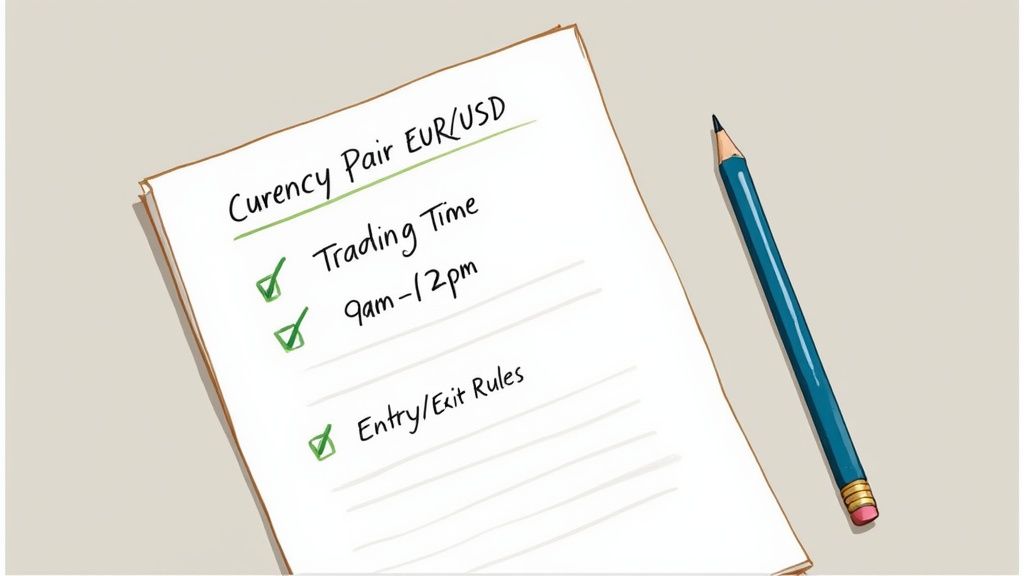
What Is Paper Trading? A Beginner’s Guide to Practicing for Free

ye

Ever wish you could hit "undo" on a bad decision? In the stock market, you can’t. But what if you could practice trading without the stomach-churning stress of losing real money? That's exactly what paper trading is for.

Imagine playing a high-stakes poker game, but with monopoly money. Paper trading is a simulation that lets you buy and sell stocks, crypto, and other assets using fake money in a real-time market environment. It's the perfect way for a beginner to get their feet wet and practice their moves without risking a single actual dollar.

Your Personal Stock Market Sandbox

Think of it like a flight simulator for a pilot or a scrimmage before the big game. It’s a dedicated space where you can get comfortable with a trading platform, figure out how market orders really work, and watch your decisions play out with zero financial consequences.

This isn't some new idea. The legendary trader Jesse Livermore – one of the most famous speculators of all time – reportedly got his start by mentally "trading" the stock prices he saw ticking by on the tape. That was just an old-school, manual version of what we do today.

In fact, it's become a standard first step for new traders. One study found that over 60% of new retail traders in the United States jump into a paper trading platform before putting their own capital on the line. It's just a smarter way to learn. You can find more insights about paper trading and its growing popularity online.

To give you a better idea of what we're talking about, here's a quick summary.

Paper Trading at a Glance

This table breaks down the core components of paper trading into simple terms.

Feature Description
Environment A simulated trading platform that mirrors a real brokerage account.
Capital You're given a virtual cash balance (e.g., $100,000) to trade with. No real money is ever at risk.
Market Data Uses real-time or slightly delayed data from actual stock exchanges like the NYSE and NASDAQ.
Primary Goal To practice trading strategies, learn platform mechanics, and build confidence without financial loss.
Key Benefit A completely risk-free educational tool.
Main Drawback Doesn't replicate the real emotional pressure of having your own money on the line.

Essentially, it's the ultimate "try before you buy" experience for the stock market.

What Does a Paper Trading Account Look Like?

Most modern paper trading platforms are designed to look and feel exactly like a real brokerage account. This screenshot from Investopedia shows a pretty standard paper trading interface.

Screenshot from https://www.investopedia.com/paper-trading-4689693

You've got your portfolio balance, live stock charts, and the same buttons to buy or sell that you'd find in a live account. The only difference? That account balance is just for show. It’s all virtual, which lets you click "buy" and "sell" without a second thought.

The whole point is to build muscle memory and sharpen your strategic thinking. As the investing icon Benjamin Graham famously said, "The investor's chief problem – and even his worst enemy – is likely to be himself."

Paper trading gives you a safe arena to face that challenge head-on. It helps you learn to control your impulses and stick to a plan – the perfect foundation for anyone hoping to build the skills and confidence needed to step into the real market.

The Real Benefits of Practicing with Virtual Money

A person sitting at a desk with a laptop displaying financial charts and graphs

So, why would anyone bother trading with fake money? Simple: it’s your personal, zero-risk sandbox. This is where you get to build confidence, test-drive different investing styles, and make all the classic rookie mistakes without losing a single real dollar.

Think of it as a flight simulator for traders. You learn the ropes and figure out the technical side of placing orders – like the difference between a “market order” and a “limit order” – when the stakes are literally zero. It’s your chance to rehearse before the big show.

“The beautiful thing about learning is that nobody can take it away from you.” – B.B. King

That quote wasn’t about the stock market, but it hits the nail on the head. The knowledge you bank from practicing is yours forever. The losses? They're completely imaginary. It's a pretty powerful trade-off.

Mastering Your Mindset and Skills

Beyond just clicking buttons, paper trading is where you forge the discipline and emotional control every real trader needs. It's like a basketball player shooting hundreds of free throws in an empty gym. That repetition builds the muscle memory and mental toughness required to perform under pressure.

It’s the perfect place to explore different strategies and see what fits your personality:

  • Day Trading: Get a feel for the lightning-fast pace of buying and selling within the same day.
  • Swing Trading: Learn to hold positions for a few days or weeks to catch those short-term market "swings."
  • Long-Term Investing: Practice the art of buying and holding quality assets, focusing on the big picture just like the pros.

Even seasoned pros know the power of practice. Mark Cuban, the billionaire owner of the Dallas Mavericks, famously reads for hours every day to keep his edge. Paper trading is your active-learning equivalent. It’s how you prepare for the real game.

Ultimately, the goal is to get a genuine feel for the market's natural ups and downs in a completely safe space. By mastering the tools and getting a handle on market psychology first, you’re building a solid foundation before you ever put your own money on the line. Honestly, it's the smartest first step you can possibly take.

Choosing The Best Paper Trading Platform

Alright, you're ready to jump in and practice, but where do you even start? Picking a paper trading platform is a bit like choosing your first car. They all get you on the road, but some have more horsepower, better handling, or just a dashboard that makes sense to you.

Not every simulator is built the same, and the one you pick will absolutely shape how you learn. The goal is to find a platform that clicks with what you want to achieve. Are you just trying to get the hang of buying and selling stocks? Or are you aiming higher, wanting to test-drive complex options strategies with professional-grade tools?

What To Look For In A Simulator

As you shop around, there are a few features that are non-negotiable. First and foremost, you need real-time or near-real-time market data. Practicing with prices from 20 minutes ago is like trying to learn baseball with a massive video delay – it’s just not going to prepare you for the real game.

Next, look at the variety of assets available. Some simulators are pretty basic and only offer stocks. Others let you experiment with everything from crypto and forex to options and futures. A clean, intuitive interface is also huge. You want to spend your time learning how to trade, not getting frustrated with confusing menus.

Finally, don't forget the fun factor! Exploring different trading games can be a surprisingly effective way to build your skills. For a deeper look, check out our guide on the 2024-2025 must-have stock market games for traders.

A high-quality platform like TradingView will give you an interface packed with powerful charting tools for analyzing market movements.

Getting comfortable with powerful charts like this is key. It allows you to practice technical analysis, a core skill for countless professional traders.

Top Paper Trading Platforms For Beginners

To help you narrow down the options, I've put together a quick comparison of a few popular platforms that are great for beginners. Each has its own strengths, so think about which one aligns best with your learning style.

Platform Best For Key Feature
TradingView Charting and social trading Incredible, easy-to-use charts and a huge community.
thinkorswim Serious, in-depth strategy testing Professional-grade tools that mimic a real brokerage desk.
eToro Beginners interested in copy trading Simple interface and the ability to simulate copying pros.

Ultimately, choosing the right tool is your first real trade, so don't rush it. Take a couple for a spin, see what feels right, and pick the one that makes learning feel less like a chore and more like a game you’re determined to win.

Your First Paper Trade in Four Easy Steps

Ready to jump in? Getting started with paper trading is a lot simpler than most people think. We'll walk you through it, step-by-step, so you can place your first practice trade in just a few minutes.

The whole point is to make this process feel welcoming, not intimidating. This infographic breaks down the basic flow, from picking your platform to making that first move.

Infographic showing a three-step process: 1. Choose a paper trading platform, 2. Explore the dashboard and tools, 3. Execute your first practice trade.

As you can see, you don't need a massive instruction manual to learn the ropes. It’s all about taking one small step at a time and building up your confidence along the way.

Step 1: Pick Your Platform

First things first, you need a playground. Look back at our recommendations and choose a platform that clicks with you.

Maybe you love the slick charts on TradingView, or perhaps the professional-grade tools on thinkorswim catch your eye. There’s no wrong answer here – just find one you genuinely enjoy using.

Step 2: Create Your Virtual Account

Got your platform? Great. Now, sign up for your free virtual account. This is usually a quick, five-minute process that just needs an email.

Once you're in, the platform will typically drop a hefty sum of virtual cash into your account, often $100,000, to get you started.

Step 3: Explore the Dashboard

Hold on – don't start buying just yet. Take a few minutes to get your bearings.

Click around the dashboard, play with the charting tools, and locate the buy and sell buttons. Getting comfortable with the layout now will save you from fumbling around later when you need to act fast.

Step 4: Place Your First Practice Trade

Alright, it's go-time. Pick a company you already know and are interested in, like Apple (AAPL) or Nike (NKE), and place your first trade.

The most important part? Treat this virtual money like it’s real. This single habit will help you build the right mindset from day one.

Common Paper Trading Mistakes and How to Avoid Them

A person looking at a downward-trending stock chart with a concerned expression.

Paper trading is an incredible tool, but it's far from a perfect mirror of the real market. Think of it like a flight simulator – it teaches you the controls, but it can't replicate the feeling of hitting real turbulence. The biggest trap is that without any real skin in the game, it's easy to develop some seriously bad habits.

The number one pitfall? The complete absence of real emotions. You simply don't feel that gut-punch of panic on a losing trade or the electric thrill of a big win when you’re not risking actual money. This emotional disconnect often leads to a false sense of security, encouraging you to make reckless bets you’d never dream of with your own savings.

"The four most dangerous words in investing are: 'This time it's different.'" – Sir John Templeton

This classic quote perfectly nails the overconfidence that can build up. A few lucky wins with fake money might make you feel like a market wizard, but the real market has a way of humbling everyone.

Treating It Like a Game Instead of Training

It’s tempting to start making huge, unrealistic bets just for the fun of it – a "Monopoly money" mindset. While entertaining, this is a massive mistake. The goal here isn't to get the highest score; it's to build real-world discipline and test strategies that will actually work.

To sidestep this, you have to treat it like serious training. Here’s how:

  • Set Realistic Capital: Forget the default million-dollar account. Knock your virtual balance down to an amount you would genuinely invest, whether that's $1,000 or $5,000.
  • Factor in Trading Costs: Most simulators conveniently ignore commissions and fees. Manually deduct a few dollars for each trade to see how those costs eat into your profits.
  • Keep a Trading Journal: Don't just click buttons. For every trade, write down why you made it. This forces you to be strategic rather than just gambling.

While paper trading can't fully capture the emotional rollercoaster, it's fantastic for nailing the technical side of things. Modern platforms mimic real-time price action and market depth, which is a huge advantage for sharpening your execution skills before you put cash on the line. Pros use these simulators all the time to refine their strategies without risk.

Ultimately, your success hinges on how seriously you take the simulation. Use it to forge a solid plan and cultivate discipline, and you'll be far better prepared for what the real markets throw at you. A great next step is to explore our guide on how to backtest trading strategies to further strengthen your approach.

Got Questions? Let's Get Them Answered.

If you've still got a few questions buzzing around, you're in the right place. Let's walk through some of the most common things new traders ask when they first hear about paper trading.

Is Paper Trading Really Free?

Yes, it absolutely is. The big brokerage platforms like TD Ameritrade and E*TRADE offer paper trading accounts at no cost. Even popular charting sites like TradingView have free versions.

Why? It’s simple: they want you to get comfortable with their platform. If you learn the ropes with them, you're much more likely to stick around when you're ready to put real money on the line. Bottom line: you should never have to pay for a basic paper trading account.

Can You Make Real Money From Paper Trading?

Nope, you can't cash out your paper profits. Since you're using virtual money, any gains you see are just part of the simulation. Think of it less like a job and more like an education.

The real "profit" you're making is in knowledge, experience, and confidence. Those are priceless assets when it's time to invest your hard-earned cash. As the legendary investor Warren Buffett put it, "The most important investment you can make is in yourself." Paper trading is a direct investment in your financial education.

How Long Should I Paper Trade?

There isn't a magic number, but a good rule of thumb is to practice for at least one to three months. The goal isn't just about marking days on a calendar – it's about hitting key milestones.

Before you even think about going live, you should be able to:

  • Navigate your trading platform like the back of your hand.
  • Build a clear, written-down trading plan.
  • Actually follow that plan, day in and day out, for weeks.

You’re trying to prove to yourself that you have the discipline to make smart decisions when there’s zero pressure. Once you can do that consistently, you might just be ready for the real deal.


Ready to start your learning journey? The Finance Illustrated Trading School offers free, bite-sized lessons to build your skills in just 60 minutes. Practice what you learn with fun simulators and become a more confident trader today. Explore our free resources.

What Is Market Capitalization? A Simple Guide

ye

Ever wonder how a company like Tesla or Nike gets a price tag worth billions? It all comes down to a simple idea called market capitalization, or 'market cap' for short. Think of it as the stock market's real-time vote on a company's total worth.

What Is Market Capitalization, Really?

Imagine a company is a giant pizza, cut into millions of tiny slices. Each slice is a single share of the company's stock. Market cap is just the total cost to buy up every single slice at its current price.

It’s the big, flashy number you hear on the news that tells you a company's total value, at least according to what investors think it's worth right now.

Image

Let's get one thing straight: market cap isn't about how many buildings a company owns or how much cash it has. It's a living, breathing number that changes every second the stock market is open. If the share price goes up, the market cap follows. If it drops, so does the market cap.

A Look at the Big Picture

This concept is huge – literally. When you add up the market cap of all publicly traded companies, the figure is mind-blowing. Recently, the global market cap was around $114.46 trillion USD. To put that in perspective, if you spent $1 million every day, it would take you over 300,000 years to spend that much! You can read more about these global market trends to see the full scale.

So what does this giant number mean for you?

Knowing a company's market cap helps you understand its size and where it might fit into your personal investment strategy. As the legendary investor Peter Lynch famously said, "Know what you own, and know why you own it." Getting a handle on market cap is your first step.

Market capitalization is the simplest way to gauge a company's size from an investor's point of view. It lets you quickly sort the giants from the up-and-comers.

To bring back the pizza analogy one last time: market cap tells you the value of the entire pizza, not just one slice. This is the core idea you need before we dive into the numbers and what they mean for your financial journey.

The Simple Math Behind Market Cap

You don't need to be a math whiz to figure out market capitalization. The calculation is surprisingly simple. There's no complex algebra, just one basic multiplication that gets you started.

A person using a calculator with financial charts in the background, illustrating the simplicity of market cap calculation.

The formula is as easy as it gets:

Market Cap = Current Share Price × Total Number of Outstanding Shares

That’s it! The “Current Share Price” is what one share costs on the stock market right now. The “Total Number of Outstanding Shares” represents all the slices of the company's "pizza" owned by investors, from huge funds to regular people like you.

How to Calculate Market Cap in the Real World

Let's try this with a company everyone knows: Apple. Actually doing the math yourself is the best way to make the concept stick.

Here’s how you’d do it, using some recent numbers for Apple (ticker symbol: AAPL):

  1. Find the Current Share Price: A quick search shows Apple's stock is trading at, let's say, $210 per share.
  2. Find the Outstanding Shares: Next, you find out Apple has about 15.3 billion shares out there. This is public info you can easily find online.
  3. Do the Math: Now, you just multiply those two numbers.

The calculation looks like this: $210 (Share Price) × 15,300,000,000 (Shares) = $3.21 trillion.

And just like that, you’ve calculated Apple’s market cap! This simple equation is how analysts and investors get those massive valuations. You can do this for any public company, from your favorite gaming brand to the tech giant that made your phone. It's the first step to understanding the true scale of a business.

How Market Cap Sorts Companies by Size

Ever wonder how Wall Street makes sense of thousands of companies? One of the simplest yet most powerful tools is market capitalization. Think of it like a boxing league. Market cap sorts companies into different weight classes, giving investors a quick snapshot of the kind of "fighter" they're looking at.

This isn't just a label – it's a crucial first look. It gives you immediate clues about a company's stability, growth potential, and risk. It's one of the first things experienced investors check.

The Three Main Weight Classes

Just like in boxing, each category has its own vibe. The biggest companies are the heavyweight champions – powerful and established. The smallest are more like scrappy up-and-comers, full of potential but also riskier.

  • Large-Cap (Mega-Cap): These are the giants of the stock market, the household names everyone knows, like Apple, Microsoft, and Amazon. Valued at over $200 billion, they're known for their stability. They are the established champions. A fun fact: the first company to ever hit a $1 trillion market cap was PetroChina in 2007, but Apple was the first U.S. company to do it in 2018.
  • Mid-Cap: Think of these as the rising contenders. Valued between $2 billion and $10 billion, they are established companies with proven business models but still have plenty of room to grow. Companies like Domino's Pizza or Williams-Sonoma fit in here.
  • Small-Cap: These are the energetic newcomers. Usually valued under $2 billion, these companies are often younger and operate in new or niche industries. They bring higher risk but also the potential for explosive growth.

This infographic lays out the basic hierarchy of these market cap categories perfectly.

Infographic about what is market capitalization

As you can see, the scale difference between a small-cap business and a large-cap titan is massive.

To help visualize the differences, here’s a quick breakdown of what you can generally expect from each category.

Market Cap Categories Compared

Category Typical Market Cap Example Company Key Trait
Large-Cap Over $200 Billion Apple Inc. Stability & Dividends
Mid-Cap $2 Billion – $10 Billion Domino's Pizza Growth Potential & Stability
Small-Cap Under $2 Billion (Varies, often emerging) High Growth Potential & Higher Risk

This table highlights the core trade-offs. Choosing a large-cap stock is often a bet on stability, while investing in a small-cap is a bet on the future.

Ultimately, understanding these categories helps you manage your expectations and align your investments with your personal financial goals. Each "weight class" plays a very different, but important, role in the vast world of investing.

How Legendary Investors Use Market Cap

https://www.youtube.com/embed/w5gyyx2S5Ow

For the pros, market cap isn't just a simple label – it's a powerful tool they use to take the market's temperature. Legendary investors don't just look at one company's valuation. Instead, they zoom out and use market cap to see the bigger picture, helping them decide when to be bold and when to play it safe.

One of the most famous examples comes from Warren Buffett, arguably one of the most successful investors in history. He didn't become a multi-billionaire by accident. He relies on a clever, big-picture metric that uses market capitalization to guide his major investment decisions.

The Famous Buffett Indicator

Buffett popularized a simple yet powerful concept now known as the "Buffett Indicator." It's a reality check for the entire stock market.

The indicator compares a country's total stock market capitalization to its economic output, or Gross Domestic Product (GDP). This helps answer a crucial question: Is the market getting overheated and expensive, or is it trading at a reasonable level?

This 30,000-foot view tells investors if stock prices are running way ahead of the actual economy. The Buffett Indicator essentially divides a country's total market cap by its GDP to get a ratio. In the United States, the Wilshire 5000 index is often used to represent the total market cap, since it includes thousands of U.S.-based companies.

"The price is what you pay. The value is what you get." – Warren Buffett

This classic Buffett quote perfectly captures the spirit of the indicator. It encourages investors to look past the day-to-day noise and focus on the fundamental value of the market as a whole.

This kind of analysis shows that market cap is so much more than one company's price tag; it can be a vital sign for the health of an entire economy. Professionals take this even further, using market trends for forecasting and planning. Many rely on specialized finance FPA data analysis tools for forecasting and scenario planning to make informed decisions.

By understanding how the best in the business use this metric, you can start to think like a pro yourself.

A Global View of Market Capitalization

Market capitalization does more than just tell you a company's size; it paints a fascinating picture of economic power on a global scale. Think of it as the world's economic scoreboard.

For a long time, the stock market game was dominated by just two heavyweights: first the United Kingdom, and then, decisively, the United States.

A world map with glowing nodes over major economic centers like the US, China, and Japan, representing global market capitalization.

That trend has only accelerated. The U.S. market has grown so massive that its total value now makes up roughly half of the entire world's market capitalization. It's a staggering figure. For over 250 years, global market dominance has largely belonged to these two countries. You can dig deeper into this history and the dominance of the Anglo countries on finaeon.com.

The Shifting Balance of Power

But the story is always changing. The rise of China's market, especially since the 2000s, has been incredible. It has shot up the ranks to become a major player, showing just how fast economic tides can turn. And let's not forget other giants like Japan, which also plays a crucial role in the global financial arena.

This dynamic view helps you see the stock market not as a static list of companies, but as a live arena. It's a place where countries compete, economies shift, and new leaders emerge over time.

"The stock market is a device for transferring money from the impatient to the patient." – Warren Buffett

This timeless quote from Warren Buffett reminds us that market leadership can, and does, shift with long-term trends. Understanding the global market cap landscape is key to seeing these larger movements.

It helps you diversify your portfolio and make smarter choices, whether you're picking individual stocks or deciding between different ways to invest. If you're weighing your options, you can explore our guide on ETFs vs. mutual funds to learn more.

Ultimately, market cap is the scoreboard for the world economy, and the game is always on.

Putting Market Cap to Work for You

Alright, so what does this all actually mean for you, the investor?

Think of market cap as your starting block, not the finish line. It’s the first piece of the puzzle that gives you context before you start digging deeper.

A massive market cap doesn't automatically scream "great buy," just like a tiny one doesn't mean "bad bet." It's purely a measure of size. Taylor Swift has a colossal global brand, but that doesn't guarantee her next album will be a chart-topper – it just means a lot of people are paying attention. Market cap is the same deal.

Market cap tells you how big a company is, not how good it is. It’s a tool that helps you ask the right questions, not a crystal ball that spits out all the answers.

A Quick Checklist for Getting Started

As you begin to explore stocks, keep these simple ideas in your back pocket. This isn't about a secret formula; it's about building smart habits from day one.

  • Size vs. Story: What does the market cap tell you about the company's scale? Now, does its story – its growth potential, industry, and products – actually justify that size?
  • Context is Everything: How does this company stack up against its direct competitors? Is it a giant in a small niche, or a small fish trying to survive in a huge pond?
  • Does It Fit Your Portfolio? How would a company of this size fit into your broader investment strategy? If you're building a balanced approach, check out our guide on how to diversify an investment portfolio.

Using market cap as your initial filter helps you move forward with more confidence, making smarter, more informed decisions on your investment journey.

Answering Your Market Cap Questions

Let's clear the air and tackle some of the most common questions about market capitalization. Think of this as a quick FAQ to connect the dots and clear up any confusion.

Does a High Market Cap Mean It's a "Good" Company?

Not necessarily. A high market cap tells you one thing: the company is big and likely a household name. But that’s it. It’s not a guarantee of future growth, nor does it mean the stock is a smart buy right now.

Think of it like a Hollywood blockbuster. A massive budget and A-list stars don't automatically make it a great film. Sometimes, the small indie flick (your small-cap stock) is the one that wins all the awards and delivers surprising returns.
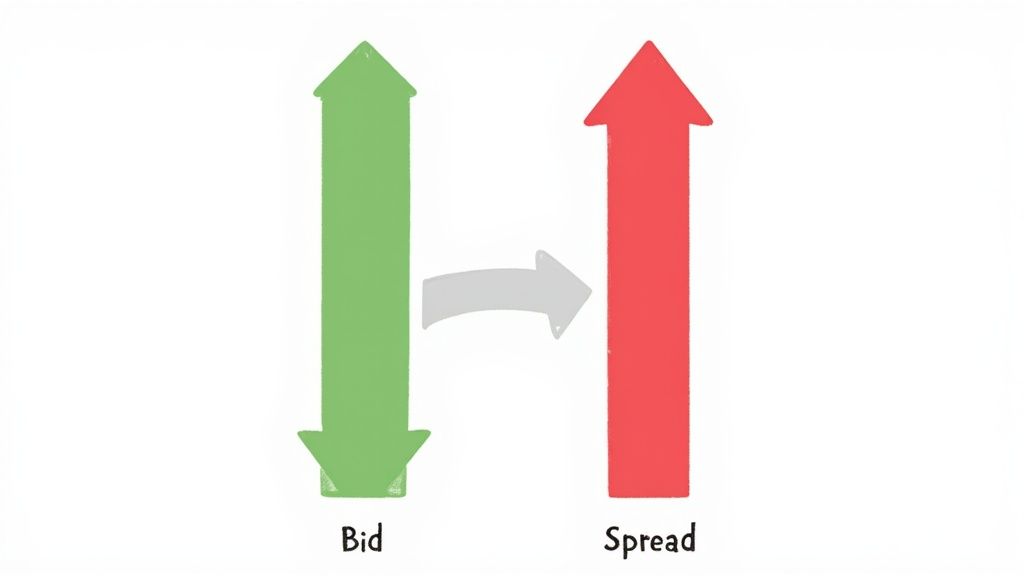
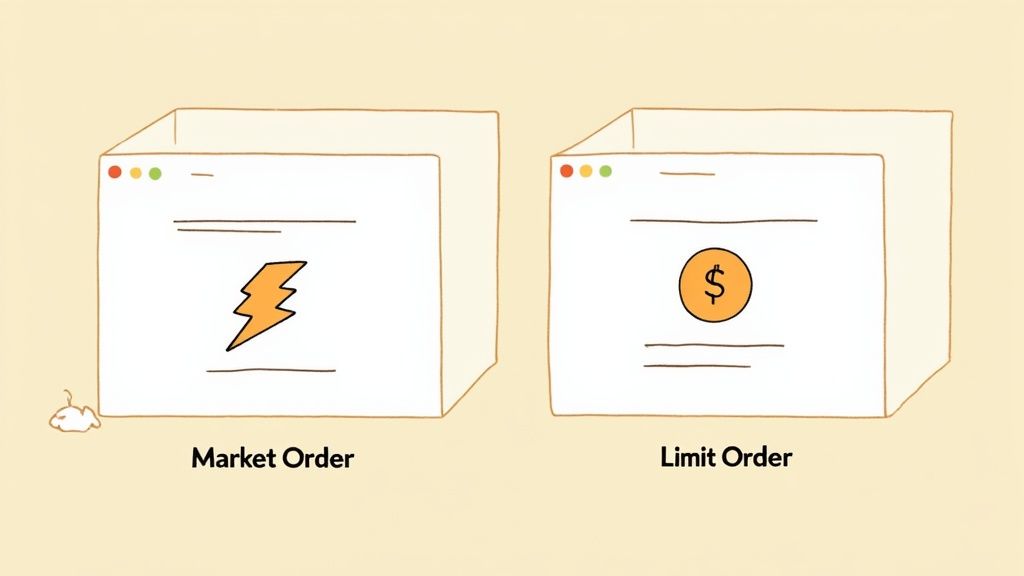
Market cap is your starting point for research, never the final answer. It gives you context on size, but you still have to dig into the company’s financial health and growth potential.

Market Cap vs. Enterprise Value

This one trips people up, but the difference is actually pretty simple. Market cap is just the total value of a company’s stock. Enterprise value gives you a fuller picture by including debt and subtracting cash.

Let's use a housing analogy:

  • Market Cap: This is like the sticker price of the house.
  • Enterprise Value: This is the sticker price, plus the mortgage you have to take over, minus any cash you find stashed under the floorboards. It's the true cost to own the whole thing.

Does Market Cap Change Every Day?

Absolutely. In fact, it changes every second the stock market is open.

Because market cap is calculated using the live stock price, it’s constantly moving as investors buy and sell shares throughout the day. A company’s valuation can easily swing by billions of dollars in a single trading session.


Ready to put this knowledge into practice without risking a dime? Head over to financeillustrated.com to check out our free trading simulators and fun, bite-sized lessons. Start learning on financeillustrated.com today

Ask Price vs Bid Price: Your Ultimate Guide to Trading

ye

Ever looked at a stock and seen two prices? Welcome to the club. When you first get into trading, you'll see a bid price and an ask price for everything, from stocks to crypto. The difference is super simple once you get the hang of it.

The ask price is the lowest price a seller is willing to accept for their asset. Think of it as the "sticker price." On the other side, the bid price is the highest price a buyer is willing to pay for that same asset. As a trader, you almost always buy at the ask price and sell at the bid price.

What Are Bid and Ask Prices in Trading?

Imagine you're trying to sell a limited-edition sneaker. You list it for $500 – that's your ask price. At the same time, someone out there is offering to buy that exact sneaker for $475. That's their bid price. The stock market is basically a massive, lightning-fast version of this.

The ask price is always higher than the bid price. It's a constant, silent negotiation. The seller wants the most money possible (the ask), and the buyer wants to pay the least (the bid).

Bid and Ask Explained

When you hit the "buy" button on a stock, you agree to pay a price close to the current ask. When you decide to sell, you get a price near the current bid. That small gap between the two is called the spread, and it's how brokers and market makers make their money.

This visual gives you a clear look at how these two prices show up on a trading platform.

Infographic about ask price vs bid price

As you can see, the ask price always sits above the bid. If you're looking to brush up on more trading terms, a good comprehensive financial glossary can be a huge help.

For huge companies like Apple (AAPL), the spread can be tiny – sometimes just a penny – because millions of people are buying and selling all the time. For less popular assets, that gap can be much wider.

Quick Comparison of Bid vs Ask

Here's a simple table to break down the key difference between bid and ask prices from your perspective as a trader.

Concept Bid Price Ask Price
Who sets it? The buyer The seller
What does it represent? The highest price someone is willing to pay The lowest price someone is willing to accept
Your action This is the price you sell at This is the price you buy at
Relative Value Always lower than the ask price Always higher than the bid price

Ultimately, understanding this simple relationship is your first step to navigating the market. It dictates the price you pay and the price you get, forming the foundation of every trade you'll ever make.

Understanding the Bid-Ask Spread

So, you have the bid price (what buyers will pay) and the ask price (what sellers want). That little gap in between? That's the bid-ask spread. It’s not just empty space; it’s the engine room of the market and how brokers earn a small profit on every trade.

Diagram showing the bid and ask prices with a gap labeled as the spread

Think about it like changing money at an airport. They'll buy your dollars for one price (their bid) but sell you euros for a slightly higher price (their ask). That tiny difference is how they make money. The bid-ask spread in the stock market works the exact same way.

“The stock market is filled with individuals who know the price of everything, but the value of nothing.” – Philip Fisher

Getting a handle on the spread helps you see the true cost of placing a trade. It’s an invisible fee, baked right into the price of every transaction.

Why the Spread Matters to You

The size of the spread is like a health check for a stock. A tight spread – meaning a tiny gap between the bid and ask – is a fantastic sign. It usually means the stock is heavily traded, making it easy to buy or sell without your order messing with the price. You'll see this with giants like Amazon or Tesla.

On the other hand, a wide spread can be a red flag. It suggests there aren't many buyers and sellers, which can make getting a fair price a real headache. This is common with smaller companies or when the market gets spooked.

Here's what the spread is really telling you:

  • Liquidity: A tight spread screams high liquidity (easy to trade). A wide spread signals the opposite.
  • Volatility: Spreads can get wider during major news events, reflecting higher risk.
  • Trading Costs: Every time you trade, that spread is a cost you pay. For active traders, these small costs can seriously add up and eat into your profits.

Ultimately, paying attention to the difference between the ask and bid price is more than just looking at numbers. You're getting a real-time report card on a stock's popularity and your actual trading costs.

Why Bid and Ask Prices Constantly Change

If you've ever watched a live stock chart, you've seen it: the bid and ask prices flicker non-stop. This isn't random noise. It's the market's heartbeat, the result of a constant tug-of-war between supply (sellers) and demand (buyers).

Think of it like an auction. When lots of people want to buy something, they start offering more money, pushing the bid price up. Sellers see this and raise their prices, pulling the ask price up too. If bad news hits and everyone wants to sell, they lower their prices to get out fast. This makes the ask price drop, dragging the bid price down with it.

What Makes the Market Move

So, what causes these sudden shifts? A few key things are almost always behind the action. Getting a feel for them is key to seeing the bigger picture.

  • Breaking News: A company announcing a cool new product can start a buying frenzy in minutes.
  • Company Earnings: A great earnings report can send a stock soaring. A bad one can cause it to crash.
  • Economic Data: Big-picture news on things like inflation or jobs can shake the whole market.
  • Social Media Hype: Never underestimate the power of a single tweet. A message from an influential figure like Elon Musk can create massive, instant demand. A funny fact: in 2021, Musk's tweets about Dogecoin sent its price flying over 400% in a week.

Each of these events changes how investors feel about an asset's future. Their collective buying and selling is what moves the bid and ask prices in real-time. To see how these ideas apply globally, our guide on what influences exchange rates is a great next step.

“The key to making money in stocks is not to get scared out of them.” – Peter Lynch

This classic quote perfectly captures how emotional reactions to news are what fuel most of the market's short-term swings.

Today, this process is supercharged by high-frequency trading (HFT) algorithms. These aren't people clicking buttons; they're powerful computer programs that scan the news and make trades in millionths of a second, which is why prices adjust almost instantly.

How to Place Smarter Trades Using Bid and Ask

Okay, you get the theory behind ask price vs bid price. Now it's time to actually use that knowledge to make smarter moves. This is where you go from being a spectator to a player with a game plan. It all comes down to how you place your trades.

A person analyzing stock charts on a computer screen, looking thoughtful and strategic.

You have two main tools: market orders and limit orders. Think of them as a choice between speed and precision. One gets you in the game now, the other lets you set the rules.

Market Orders for Speed

A market order is the simplest way to trade. You’re telling your broker, "Get me this stock right now at the best available price." When you buy, your order will be filled at or near the current ask price. When you sell, you'll get a price close to the bid price.

This is perfect when your top priority is getting the trade done immediately. You aren't worried about a few pennies – you just want in or out, fast.

Limit Orders for Control

A limit order, on the other hand, puts you in the driver's seat. Instead of taking whatever the market offers, you set the exact price you're willing to pay or accept. For example, you could set a limit order to buy a stock only if it drops to $50.05, or to sell it only if it climbs to $52.50.

Using a limit order is your best defense against paying more than you planned. It ensures your trade only happens at your price or better.

This approach gives you total control. The downside? If the stock never hits your price, your order might sit there unfilled.

So, when do you use which? Here’s a quick guide:

  • Use a Market Order if: You’re trading a popular stock with a tight spread and you need to get the trade done instantly.
  • Use a Limit Order if: You have a specific entry or exit price in mind, or if you're dealing with a less-traded stock with a wide spread.

Getting comfortable with both is a fundamental skill. To take your strategy to the next level, you might also find some great insights from these effective day trading tips. Knowing which order to use is how you turn a basic understanding of the bid-ask spread into a real trading advantage.

Bid and Ask Prices Beyond the Stock Market

The whole bid vs. ask price concept isn't just for stocks. Once you get it, you'll start seeing it everywhere in finance. It's the universal language of buying and selling pretty much any asset.

Take the huge foreign exchange (Forex) market. When you look at a currency pair like EUR/USD, the bid-ask spread is often razor-thin – we're talking fractions of a penny. That’s because countless banks and traders are constantly buying and selling, which keeps things super liquid. If you want to get into the details, our guide on how to read currency pairs breaks it down perfectly.

Commodities and Crypto Markets

This same principle powers the world of commodities. Whether it's a barrel of oil or an ounce of gold, you'll always find a bid and an ask price. Big news, like a surprise oil discovery, can make that spread widen in a heartbeat as traders scramble to react.

And yes, the same rules apply to the wild world of cryptocurrency. The bid-ask spread on a major player like Bitcoin might be pretty tight. But for a smaller, lesser-known altcoin? That spread can be huge. A wide gap is a dead giveaway for lower trading volume and higher risk. Fun fact: even celebrities get involved. When Ashton Kutcher's venture capital firm invested in a crypto project, it brought huge attention, which tightened the bid-ask spread as more people started trading it.

"The four most dangerous words in investing are: 'this time it's different'." – Sir John Templeton

This quote is a great reminder that no matter the asset – currency, commodity, or crypto – the fundamental principles of supply and demand, shown through the bid-ask spread, always apply.

Across all these markets, the core idea is the same. The bid is what buyers will pay, the ask is what sellers will accept, and the spread is the cost of making the trade happen. Grasping this simple dynamic gives you a powerful lens to view any asset you might consider trading.

Common Questions Answered

Got a few more questions rattling around? No problem. Here are some quick answers to the things new traders often wonder about.

What Is a Good Bid-Ask Spread?

Simple: a tight one. For big, popular stocks that trade millions of shares a day, the spread might only be a penny. A tiny spread is a great sign – it means the stock is super liquid (easy to get in and out of) and your trading costs are low.

On the other hand, a really wide spread should make you pause. It can be a red flag for low trading volume, wild price swings, or general riskiness.

Can I Buy at the Bid Price?

As a regular retail trader, the system is pretty set: you buy from the market at the ask price and you sell to the market at the bid price. Think of the bid price as the standing offer from buyers (like market makers) ready to take shares off your hands.

The best way to get control over your price is to use a limit order. This tells your broker the exact price you're willing to pay, giving you the final say.

Using limit orders is a smart habit that can stop you from overpaying if the price suddenly jumps right as you hit the buy button.

How Does the Spread Affect My Profit?

The spread is a direct, unavoidable cost of trading. If you buy a stock, its price has to climb higher than the spread itself just for you to break even.

This might seem small on one trade, but for active traders making dozens or hundreds of trades, these little costs can bleed you dry. They stack up fast and can take a serious bite out of your profits. Learning to minimize the impact of the spread is a key skill for any winning strategy.


Ready to put this knowledge into practice? financeillustrated.com offers a free Trading School that breaks down how markets really work. You can start with easy-to-digest lessons and then jump into risk-free simulators to build your confidence at https://financeillustrated.com.