

Crypto
Bitcoin Memes: 13 Funny Favorites and the Truth Behind the Jokes
13 funny Bitcoin memes and two viral crypto videos, from chart-checking to AI meme-coin hype, with the real lesson behind each joke.
Crypto prices can fall fast and far. Learn how to measure a fall, why the climb back is always steeper, and how much of your money a crash could really touch.
means how much and how fast a price moves up and down. Crypto prices can be very volatile. Canada's Ontario Securities Commission notes that they can rise or fall by large amounts several times in one day.
A is a fall from an earlier high point, called a . If a coin goes from $100 to $75, the drawdown is 25%.
A drawdown describes the past. It does not tell you where the bottom is, when prices will recover, or whether they will recover at all. So a more useful question is this: what would a fall like this do to the money I need?
For real examples, read about Bitcoin's biggest crashes and Ethereum's crashes. This lesson sticks to made-up numbers, so the arithmetic stays clear.
Start a made-up coin at 100. It falls to 75, a loss of 25%. To get back to 100, it must gain 25. But 25 out of 75 is 33.3%, not 25%.
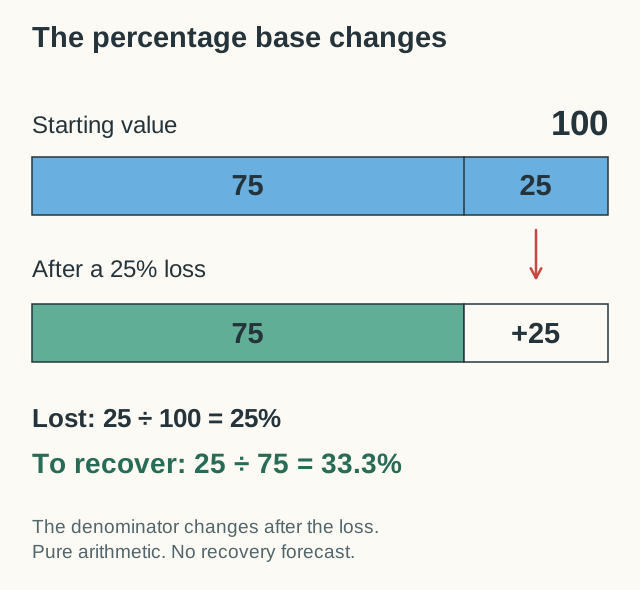
A 25% gain from 75 only reaches 93.75. The two percentages start from different numbers. That is why "down 25%, then up 25%" does not bring you back.
| Fall | Value left | Gain needed to get back to 100 |
|---|---|---|
| 10% | 90 | 11.1% |
| 25% | 75 | 33.3% |
| 50% | 50 | 100% |
| 75% | 25 | 300% |
The deeper the fall, the faster the climb grows. This is arithmetic, not a forecast. Fees make the climb a little steeper still.
Try it yourself
Drag the slider to make the fall deeper. Watch how big the climb back has to be. Keep going past 50%.
Start with $1,000. A 20% fall leaves $800, which needs a 25% gain to recover. A 50% fall leaves $500, which needs a 100% gain. A 75% fall leaves $250, which needs a 300% gain.
What would you expect?
What this shows: A 50% fall needs a 100% gain just to get back to the start. The deeper the fall, the faster the climb grows.
The climb starts from the smaller amount. $1,000 falls to $500, and $500 must double to reach $1,000 again. After a 75% fall, you would need a 300% gain.
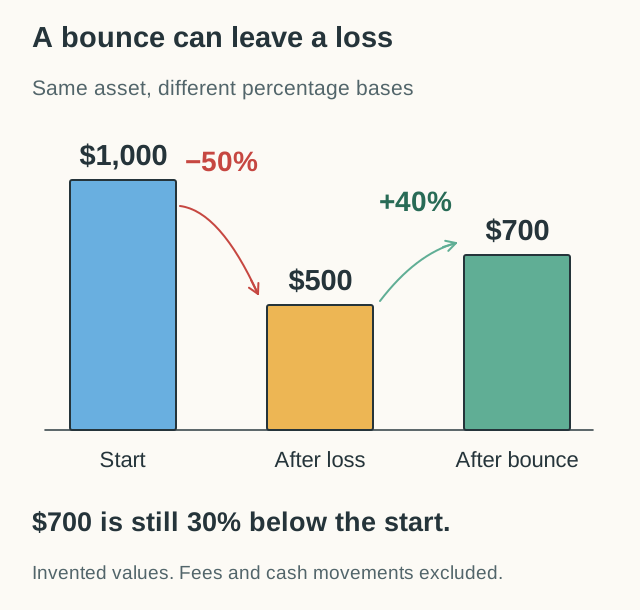
Not always. Say a made-up falls from $1,000 to $500. Then it jumps 40% to $700. The latest move looks great, but you are still $300 below where you started.
Both headlines are true: "up 40%" and "down 30%". A chart that only shows the rebound tells half the story.
A price on a chart is not the same as a sale. Canada's securities regulators list , platform and technology risks, not just price swings. Liquidity means how easily you can sell without pushing the price down. When buyers are scarce, your sale may fill lower, or not at all.
Say your plan was to sell at $80, but the only buyer paid $74. Write down $74, not $80. If the app showed an error and nothing sold, write that down too.
Don't pretend you sold at a better price just because the chart passed through it later. A fall in price, an order that does not fill and an account you can't reach are three different problems. Each one needs its own line in your notes.
The same fall hurts very differently depending on how much you hold. Imagine a $10,000 portfolio with three different amounts in crypto, and a 60% crypto crash.
| Amount in crypto | Loss after a 60% fall | Share of the whole $10,000 |
|---|---|---|
| $200 | $120 | 1.2% |
| $1,000 | $600 | 6% |
| $4,000 | $2,400 | 24% |
This is not advice on how much to hold. It shows how the size of your position, the amount you hold, changes what the same price move does to you.
Now make the test harder. Let your other savings fall at the same time, and add a surprise bill. Would the money still be there when you need it? A plan that only works if you can wait for years may not fit a bill that is due in six months.
The UK's Financial Conduct Authority gives a simple rule: never invest money you can't afford to lose.
No one can promise that. The Ontario Securities Commission warns that crypto investors can lose some or all of their money. ASIC Moneysmart in Australia says that if a crypto asset fails, you will most likely lose all the money you put in.
Some coins have recovered after big falls. Others have failed. If you only study the coins that still exist, the past looks better than it really was.
Try this: a coin falls 20%, then rises 20%. Is it back where it started? From 100, the fall takes it to 80 and the rise takes it to 96. It is still 4% down. To get from 80 back to 100, it needs a 25% gain.
Next, see what real Bitcoin crashes looked like in 5 big Bitcoin crashes. Later in the path, learn the warning signs of crypto scams. A loss is not proof of fraud, and a rising balance is not proof that a platform is real.
Divide the fall by the peak. From $1,000 to $700 is a $300 fall, and 300 ÷ 1,000 = 30%. To find the gain needed to recover, divide the fall by the lower value instead: 300 ÷ 700 is about 42.9%.
Because the gain starts from a smaller number. 100 falls 20% to 80, and 20% of 80 is only 16. You end at 96, still 4% down. You need a 25% gain to get back to 100.
No. Some coins have recovered after big falls, and others have failed. Regulators in Canada and Australia warn that you can lose some or all of the money you put in.
Volatility describes how much and how fast a price moves, up and down. A drawdown measures one fall, from a peak to a later low. A very volatile coin can have deep drawdowns.
13 funny Bitcoin memes and two viral crypto videos, from chart-checking to AI meme-coin hype, with the real lesson behind each joke.
Bitcoin millionaire stories, from 5,000 forgotten coins to a $1,000 bet in 2011, and what the headlines leave out: timing, paper wealth and the losers.