
Crypto
Crypto Trading for Beginners PDF: Free Download and Study Guide
Get the free 25-page crypto trading PDF for beginners: what is inside, which old claims to read with care, and the six free lessons to read next.
You can learn the most important crypto skills without sending a single coin. Here are six exercises, a worked journal entry and a simple way to check your progress.
Practise six skills on paper: ownership, keys, orders, drawdowns, scam checks and review.
A good practice plan gives you skills you can show, not a fake profit. Can you explain what you own and who controls it? Can you work out what a trade costs? Can you spot a request that should make you stop?
You can practise all of this without opening an account or depositing money. A mistake on paper costs nothing. A mistake with real crypto often can't be undone, because payments can't be reversed.
This plan brings together the seven earlier lessons in the crypto path, from Bitcoin basics to scams. If a task feels hard, go back to that lesson for a worked example. Going back is part of the plan, not a sign you have failed.
| Exercise | What to produce |
|---|---|
| 1. Explain what you own | The difference between your own wallet, an exchange balance and a fund |
| 2. Map who holds the keys | A drawing of who signs, where the seed phrase is kept and what is unknown |
| 3. Work out an order | The amount, the fill price, the fees and anything left unfilled |
| 4. Measure a | The fall from the peak and the gain needed to get back |
| 5. Turn down a bad request | Why a seed-phrase request or a release fee fails your checks |
| 6. Review your work | Your mistakes, and one change to test next time |
Each exercise has a lesson behind it: Bitcoin basics, wallets and custody, orders and fees, volatility and drawdowns and crypto scams. Work through them in order. Then go back to the one you found hardest to explain.
Notice what is missing from the list: sending real coins, sharing real secrets and borrowing money to trade. None of them is needed to learn.
Try it yourself
Sort each task into Practise it for free or Never needed to learn. A wrong answer bounces back with a reason.
Practise it for free (4 tasks): explain key control with made-up accounts, work out a spread and two fees, reply to a fake support message, and measure a drawdown. Never needed to learn (3 tasks): test-sending coins to a stranger, showing your real seed phrase to anyone, and using leverage.
What would you expect?
What this shows: Every real skill here can be practised for free. The tasks that need real coins are the ones that can cost you.
Knowing who holds the keys, adding up costs, measuring a fall and saying no to a scam can all be learned with made-up numbers. Test payments, shared secrets and borrowed money add risk without teaching anything extra.
You need a notebook, one made-up coin and a short list of prices. At the top of the page, write the currency, the number of coins and your costs. Use no , meaning no borrowed money. That keeps the arithmetic simple. It does not mean that crypto without leverage is safe.
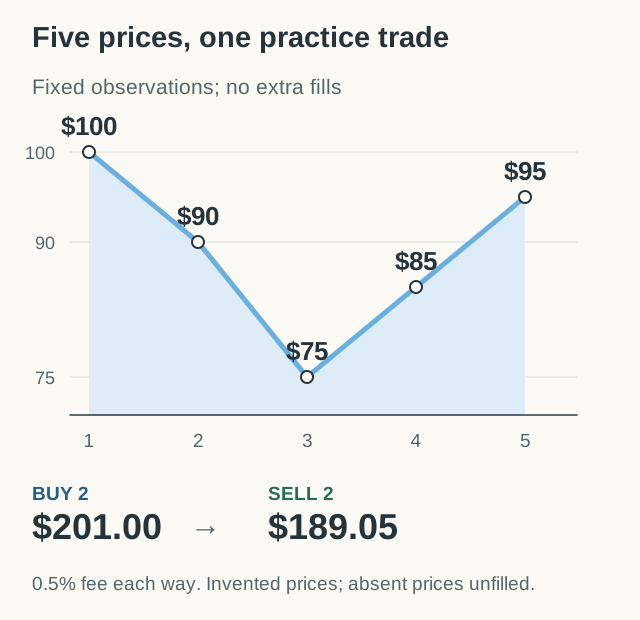
Use these five made-up prices, in this order: $100, $90, $75, $85 and $95. They are teaching numbers, not real market prices.
Set one strict rule: you can only buy or sell at these five prices. If the price you wanted never appears, write "not filled". Don't change a price later because it was awkward, and don't switch coins because another chart looks better. Fixed rules stop you from fooling yourself.
Write your entry and exit plan next to that number. Then add one more measure. At the $75 price, your 2 coins were worth $150. Compared with the $200 you paid for the coins, that is a 25% drawdown.
Keep these two numbers apart. The 25% drawdown measures how far the coin's price fell. The $11.95 loss is your final result after fees. Mixing them up is a common mistake, so label each one clearly.
Give each of the six exercises one of three marks:
A profit on a made-up trade can't turn an unresolved custody question into a complete answer. Score your explanations, not your returns.
When you correct something, keep the original entry and add a dated note beside it. That gives you an honest record of what you learned. For every unknown, write down the source you would check next.
Real trades need real records. In the US, the IRS digital assets page shows why you need more than a final profit number. Other countries have their own tax rules, so check yours. A practice journal is not a tax record.
A lets you place pretend trades with virtual money. Our own crypto simulator, Bitcoin Flip, is being rebuilt. Its official site says a new version is coming, and there is no download today. If you see an app with a similar name in a store, don't assume it is the original.
You don't need any app for the written exercises. If you do use a simulator, check how it works first. Which coins does it have? Are its prices delayed? How does it handle fees and fills? If you skip this, its results may not match your notebook.
One last check: does finishing this plan prove you are ready to make money? No. It shows you can do these tasks with made-up numbers. It does not test real prices, real withdrawals or how you feel during a real loss. Another round of practice, or deciding not to trade at all, are both good results.
No. You can learn ownership, keys, costs, drawdowns and scam checks with made-up numbers and a notebook. At this stage, real money adds risk, not understanding.
There is no set time. A better test is whether you can complete all six exercises and explain them so another learner could follow. Even then, practice can't show how you will feel during a real loss.
Our crypto simulator, Bitcoin Flip, is being rebuilt and has no download today. You can do every exercise in this plan on paper. If you use any simulator, check its prices, delays, fees and fill rules first.
One measures the price and the other measures your money. In the example, the 25% drawdown is the coin's fall from $100 to $75. The $11.95 loss is your final result after buying, selling and fees.
Get the free 25-page crypto trading PDF for beginners: what is inside, which old claims to read with care, and the six free lessons to read next.

13 funny Bitcoin memes and two viral crypto videos, from chart-checking to AI meme-coin hype, with the real lesson behind each joke.